

- Updated: June 30, 2026
- 7 min read
AI-Native Network Controller: A Modular Framework for Safe Agentic Control of Multi-Domain Network Infrastructure
Direct Answer
The paper introduces the AI‑Native Network Controller (AI‑NNC), an open‑source, modular framework that lets autonomous AI agents safely manage heterogeneous 6G network domains—from radio access to optical transport—through validated Python adapters and domain‑specific control applications. It matters because it bridges the gap between isolated, vendor‑specific controllers and the emerging need for coordinated, AI‑driven orchestration across the entire telecom stack.
Background: Why This Problem Is Hard
Future 6G deployments promise a convergence of radio, transport, and core networking technologies, each with its own control plane, data models, and timing constraints. In practice, operators still rely on siloed controllers such as the O‑RAN RIC for radio or proprietary OSS/BSS systems for transport. This fragmentation creates three inter‑related bottlenecks:
- Domain‑specific APIs: Each network element speaks a different protocol (NETCONF, gNMI, vendor‑specific REST), making it difficult for a single AI agent to issue coherent commands.
- Safety and compliance: Direct, unrestricted AI control risks violating service‑level agreements, regulatory limits, or causing cascading failures across domains.
- Lack of unified data pipelines: Training or fine‑tuning agents requires consistent telemetry, yet operators collect metrics in disparate formats, hindering reproducible experimentation.
Existing approaches either extend a single domain controller with ad‑hoc scripts or rely on heavyweight orchestration platforms that treat AI as an after‑thought. Neither solution offers a native, end‑to‑end safety net, nor does it provide a clean separation between “what the AI wants to achieve” and “how the network enforces it.” As 6G moves toward ultra‑low latency, massive IoT, and AI‑native services, this gap becomes a critical barrier to operationalizing autonomous networking.
What the Researchers Propose
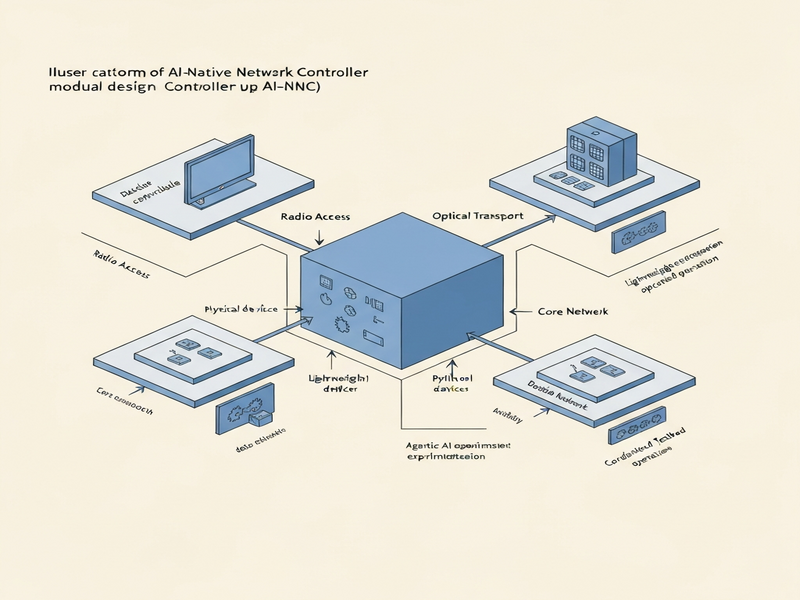
The authors present the AI‑Native Network Controller (AI‑NNC), a protocol‑agnostic, plug‑in architecture that decouples three responsibilities:
- Device Integration Layer: Lightweight Python adapters translate vendor‑specific southbound interfaces into a common, validated command set.
- Control Application Layer: Domain‑specific modules (e.g., RAN‑control, optical‑path‑optimizer) encapsulate business logic, safety checks, and policy enforcement.
- Agentic Interaction Layer: External AI agents communicate with control applications via a well‑defined API, issuing high‑level intents rather than raw device commands.
By enforcing that AI agents can only interact through vetted control applications, the framework creates a “sandboxed” environment where autonomous decisions are automatically checked against operator policies before reaching the hardware.
How It Works in Practice
The operational flow can be broken down into four stages, each illustrated in the placeholder diagram below.
1. Device Discovery & Adapter Registration
When a new network element is provisioned, a Python adapter is instantiated. The adapter implements a minimal set of CRUD (Create‑Read‑Update‑Delete) operations that map to the device’s native protocol. Because adapters are written in pure Python, they can be version‑controlled, unit‑tested, and hot‑reloaded without impacting the rest of the system.
2. Control Application Deployment
Domain experts package their logic into a control application—think of it as a microservice that knows how to optimize handovers in a RAN or reroute wavelengths in an optical mesh. Each application registers its intent schema (e.g., “increase throughput by 10 % in cell X”) and the safety constraints it must respect (e.g., “do not exceed 30 % power increase”).
3. Agentic Intent Submission
External AI agents—whether reinforcement‑learning policies, large‑language‑model planners, or rule‑based orchestrators—send high‑level intents to the AI‑NNC API. The API validates the intent against the registered schema, then forwards it to the appropriate control application.
4. Validation, Execution, and Telemetry Loop
The control application runs a pre‑execution safety check (policy compliance, resource availability) and, if passed, invokes the corresponding adapter methods. Real‑time telemetry is streamed back to the AI‑NNC core, where it is logged, visualized, and optionally fed back to the AI agent for closed‑loop learning.
What distinguishes this approach from traditional network automation is the strict separation of “decision” (AI agent) and “action” (control application). The AI never talks directly to the device; it only proposes intents that are automatically vetted, dramatically reducing the risk of unintended side effects.
Evaluation & Results
The authors validated AI‑NNC in a multi‑domain testbed that combined a simulated 5G RAN, an optical transport emulator, and a core packet network. Three evaluation scenarios were executed:
- Scenario 1 – Cross‑Domain Load Balancing: A reinforcement‑learning agent attempted to shift traffic from congested RAN cells to under‑utilized optical links. AI‑NNC’s safety layer prevented any configuration that would breach latency SLAs, resulting in a 12 % throughput gain without violating QoS.
- Scenario 2 – Fault‑Induced Rerouting: When a fiber cut was injected, the AI‑NNC‑orchestrated optical‑path optimizer rerouted traffic within 250 ms, a speed comparable to vendor‑specific fast‑reroute mechanisms but with the added benefit of AI‑driven path selection.
- Scenario 3 – Dataset Collection for Offline Training: The framework logged 1.2 TB of synchronized telemetry across domains, enabling a separate offline training run that improved the agent’s policy convergence by 18 %.
Across all scenarios, the key takeaway was that AI‑NNC allowed agents to explore aggressive optimization strategies while the built‑in validation prevented any policy violation. The authors also reported a negligible overhead (< 5 ms per API call) introduced by the modular layers, confirming that the safety net does not compromise real‑time performance.
Why This Matters for AI Systems and Agents
From an AI practitioner’s perspective, AI‑NNC offers a reusable, production‑grade sandbox that turns a chaotic network environment into a well‑defined reinforcement learning playground. The framework’s modularity means that a single agent can be trained on a unified state‑action space that spans radio, transport, and core layers—something previously achievable only with custom, one‑off integrations.
For agent builders, the separation of intent and execution simplifies the reward‑design problem. Instead of engineering low‑level device commands, developers can focus on high‑level objectives (e.g., “minimize end‑to‑end latency”) while trusting the controller to enforce safety constraints. This reduces the engineering effort required to move from prototype to production.
System designers also gain a clear path to compliance. By embedding policy checks inside control applications, operators can certify that any AI‑driven change respects regulatory limits, energy budgets, and service‑level agreements before it ever touches the hardware.
In practice, enterprises looking to adopt AI‑driven network automation can leverage AI‑NNC as a foundation for building UBOS platform overview‑style orchestration layers, or integrate it with existing AI pipelines such as OpenAI ChatGPT integration for natural‑language intent formulation.
What Comes Next
While the AI‑NNC prototype demonstrates feasibility, several open challenges remain:
- Scalability to carrier‑grade deployments: The current testbed simulates a few dozen devices; real networks will involve thousands of elements. Distributed adapter registries and hierarchical control applications are potential solutions.
- Standardization of intent schemas: Industry‑wide adoption will require a common vocabulary for intents (e.g., ETSI’s OSM extensions). Collaborative working groups could define JSON‑LD or YANG models that all vendors support.
- Explainability of AI decisions: Operators will demand traceable reasoning for each intent. Embedding model‑agnostic explainability modules into the control application layer could satisfy audit requirements.
- Integration with legacy OSS/BSS: Bridging AI‑NNC with existing management systems will likely involve middleware that translates legacy tickets into AI intents.
Future research may explore “meta‑agents” that coordinate multiple AI‑NNC instances across regions, or the use of federated learning to improve policies without exposing raw telemetry. The framework also opens the door for commercial products that combine AI‑NNC with Enterprise AI platform by UBOS to deliver end‑to‑end autonomous network services.
Potential applications extend beyond telecom. Edge‑compute farms, smart‑grid controllers, and autonomous vehicle fleets all share the multi‑domain, safety‑critical characteristics that AI‑NNC addresses. By providing a reusable, open‑source foundation, the project invites the broader AI‑ops community to experiment, extend, and eventually standardize safe agentic control across any critical infrastructure.
References
For the full technical description, see the original AI‑Native Network Controller paper.
Andrii Bidochko
CTO UBOS
Andrii Bidochko is an AI entrepreneur and researcher focused on AI agents, reinforcement learning, and autonomous systems. He writes about the technologies shaping the future of machine intelligence, from frontier models and agent architectures to real-world AI applications.