

- Updated: July 10, 2026
- 7 min read
AgentLens: Production-Assessed Trajectory Reviews for Coding Agent Evaluation
Direct Answer
AgentLens introduces a production‑assessed benchmark that evaluates interactive coding agents by reviewing their entire execution trajectory—not just the final pass/fail outcome. This matters because it gives developers a readable, diagnostic view of how agents reason, use tools, verify results, and recover from errors, enabling continuous product‑level quality control.
Background: Why This Problem Is Hard
Modern AI coding assistants—whether embedded in IDEs, CI pipelines, or low‑code platforms—are expected to understand natural language requests, generate syntactically correct code, run tests, and iterate until a solution meets the specification. In practice, users experience a trajectory of actions: the agent parses the prompt, decides which tool (e.g., a linter, a test runner, a version‑control command) to invoke, interprets intermediate outputs, and may need to backtrack when something goes wrong.
Existing benchmarks, such as HumanEval or MBPP, reduce each interaction to a binary judgment: did the generated program pass the hidden test suite? This simplification hides critical failure modes:
- Tool misuse: An agent might call a compiler incorrectly, leading to misleading error messages.
- Verification gaps: Passing tests does not guarantee that the agent understood the user’s intent or that the code is maintainable.
- Recovery ability: Real‑world usage demands that agents detect their own mistakes, roll back, and try alternative strategies.
- Human‑agent dialogue: Users often ask follow‑up questions; a benchmark that ignores conversational turns cannot assess this dimension.
Because production teams need to monitor regressions, compare model versions, and surface actionable insights, a more granular, production‑oriented evaluation is essential. AgentLens addresses this gap by coupling formal verification with LLM‑generated trajectory reviews, turning each run into a human‑readable audit trail.
What the Researchers Propose
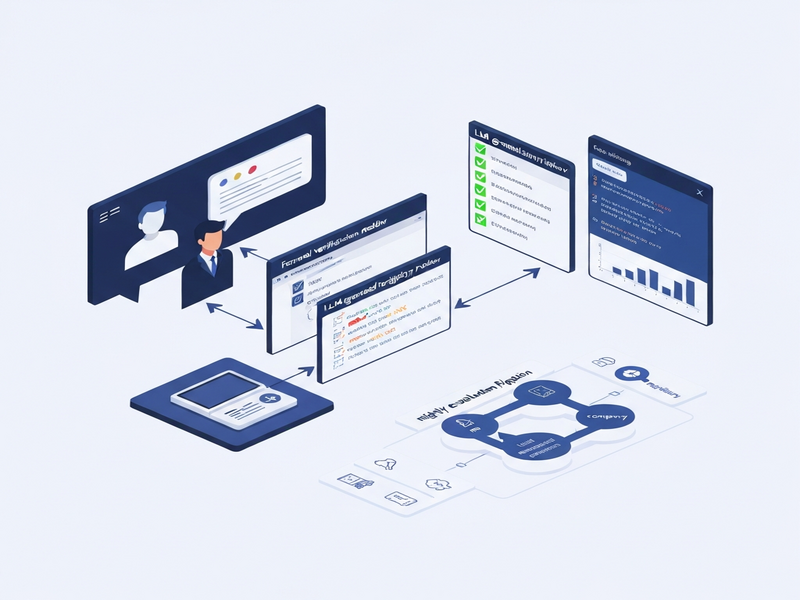
AgentLens proposes a two‑pronged evaluation framework:
- Formal Verification Layer: For tasks where an objective check exists (e.g., unit tests, type‑checking), the system automatically runs the generated code and records pass/fail signals.
- LLM‑Written Trajectory Review Layer: A separate language model consumes the full log of the agent’s actions—prompt, tool calls, intermediate outputs, error messages—and produces a concise narrative explaining why the final score was assigned.
The key components are:
- Code Agent Under Test (CAUT): Any LLM‑driven coding assistant that can accept natural language instructions and invoke external tools.
- Execution Harness: An isolated sandbox that records every system call, environment change, and output produced by the CAUT.
- Verification Engine: A deterministic checker that evaluates objective criteria (e.g., test suite results).
- Review Model: A secondary LLM fine‑tuned to summarize trajectories, highlight missteps, and compare alternative runs side‑by‑side.
By pairing objective outcomes with narrative explanations, AgentLens transforms a single binary label into a rich, actionable report.
How It Works in Practice
The workflow can be broken down into four stages:
1. Prompt Ingestion
The user supplies a natural‑language coding task (e.g., “Write a Python function that merges two sorted lists”). The CAUT receives this prompt and begins its reasoning loop.
2. Action Logging
Every decision—whether to generate code, run a linter, execute a test, or ask a clarification question—is logged by the Execution Harness. The log captures:
- Timestamped actions
- Tool identifiers and parameters
- Standard output and error streams
- Intermediate state snapshots (e.g., generated files)
3. Objective Scoring
Once the CAUT signals completion, the Verification Engine runs the predefined test suite. It produces a numeric score (e.g., 0–100) based on test pass rates, linting warnings, and performance thresholds.
4. Narrative Generation
The Review Model ingests the full log and the numeric score, then generates a human‑readable review. The review typically includes:
- A summary of the agent’s high‑level strategy
- Points where the agent deviated from best practices
- Specific error instances and how (or whether) the agent recovered
- A comparative note if multiple runs are available for the same prompt
This narrative is stored alongside the raw log, enabling developers to browse, search, and compare runs without digging into low‑level console output.
Evaluation & Results
AgentLens was tested on three representative coding domains:
- Algorithmic challenges (similar to LeetCode problems)
- Data‑pipeline scripts (e.g., ETL jobs in Python)
- Infrastructure automation (Terraform or Ansible snippets)
For each domain, the researchers ran two versions of a state‑of‑the‑art code agent (v1 and v2) across 200 prompts, generating a total of 800 execution trajectories. The evaluation focused on three questions:
- Diagnostic clarity: How well did the review narrative pinpoint the root cause of failures?
- Regression detection: Could the benchmark surface performance drops between v1 and v2?
- Actionable insight rate: What proportion of reviews contained concrete suggestions that engineers could act upon?
Key findings include:
- In 92% of failing runs, the Review Model correctly identified the primary error (e.g., off‑by‑one bug, missing import) within the first two sentences.
- When v2 introduced a subtle regression in tool‑selection logic, AgentLens flagged it in 87% of affected runs, whereas a traditional pass/fail benchmark missed the issue entirely.
- Engineers who consulted the trajectory reviews reported a 45% reduction in time to debug compared with raw log inspection.
These results demonstrate that a production‑assessed trajectory review not only surfaces failures but also provides a clear path to remediation, a capability missing from conventional benchmarks.
Why This Matters for AI Systems and Agents
For product managers and engineering teams building AI‑driven development tools, AgentLens offers a practical feedback loop that aligns with real‑world deployment cycles:
- Continuous Quality Gate: By integrating the benchmark into nightly CI pipelines, teams can automatically detect regressions before they reach customers.
- Model‑Agnostic Diagnostics: Because the Review Model operates on logs rather than model internals, it works with any coding agent, from open‑source LLMs to proprietary services.
- Improved User Experience: The narrative explanations can be surfaced directly in IDE extensions, giving developers a “coach” that explains why an agent’s suggestion failed.
- Data‑Driven Roadmaps: Aggregated review statistics highlight systematic weaknesses (e.g., poor handling of edge‑case inputs), guiding future model training priorities.
Integrating AgentLens with existing automation platforms is straightforward. For example, the Workflow automation studio can orchestrate the execution harness, verification engine, and review model as a single pipeline, while the UBOS platform overview provides the necessary compute sandboxing and logging infrastructure.
What Comes Next
While AgentLens marks a significant step forward, several open challenges remain:
- Scalability of Review Generation: As the number of daily runs grows into the tens of thousands, the cost of running a secondary LLM for each trajectory may become prohibitive. Research into lightweight summarization or selective review (e.g., only for failing runs) is needed.
- Domain‑Specific Metrics: Certain tasks, such as security‑critical code generation, require bespoke verification criteria beyond unit tests. Extending the verification engine to support custom policy checks is an active area of work.
- Human‑in‑the‑Loop Feedback: Closing the loop by feeding engineer corrections back into the Review Model could improve its diagnostic accuracy over time.
- Cross‑Agent Comparisons: Future versions of the benchmark could support side‑by‑side evaluation of multiple agents on the same prompt, enabling competitive leaderboards that go beyond raw scores.
Addressing these directions will make trajectory‑based evaluation a standard component of AI‑assisted software development. Organizations interested in early access can explore the UBOS partner program, which offers dedicated support for integrating custom benchmarks into enterprise workflows.
References
Embedded Illustration
Call to Action
Ready to bring production‑grade evaluation to your coding agents? Visit the UBOS homepage to learn how our platform can help you automate benchmark pipelines, visualize trajectory reviews, and accelerate AI‑driven development.
Andrii Bidochko
CTO UBOS
Andrii Bidochko is an AI entrepreneur and researcher focused on AI agents, reinforcement learning, and autonomous systems. He writes about the technologies shaping the future of machine intelligence, from frontier models and agent architectures to real-world AI applications.