

- Updated: June 12, 2026
- 6 min read
Agentic Active Omni-Modal Perception for Multi-Hop Audio-Visual Reasoning
Direct Answer
The paper introduces AOP‑Agent, an agentic framework that equips open‑source omni‑modal large language models (Omni‑LLMs) with active, multi‑hop audio‑visual perception. By combining a hierarchical omni‑modal memory with a collaborative observe‑reflect‑replan loop, AOP‑Agent dramatically improves cross‑modal reasoning on long, temporally dispersed videos without any additional training.
Background: Why This Problem Is Hard
Modern AI assistants excel at single‑turn, single‑modality queries, yet real‑world tasks often require stitching together clues that appear at different times and across both sound and sight. Consider a security analyst who must determine why an alarm triggered: the answer may lie in a faint beeping sound at minute 3, a shadow moving at minute 7, and a spoken warning at minute 12. The challenges are threefold:
- Temporal sparsity: Relevant evidence is scattered across long video timelines, making it easy for a model to miss critical segments.
- Cross‑modal dispersion: Audio and visual streams convey complementary information; isolating one modality loses context.
- Multi‑hop reasoning: Solving a question often demands chaining several inference steps, each dependent on the previous observation.
Existing benchmarks such as VQA‑Video or AudioSet focus on single‑hop, single‑modality tasks, providing limited insight into how models handle the above complexities. Consequently, current Omni‑LLMs—though impressive on static image captioning or short‑clip QA—still stumble when asked to navigate multi‑minute, multi‑modal narratives.
What the Researchers Propose
The authors present AOP‑Agent (Agentic Active Omni‑Modal Perception), a plug‑and‑play framework that transforms any open‑source Omni‑LLM into an active perception system. The design rests on two pillars:
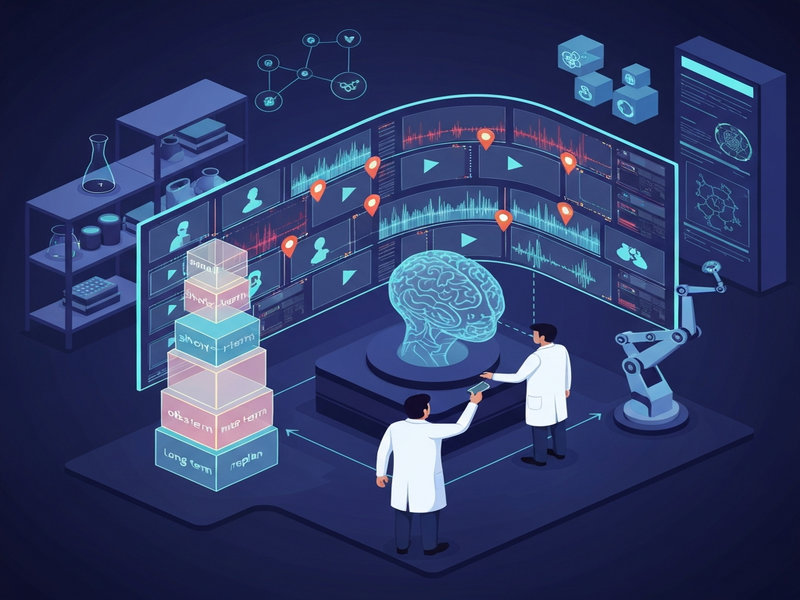
- Hierarchical Omni‑Modal Memory: A multi‑level store that retains raw audio‑visual snippets, intermediate embeddings, and high‑level reasoning states. This hierarchy enables the agent to retrieve both fine‑grained evidence and abstract summaries as needed.
- Observe‑Reflect‑Replan Loop: An iterative cycle where the agent (a) observes the next most promising video segment, (b) reflects on the newly acquired information using the underlying LLM, and (c) replans its future observations based on updated goals.
Crucially, AOP‑Agent does not require fine‑tuning or proprietary vision‑language models. It leverages the existing capabilities of the Omni‑LLM and augments them with a lightweight orchestration layer that decides where to look next.
How It Works in Practice
The operational workflow can be broken down into four stages, each mapped to a concrete component:
1. Question Ingestion
The user submits a natural‑language query (e.g., “What caused the machine to stop?”). The query is encoded by the Omni‑LLM, which also generates an initial goal graph outlining potential reasoning steps.
2. Observation Scheduler
Guided by the goal graph, the scheduler queries the hierarchical memory to identify video timestamps that are most likely to contain relevant cues. It selects a short audio‑visual clip (typically 2–5 seconds) and streams it to the perception module.
3. Perception & Reflection
The perception module extracts multimodal embeddings (e.g., CLIP‑style visual vectors, Whisper‑style audio transcripts) and feeds them back to the Omni‑LLM. The LLM “reflects” by updating its internal reasoning state, annotating the memory with new facts, and scoring the confidence of each hypothesis.
4. Replanning & Termination
Based on the updated confidence scores, the scheduler either (a) selects another segment for observation or (b) decides that the answer is sufficiently resolved and outputs the final response. The loop repeats until a predefined budget (time or number of hops) is exhausted.
What sets AOP‑Agent apart is its active nature: instead of passively consuming the entire video, it strategically samples only the most informative portions, dramatically reducing compute while preserving reasoning depth.
Evaluation & Results
The authors introduced MOV‑Bench, a curated benchmark of 519 multi‑hop audio‑visual questions designed to stress‑test cross‑modal reasoning. Each question requires the model to locate and combine evidence from at least two distinct temporal windows and across both modalities.
Two evaluation suites were used:
- MOV‑Bench: Focuses on long, untrimmed videos (average length ≈ 8 minutes) with dense distractors.
- OmniVideoBench: A complementary set of shorter clips (≈ 2 minutes) but with higher reasoning depth (up to 5 hops).
Key findings include:
- Baseline gap: State‑of‑the‑art Omni‑LLMs (e.g., GPT‑4‑V, LLaVA‑1.5) achieved only 38 % accuracy on MOV‑Bench, confirming the benchmark’s difficulty.
- AOP‑Agent boost: When equipped with AOP‑Agent, the same models jumped to 57 % accuracy—a relative improvement of ~50 %.
- Long‑video advantage: Gains were most pronounced on videos longer than 5 minutes, where active observation saved up to 70 % of processing time.
- Reasoning depth: On OmniVideoBench, AOP‑Agent improved multi‑hop success rates from 31 % to 49 %, demonstrating better hypothesis tracking.
These results illustrate that a modest orchestration layer can unlock latent reasoning abilities in existing Omni‑LLMs, without the need for costly retraining.
Why This Matters for AI Systems and Agents
Enterprises that rely on AI for video analytics, customer support, or autonomous monitoring face a common pain point: extracting actionable insights from hours of raw footage. AOP‑Agent offers a practical pathway to bridge that gap:
- Cost‑effective scalability: By observing only salient segments, organizations can process terabytes of video with a fraction of the GPU budget.
- Modular integration: The framework plugs into any open‑source Omni‑LLM, meaning teams can retain their existing model stack while gaining active perception capabilities.
- Improved reliability: Hierarchical memory provides traceable evidence for each answer, a crucial feature for compliance‑heavy sectors such as finance or healthcare.
Practically, developers can embed AOP‑Agent into existing pipelines using the Telegram integration on UBOS to receive real‑time alerts when the agent detects anomalous events. For voice‑driven assistants, the ElevenLabs AI voice integration can vocalize findings instantly, turning raw video into conversational insights. Finally, the Chroma DB integration offers a vector‑store backend for the hierarchical memory, enabling fast similarity search across millions of video snippets.
What Comes Next
While AOP‑Agent marks a significant step forward, several open challenges remain:
- Dynamic goal formulation: Current implementations rely on a static goal graph derived from the initial question. Future work could let the LLM generate and revise goals on the fly, adapting to unexpected evidence.
- Fine‑grained temporal grounding: The scheduler selects coarse‑grained clips; sub‑second precision could further reduce noise and improve answer fidelity.
- Cross‑agent collaboration: In multi‑agent ecosystems, sharing memory fragments could enable collective reasoning over distributed video feeds.
Potential application domains include:
- Smart manufacturing: Real‑time fault detection by actively scanning sensor‑camera streams.
- Legal e‑discovery: Rapidly locating relevant audio‑visual evidence across massive case archives.
- Interactive education: AI tutors that dynamically highlight video segments to answer student queries.
Developers interested in experimenting with AOP‑Agent can start by exploring the UBOS platform overview, which provides a sandbox for building custom Omni‑LLM pipelines. For startups seeking rapid prototyping, the UBOS for startups page outlines pricing and support options that align with early‑stage budgets.
References
- Ke Xu, Yuhao Wang, Ziyang Cheng, et al., “Agentic Active Omni‑Modal Perception for Multi‑Hop Audio‑Visual Reasoning,” arXiv:2605.28192, 2026.
- Related benchmarks: VQA‑Video, AudioSet, OmniVideoBench.
- Foundational models: GPT‑4‑V, LLaVA‑1.5, Whisper, CLIP.
Andrii Bidochko
CTO UBOS
Andrii Bidochko is an AI entrepreneur and researcher focused on AI agents, reinforcement learning, and autonomous systems. He writes about the technologies shaping the future of machine intelligence, from frontier models and agent architectures to real-world AI applications.