

- Updated: July 31, 2026
- 7 min read
ABot-AgentOS: A General Robotic Agent OS with Lifelong Multi-modal Memory – Technical Overview
Direct Answer
ABot‑AgentOS is a general‑purpose operating system for robotic agents that adds a deliberative, memory‑rich layer on top of low‑level controllers. By unifying scene‑conditioned planning, isolated skill execution, multi‑stage verification, and a lifelong multi‑modal graph memory, it enables robots to reason, remember, and evolve across diverse tasks and environments.
Background: Why This Problem Is Hard
Long‑horizon embodied agents—robots that must navigate, manipulate, converse, and adapt over extended periods—face three intertwined bottlenecks:
- Fragmented runtime stacks. Most robotics stacks stop at motor control or perception, leaving higher‑level reasoning to ad‑hoc scripts that cannot be reused across platforms.
- Ephemeral perception. Vision‑language models (VLMs) and vision‑language agents (VLAs) excel at single‑shot perception, yet they lack a persistent substrate to store observations, dialogues, and task traces for later recall.
- Verification gaps. Without systematic checks, a robot may execute a skill that appears successful locally but violates global constraints, leading to unsafe or inefficient behavior.
Current approaches typically bolt a planner onto a perception module, or they rely on cloud‑only memory services that introduce latency and privacy concerns. None provide a unified, auditable, and lifelong memory that can be queried by the robot itself during execution. As enterprises push robots from isolated labs into warehouses, hospitals, and public spaces, the need for a general, extensible Agent OS becomes critical.
What the Researchers Propose
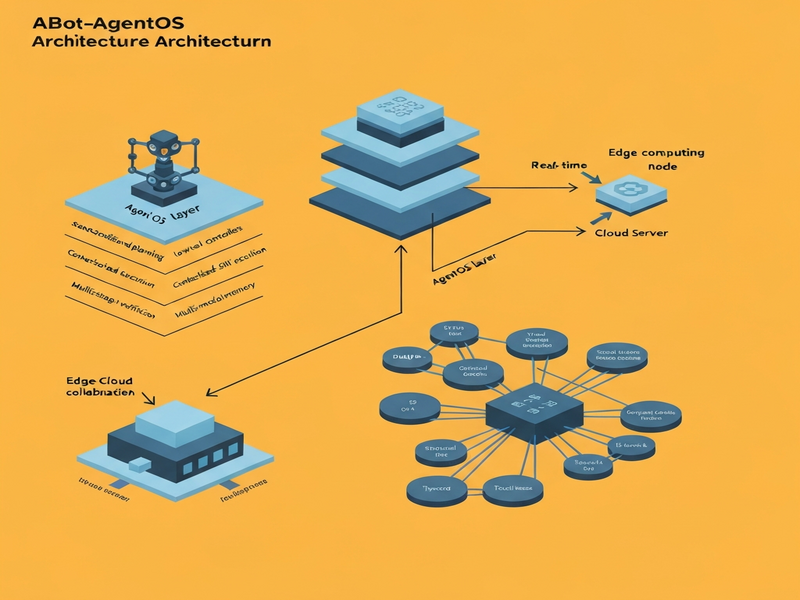
The authors introduce ABot‑AgentOS, a software layer that sits between hardware drivers and high‑level AI agents. Its design rests on three pillars:
- Deliberative Agent Layer. This component receives a scene description, selects a plan, and orchestrates skill modules in an isolated context to avoid side‑effects.
- Universal Multi‑modal Graph Memory. A persistent, typed graph that ingests visual frames, natural‑language dialogue, spatial maps, temporal relations, and execution traces, turning them into nodes and edges that can be queried later.
- Edge‑Cloud Collaboration. Lightweight edge inference handles latency‑sensitive decisions, while the cloud supplies heavyweight reasoning, memory consolidation, and model updates.
In addition, the system embeds a failure‑driven self‑evolution loop that automatically converts diagnosed memory failures into gated runtime assets (evo‑assets). These assets are promoted only after validation on future evaluation splits, ensuring that improvements do not leak ground‑truth information.
How It Works in Practice
Conceptual Workflow
When a robot receives a high‑level goal (e.g., “find the red toolbox and hand it to the operator”), the following steps occur:
- Scene Conditioning. Sensors stream raw images and depth data to a perception module that produces a symbolic scene graph (objects, locations, affordances).
- Plan Generation. The deliberative layer queries the Universal Multi‑modal Graph Memory for relevant past experiences, then uses a planner to produce a sequence of skill calls (navigate, search, grasp).
- Isolated Skill Execution. Each skill runs in a sandboxed context, preventing state bleed‑through. The system logs inputs, outputs, and intermediate observations into the graph memory as typed edges.
- Multi‑Stage Verification. After each skill, a verifier checks consistency against global constraints (e.g., safety zones, task deadlines). If a violation is detected, the planner re‑plans using the updated memory.
- Edge‑Cloud Sync. Lightweight inference (e.g., obstacle avoidance) stays on‑device, while richer reasoning (e.g., language grounding, memory consolidation) is offloaded to the cloud. The cloud returns updated graph embeddings that improve future queries.
Key Differentiators
- Persistent, source‑grounded memory. Unlike transient buffers, the graph memory retains the provenance of every datum, enabling audit trails and lifelong learning.
- Failure‑driven evolution. Errors are not merely logged; they trigger the creation of new runtime assets that are validated before deployment, fostering continual improvement without manual re‑engineering.
- Modular isolation. Skills are executed in context‑isolated containers, reducing interference and simplifying debugging.
Evaluation & Results
EmbodiedWorldBench: A New Benchmark Suite
To stress‑test ABot‑AgentOS, the authors built EmbodiedWorldBench, an executable benchmark comprising 16 indoor, outdoor, and hybrid scenes. The suite defines four difficulty levels and over 200 tasks that blend navigation, object search, NPC dialogue, dynamic events, and trace‑grounded scoring. This benchmark is designed to surface weaknesses in planning, memory recall, and verification.
Experimental Findings
Across a representative subset of EmbodiedWorldBench, ABot‑AgentOS achieved measurable gains over a single‑controller baseline:
- Task Success. Success rates rose by an average of 12 % on medium‑difficulty tasks, indicating more reliable execution.
- Goal Completion. The system completed 9 % more high‑level objectives, thanks to its ability to re‑plan after verification failures.
Memory‑centric benchmarks further highlighted the advantage of a lifelong graph memory:
| Benchmark | Static ABot‑AgentOS | Self‑Evolved ABot‑AgentOS |
|---|---|---|
| LoCoMo | 87.5 | 88.7 |
| OpenEQA EM‑EQA | 59.9 | 60.4 |
| Mem‑Gallery | 88.6 | 89.0 |
| NExT‑QA (Acc@All) | 76.5 | — |
These scores demonstrate that a unified memory graph not only improves recall but also supports cross‑task generalization. The self‑evolution loop contributed incremental gains, confirming that automated asset promotion can refine performance without human‑in‑the‑loop labeling.
Why This Matters for AI Systems and Agents
For practitioners building autonomous robots, ABot‑AgentOS offers a blueprint for moving beyond siloed perception‑action pipelines toward a cohesive, auditable operating system. The implications are threefold:
- Scalable Agent Design. By abstracting planning, verification, and memory into reusable modules, developers can compose new capabilities faster, reducing time‑to‑market for robotic products.
- Robust Evaluation. The EmbodiedWorldBench suite provides a standardized, executable yardstick that mirrors real‑world complexity, helping teams benchmark improvements objectively.
- Continuous Improvement. The failure‑driven self‑evolution loop automates the discovery of missing knowledge, turning operational failures into actionable upgrades—a key requirement for lifelong learning robots.
Enterprises looking to integrate such capabilities can leverage platforms that already support modular orchestration and edge‑cloud sync. For example, the UBOS platform overview showcases a flexible runtime that can host Agent OS layers, while the Workflow automation studio enables designers to define verification checkpoints without writing low‑level code.
What Comes Next
While ABot‑AgentOS marks a significant step forward, several challenges remain:
- Scalability of Graph Memory. As robots accumulate years of experience, the graph could become unwieldy. Future work must explore hierarchical summarization and pruning strategies.
- Cross‑Embodiment Transfer. The current system assumes a single robot morphology. Extending the memory substrate to support heterogeneous fleets will require ontology alignment.
- Real‑World Deployment. Benchmarks are valuable, but field trials in noisy, unstructured environments will surface latency, sensor drift, and safety concerns that are hard to simulate.
Addressing these gaps will likely involve tighter integration with large‑scale foundation models, more sophisticated edge‑cloud scheduling, and open standards for robot memory exchange. Researchers and product teams interested in contributing to this ecosystem can join the UBOS partner program, which offers co‑development opportunities and access to shared datasets.
For a deeper dive into the original research, consult the full paper on arXiv. The community is encouraged to replicate the EmbodiedWorldBench suite, extend the memory graph schema, and experiment with alternative verification strategies.
Conclusion
ABot‑AgentOS demonstrates that a dedicated operating system layer—complete with scene‑conditioned planning, isolated skill execution, multi‑stage verification, and a lifelong multi‑modal graph memory—can materially improve long‑horizon robotic performance. By coupling edge efficiency with cloud‑scale reasoning and a self‑evolution loop, the framework offers a practical path toward autonomous agents that learn, remember, and adapt continuously. As the robotics industry matures, such generalizable OS abstractions will become as essential as the Linux kernel is to modern computing.
Explore how you can build next‑generation robotic agents on top of a robust OS foundation by visiting the UBOS homepage and reviewing the available integrations, such as Chroma DB integration for scalable vector storage or the ElevenLabs AI voice integration for natural language interaction.
Andrii Bidochko
CTO UBOS
Andrii Bidochko is an AI entrepreneur and researcher focused on AI agents, reinforcement learning, and autonomous systems. He writes about the technologies shaping the future of machine intelligence, from frontier models and agent architectures to real-world AI applications.