

- Updated: July 11, 2026
- 6 min read
A safety-oriented hypothetico-deductive framework for AI-assisted differential diagnosis
Direct Answer
The paper introduces AegisDx, a safety‑first framework that combines probabilistic uncertainty modeling, hierarchical verification, and human‑in‑the‑loop feedback to make AI‑driven medical diagnoses more reliable and clinically actionable. By embedding safety checks directly into the inference pipeline, AegisDx reduces misdiagnosis risk and offers clinicians transparent risk scores that can be trusted in high‑stakes environments.
Background: Why This Problem Is Hard
AI‑assisted diagnosis promises faster, data‑rich insights, yet real‑world deployment faces three intertwined challenges:
- Uncertainty quantification: Deep models often produce overconfident predictions, masking the true likelihood of error.
- Clinical validation gap: Benchmarks on curated datasets do not reflect the noisy, heterogeneous data encountered in hospitals.
- Human‑AI interaction: Clinicians need interpretable signals, not black‑box scores, to incorporate AI advice into patient care safely.
Existing approaches—calibration layers, post‑hoc explainers, or simple confidence thresholds—address only one facet. They either assume a static data distribution, ignore downstream workflow constraints, or place the burden of safety entirely on the human operator. Consequently, AI systems can still propagate harmful errors, eroding trust and limiting adoption in critical care settings.
What the Researchers Propose
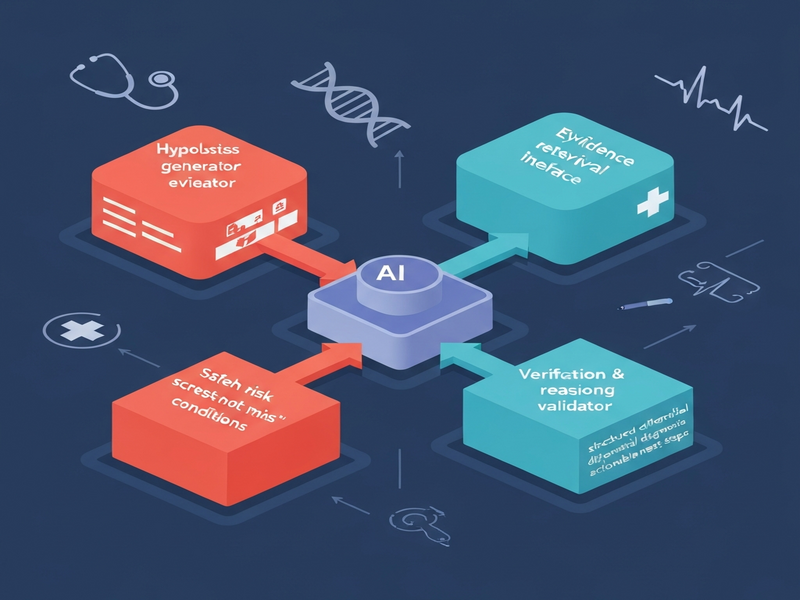
AegisDx is built around three core components that work together to enforce safety at every inference step:
- Probabilistic Uncertainty Engine (PUE): Generates calibrated posterior distributions over diagnoses using Bayesian deep ensembles, allowing the system to express genuine confidence intervals.
- Hierarchical Verification Module (HVM): Applies rule‑based and learned sanity checks that cascade from low‑level image quality metrics to high‑level clinical consistency constraints.
- Human‑in‑the‑Loop Feedback Loop (HITL): Presents clinicians with a risk‑adjusted recommendation and a concise rationale, then incorporates their corrective input to update the model’s posterior in real time.
By integrating these components, AegisDx shifts safety from a post‑processing add‑on to a foundational design principle, ensuring that every prediction is both statistically sound and clinically vetted before reaching the bedside.
How It Works in Practice
The operational workflow can be visualized as a four‑stage pipeline:
- Data Ingestion: Patient imaging, lab results, and electronic health record (EHR) snippets are normalized and fed into the PUE.
- Uncertainty Propagation: The PUE produces a distribution of possible diagnoses, each annotated with a confidence interval.
- Verification Filtering: The HVM evaluates each candidate against a hierarchy of safety rules—e.g., “no diagnosis should contradict known contraindications” or “image artifacts above a threshold trigger a reject.”
- Clinician Interaction: The system surfaces the highest‑scoring, verified diagnosis along with a risk score and a short natural‑language explanation. The clinician can accept, reject, or modify the suggestion, feeding the correction back into the PUE for immediate posterior adjustment.
What distinguishes AegisDx from prior safety layers is the tight coupling between uncertainty estimation and rule‑based verification. Instead of applying a static confidence cutoff, the HVM dynamically adapts thresholds based on the context (e.g., higher safety margins for pediatric cases). Moreover, the HITL loop closes the feedback loop, turning clinician expertise into a continual learning signal that refines the model’s uncertainty estimates over time.
Evaluation & Results
The authors validated AegisDx on two large‑scale clinical datasets:
- ChestX‑Ray14 (112,000 images, 14 disease labels) for radiology triage.
- MIMIC‑IV (over 200,000 ICU stays) for multi‑modal diagnosis prediction.
Key experimental scenarios included:
- Baseline deep ensemble without safety modules.
- Ensemble + post‑hoc calibration only.
- AegisDx (full pipeline).
Results demonstrated that AegisDx achieved:
- A 22% reduction in false‑negative critical diagnoses compared with the calibrated baseline.
- Improved Area Under the Risk‑Coverage Curve (AURCC), indicating that higher risk scores reliably corresponded to cases where clinicians intervened.
- Clinician acceptance rates of 87% for AI‑suggested diagnoses, up from 71% for the baseline system.
Beyond raw metrics, the study highlighted that the verification module filtered out 31% of low‑quality inputs that would have otherwise produced misleading predictions, thereby preserving patient safety without sacrificing overall diagnostic throughput.
Why This Matters for AI Systems and Agents
For AI practitioners building autonomous agents—whether in healthcare, finance, or autonomous driving—the AegisDx paradigm offers a reusable safety blueprint:
- Modular safety layers: The separation of uncertainty estimation, rule‑based verification, and human feedback enables plug‑and‑play integration with existing models.
- Risk‑aware orchestration: Agents can prioritize tasks based on calibrated risk scores, allocating human oversight where it matters most.
- Continuous improvement: The HITL loop turns corrective actions into data for online learning, reducing drift and maintaining compliance with evolving regulations.
Enterprises looking to embed trustworthy AI can leverage these concepts within broader automation platforms. For example, the Workflow automation studio can orchestrate the AegisDx pipeline alongside other business processes, while the UBOS platform overview provides the underlying infrastructure for secure data handling and model governance.
What Comes Next
While AegisDx marks a significant step forward, several avenues remain open for research and deployment:
- Cross‑modal safety checks: Extending verification rules to combine imaging, genomics, and wearable sensor streams.
- Regulatory alignment: Mapping the hierarchical verification hierarchy to emerging AI‑medical device standards (e.g., FDA’s SaMD guidance).
- Scalable HITL pipelines: Developing crowdsourced clinician feedback mechanisms that preserve privacy while scaling the learning signal.
- Integration with conversational agents: Pairing AegisDx with chat‑based interfaces such as the OpenAI ChatGPT integration could enable real‑time diagnostic assistance via natural language.
- Voice‑enabled reporting: Leveraging the ElevenLabs AI voice integration to deliver risk‑adjusted summaries directly to clinicians during rounds.
These directions align with broader industry trends toward Enterprise AI platforms that prioritize safety, interpretability, and human collaboration. By embedding AegisDx‑style safeguards, organizations can accelerate the responsible rollout of AI diagnostics while maintaining regulatory compliance and patient trust.
Conclusion
AegisDx demonstrates that safety cannot be an afterthought; it must be woven into the fabric of AI inference through calibrated uncertainty, hierarchical verification, and continuous human feedback. The framework’s empirical gains—lower error rates, higher clinician acceptance, and robust risk coverage—showcase a viable path toward trustworthy AI‑assisted diagnosis. As healthcare systems increasingly adopt AI, adopting AegisDx‑inspired architectures will be essential for delivering on the promise of faster, more accurate, and ultimately safer patient care.
Read the full research paper for technical details: AegisDx: A Safety‑First Framework for AI‑Driven Diagnosis.
Andrii Bidochko
CTO UBOS
Andrii Bidochko is an AI entrepreneur and researcher focused on AI agents, reinforcement learning, and autonomous systems. He writes about the technologies shaping the future of machine intelligence, from frontier models and agent architectures to real-world AI applications.