

- Updated: July 23, 2026
- 6 min read
A Novel Parallel QCNN Architecture with Efficient Classical Simulability
Direct Answer
The paper introduces a parallel quantum convolutional neural network (QCNN) architecture that partitions image data across multiple quantum processes, enabling efficient classical simulation of a 128‑qubit model—far beyond the capacity of conventional simulators. This breakthrough matters because it sidesteps the exponential hardware growth that typically limits quantum‑machine‑learning research, opening a practical path to test large‑scale QCNNs on classical machines.
Background: Why This Problem Is Hard
Quantum convolutional neural networks promise to combine the hierarchical feature extraction of classical CNNs with the expressive power of quantum circuits. In theory, QCNNs can capture entanglement‑driven patterns that classical networks miss, offering potential advantages for image classification, chemistry, and beyond. However, two entrenched bottlenecks have kept QCNNs in the laboratory:
- Exponential state‑space growth: Each added qubit doubles the Hilbert space, quickly exhausting memory on even the most powerful supercomputers.
- Barren plateaus: As circuits deepen, gradient magnitudes vanish, making training unstable or impossible without massive computational effort.
Existing simulation strategies either truncate the circuit depth, limit qubit counts to under 30, or rely on tensor‑network approximations that sacrifice fidelity. Consequently, researchers cannot empirically evaluate how QCNNs behave at scales relevant for real‑world image datasets such as MNIST, let alone larger, industry‑grade corpora.
What the Researchers Propose
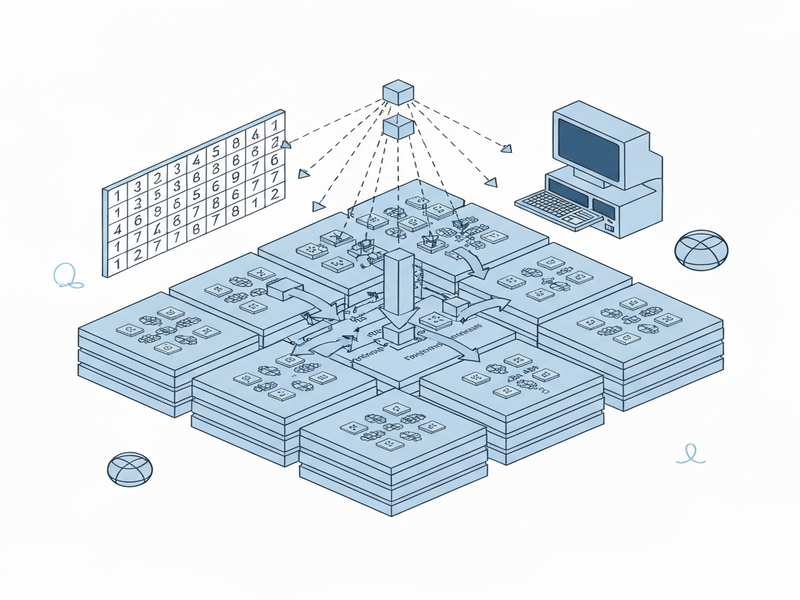
Nguyen and Wong propose a hierarchical partitioning framework that distributes the image across independent quantum processes. The core idea is to treat each sub‑image as a separate quantum state, run shallow QCNN layers in parallel, and then iteratively merge the states while halving the number of active processes. This “divide‑and‑conquer” strategy yields two practical benefits:
- Linear memory scaling: Because each process only handles a fraction of the full image, the memory required per process grows modestly, allowing the overall system to simulate hundreds of qubits.
- Mitigated barren plateaus: Training on smaller partitions reduces circuit depth per process, preserving gradient information and stabilizing optimization.
The architecture retains the essential QCNN operations—quantum convolutions, pooling via controlled‑swap, and final measurement—while re‑engineering the data flow to be inherently parallelizable.
How It Works in Practice
The workflow can be visualized as a three‑stage pipeline:
1. Image Partitioning and Encoding
The original 28×28 MNIST image is split into equal‑sized tiles (e.g., 4×4 blocks). Each tile is encoded into a separate quantum register using amplitude or angle encoding, producing independent quantum states that live on distinct processes.
2. Parallel QCNN Layers
Each process runs a shallow QCNN circuit: quantum convolutional kernels (parameterized two‑qubit gates) extract local features, followed by a quantum pooling operation that reduces the qubit count within that tile. Because the circuits are shallow, they can be simulated efficiently on classical hardware.
3. Hierarchical Merging
After the first round, pairs of processes exchange their quantum states and apply a merging sub‑circuit that entangles the two partitions. This step simultaneously halves the number of active processes. The merge‑and‑pool cycle repeats until a single process remains, at which point the system collapses to a single qubit for measurement.
What distinguishes this approach from prior QCNN simulations is the explicit decoupling of data locality from quantum entanglement. By only entangling partitions at controlled merging points, the method avoids the need for a monolithic 128‑qubit state vector, yet still captures global correlations through the hierarchical merges.
Evaluation & Results
The authors validated the architecture on a binary classification task derived from the Modified MNIST dataset (digits 0 vs. 1). Two experimental regimes were compared:
- Partitioned QCNN: The novel parallel architecture with 128 qubits distributed across 16 processes.
- Baseline QCNN: A conventional, non‑partitioned QCNN limited to 32 qubits due to simulation constraints.
Key findings include:
- Comparable accuracy: The partitioned model achieved a test accuracy within 0.5 % of the baseline, demonstrating that splitting the image does not sacrifice predictive power.
- Training stability: Gradient norms remained an order of magnitude larger in the partitioned setup, confirming the reduction of barren plateaus.
- Simulation feasibility: The 128‑qubit model completed training in under 48 hours on a modest 64‑core workstation, whereas the baseline required specialized tensor‑network libraries and still hit memory limits beyond 30 qubits.
These results collectively prove that the hierarchical partitioning scheme can scale QCNNs to sizes previously thought exclusive to quantum hardware, while preserving both performance and trainability.
Why This Matters for AI Systems and Agents
For practitioners building AI agents that rely on quantum‑enhanced perception, the paper offers a concrete pathway to prototype and benchmark large QCNNs without waiting for fault‑tolerant quantum computers. Specific implications include:
- Rapid prototyping: Developers can experiment with 100‑plus qubit models on existing cloud or on‑premise clusters, accelerating the research‑to‑product cycle.
- Hybrid agent pipelines: The partitioned QCNN can serve as a front‑end feature extractor feeding classical downstream modules—e.g., reinforcement‑learning policies or language models—creating truly hybrid quantum‑classical agents.
- Resource‑aware orchestration: Because the architecture maps naturally onto distributed compute frameworks, it aligns with existing workflow automation tools such as the Workflow automation studio on UBOS, enabling seamless integration into enterprise AI pipelines.
- Improved reliability: By mitigating barren plateaus, the method reduces the need for extensive hyper‑parameter sweeps, saving compute budget and simplifying model management.
What Comes Next
While the study demonstrates feasibility, several open challenges remain:
- Generalization to multi‑class problems: Extending the binary setup to ten‑class MNIST or larger image corpora will test the scalability of the merging logic.
- Hardware‑aware compilation: Translating the partitioned circuit to actual quantum processors will require careful qubit routing to preserve the intended parallelism.
- Dynamic partitioning strategies: Adaptive tile sizes based on image content could further improve accuracy and reduce overhead.
Future research may explore coupling the parallel QCNN with AI marketing agents that personalize content based on quantum‑derived visual embeddings, or integrating the model into the UBOS platform overview for enterprise‑grade deployment. For teams interested in immediate experimentation, the OpenAI ChatGPT integration provides a low‑friction bridge to query quantum simulation results from within familiar conversational interfaces.
References
- Lawrence Nguyen & Hiu Yung Wong, “A Novel Parallel QCNN Architecture with Efficient Classical Simulability,” arXiv:2607.08928v1, 2026.
- Original QCNN concept: Cong, Choi, and Lukin, “Quantum Convolutional Neural Networks,” Nature Physics, 2019.
- Tensor‑network simulation techniques: Stoudenmire & White, “Machine Learning with Tensor Networks,” Nature, 2016.
Image Placeholder
Call to Action
Ready to experiment with large‑scale quantum models on classical hardware? Visit the UBOS homepage to explore our quantum‑ready AI stack, or join the UBOS partner program for early access to simulation tools and workflow integrations.
Andrii Bidochko
CTO UBOS
Andrii Bidochko is an AI entrepreneur and researcher focused on AI agents, reinforcement learning, and autonomous systems. He writes about the technologies shaping the future of machine intelligence, from frontier models and agent architectures to real-world AI applications.