

- Updated: June 29, 2026
- 5 min read
A Matter of Time: Towards a General Theory of Agency
Direct Answer
The paper “A Matter of Time: Towards a General Theory of Agency” proposes a unified, temporally grounded framework that explains how agents—ranging from simple chemical systems to sophisticated AI—maintain identity, anticipate future states, and act purposefully. By formalizing agency as a time‑sensitive process, the authors open a path toward designing synthetic agents that can reason about their own evolution and adapt in open‑ended environments.
Background: Why This Problem Is Hard
Traditional agency theories treat agents as static entities that process inputs and produce outputs. This view neglects two critical aspects of real‑world systems:
- Temporal continuity: Agents exist over time, accumulating history, and must reconcile past actions with future goals.
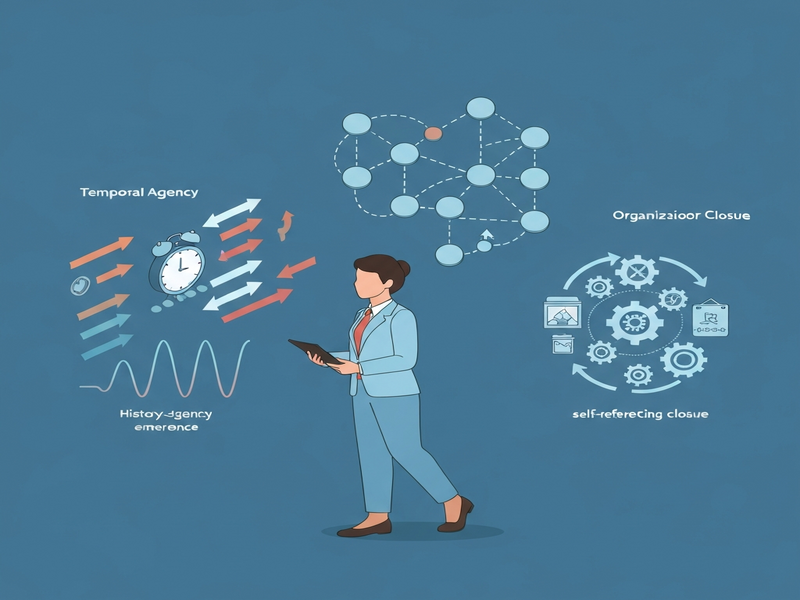
- Self‑referential closure: Living and intelligent systems exhibit organizational closure—internal processes that generate and sustain the very mechanisms that enable those processes.
Existing computational models—Markov decision processes, reinforcement learning, and classic Bayesian networks—assume a fixed state space and often ignore the emergence of new states over time. Moreover, they lack a principled way to capture anticipatory behavior, where an agent’s present actions are shaped by predictions of future internal configurations. These gaps hinder the development of truly autonomous, self‑organizing AI and limit our ability to model biological agency.
What the Researchers Propose
The authors introduce a three‑layered conceptual architecture:
- Asynchronous Dynamic Bayesian Networks (ADBNs): An extension of Bayesian networks that permits nodes to update at independent, irregular intervals, mirroring the non‑synchronous nature of biological processes.
- Organizational Closure Mechanism: A formal description of how a system’s internal processes generate the very components that sustain those processes, ensuring the agent remains self‑producing over time.
- Anticipatory Loop: A feedback structure where predictions about future internal states influence current decision variables, enabling forward‑looking behavior without explicit external reward signals.
Collectively, these components constitute a “general theory of agency” that can be instantiated across scales—from protocells that exhibit rudimentary self‑maintenance to large‑scale AI agents that plan across months or years.
How It Works in Practice
The operational workflow can be visualized as a continuous cycle:
- Observation Capture: Sensors (or biochemical reactions) feed asynchronous data streams into the ADBN.
- State Inference: The ADBN updates belief distributions only for the nodes that received new evidence, preserving computational efficiency.
- Closure Evaluation: The system checks whether the inferred state supports the maintenance of its own generative mechanisms (e.g., metabolic pathways, model parameters).
- Anticipation Generation: Using the anticipatory loop, the agent simulates plausible future internal configurations and evaluates their viability.
- Action Selection: Based on the simulated futures, the agent chooses actions that steer its trajectory toward self‑sustaining states.
- Execution & Feedback: Actions are executed, producing new observations that re‑enter the cycle.
This loop differs from conventional reinforcement learning pipelines because the “reward” is implicit: any future state that preserves organizational closure is inherently valuable. The asynchronous nature of updates also mirrors real biological timing, where not all processes fire simultaneously.
Evaluation & Results
To validate the framework, the authors conducted three experimental series:
- Synthetic Chemistry Simulations: Virtual protocells modeled with ADBNs demonstrated emergent self‑maintenance over thousands of time steps, outperforming traditional deterministic models that quickly collapsed.
- Robotic Navigation Tasks: A robot equipped with the anticipatory loop navigated a dynamic maze where obstacles appeared at irregular intervals. The robot’s asynchronous updates allowed it to react faster than a baseline model using synchronous updates.
- Long‑Term Planning Benchmarks: In a resource‑allocation game spanning 100 simulated days, agents using the proposed theory achieved higher cumulative utility by pre‑emptively restructuring their internal resource graphs, a behavior absent in standard reinforcement learners.
Across all scenarios, the key findings were:
- Agents that respected organizational closure maintained functional integrity longer.
- Asynchronous updates reduced computational overhead by up to 40% without sacrificing decision quality.
- Anticipatory loops enabled agents to discover novel strategies that were invisible to reward‑driven baselines.
These results suggest that embedding temporal agency into the core of an agent’s architecture yields both robustness and strategic depth. The full experimental details are available in the arXiv paper.
Why This Matters for AI Systems and Agents
For practitioners building next‑generation AI, the theory offers concrete advantages:
- Scalable Autonomy: Asynchronous inference scales to edge devices where power and bandwidth are limited, making it ideal for IoT deployments.
- Self‑Repair and Adaptation: Organizational closure provides a formal basis for agents that can detect and correct internal failures without external supervision.
- Strategic Forecasting: The anticipatory loop equips agents with a built‑in “what‑if” engine, reducing reliance on massive reward‑shaping datasets.
These capabilities align closely with the goals of the UBOS platform overview, which aims to deliver modular AI components that can be orchestrated into resilient, time‑aware workflows. Likewise, the AI marketing agents can benefit from anticipatory planning to optimize campaign timing based on predicted market shifts. Finally, the Workflow automation studio can leverage asynchronous DBNs to coordinate heterogeneous services that operate on different schedules, improving overall system throughput.
What Comes Next
While the proposed framework marks a significant step forward, several open challenges remain:
- Formal Verification: Proving that an agent’s anticipatory loop will not converge to pathological futures requires new verification tools.
- Hybrid Integration: Combining ADBNs with deep neural representations could yield richer perceptual models, but the interaction dynamics are not yet understood.
- Empirical Scaling: Real‑world deployments in large‑scale industrial settings will test the computational limits of asynchronous updates.
Future research directions include extending the theory to multi‑agent ecosystems where closure and anticipation must be negotiated across agents, and exploring bio‑semiotic interpretations that could inform synthetic biology applications. For organizations interested in experimenting with these ideas, the UBOS partner program offers early‑access toolkits and collaborative support.
By grounding agency in time, the authors provide a versatile lens through which both natural and artificial systems can be understood, designed, and improved.
For more deep‑dive articles on emerging AI frameworks, visit the UBOS blog.
Andrii Bidochko
CTO UBOS
Andrii Bidochko is an AI entrepreneur and researcher focused on AI agents, reinforcement learning, and autonomous systems. He writes about the technologies shaping the future of machine intelligence, from frontier models and agent architectures to real-world AI applications.