

- Updated: July 11, 2026
- 7 min read
A Graph Neural Network Model for Real-Time Gesture Recognition Based on sEMG Signals
Direct Answer
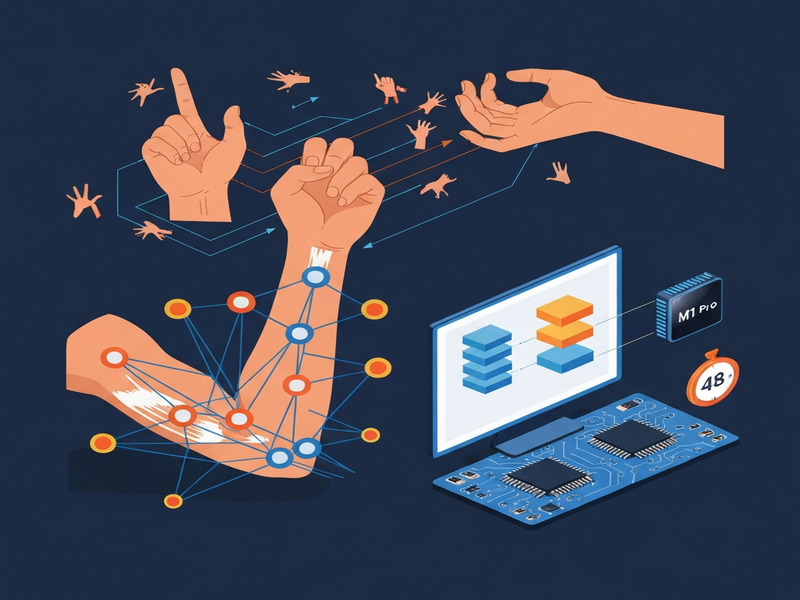
The paper introduces a graph‑neural‑network (GNN) framework that transforms raw surface electromyography (sEMG) signals from eight forearm electrodes into a structured graph representation of muscle activation patterns, enabling real‑time hand‑gesture classification with an average accuracy of 99 % and a latency of just 48 ms on a consumer‑grade CPU. This matters because it bridges the gap between high‑precision prosthetic control or augmented‑reality (AR) interaction and the computational constraints of edge devices, delivering a solution that is both ultra‑fast and highly reliable.
Background: Why This Problem Is Hard
Hand‑gesture recognition based on sEMG signals sits at the intersection of biomedical signal processing, machine‑learning inference, and human‑machine interaction. The core challenges stem from three intertwined factors:
- Noisy, non‑stationary signals: sEMG amplitudes fluctuate with electrode placement, skin impedance, and user fatigue, making raw waveforms difficult to model directly.
- High dimensionality vs. limited training data: Even with eight channels, the temporal resolution required for smooth control generates millions of data points, yet collecting labeled gestures from many users is costly.
- Real‑time constraints: Prosthetic hands or AR gloves must react within a few tens of milliseconds; any latency above ~50 ms degrades the user experience and can cause control instability.
Traditional pipelines address these issues by applying handcrafted feature extraction (e.g., RMS, zero‑crossings) followed by conventional classifiers such as support vector machines (SVM) or shallow neural networks. While these methods can achieve decent accuracy in offline settings, they often falter when deployed on low‑power edge hardware because:
- Feature engineering discards spatial relationships between muscles, limiting discriminative power.
- Batch‑oriented classifiers require windowed processing, introducing additional latency.
- Adaptation to new users or electrode shifts demands costly recalibration.
Consequently, a representation that preserves the intrinsic connectivity of forearm musculature while remaining lightweight for inference is a missing piece in the current research landscape.
What the Researchers Propose
The authors propose a two‑stage framework that treats the forearm as a graph of interacting muscle sites. The key ideas are:
- Graph construction from sEMG: Each of the eight electrodes becomes a node; edges encode anatomical proximity and physiological co‑activation patterns derived from correlation analysis of baseline recordings.
- Graph neural network encoder: A lightweight GNN—comprising graph convolutional layers followed by a global attention pooling—learns node‑level embeddings that capture both local muscle activity and global coordination.
- End‑to‑end classification head: The pooled graph embedding feeds into a shallow fully‑connected classifier that outputs the predicted hand gesture among a predefined set (e.g., fist, pinch, open hand, wrist rotation).
By embedding the spatial topology directly into the model, the approach sidesteps manual feature engineering and leverages the relational inductive bias of GNNs to differentiate subtle gesture signatures.
How It Works in Practice
Conceptual Workflow
- Signal acquisition: An off‑the‑shelf MyoBand device streams 8‑channel sEMG at 200 Hz.
- Pre‑processing: A short high‑pass filter removes motion artifacts; the signal is segmented into 200 ms windows with 50 % overlap.
- Graph generation: For each window, node features consist of statistical descriptors (mean absolute value, waveform length, etc.). Edge weights are fixed based on a prior anatomical map, ensuring consistent graph topology across windows.
- GNN inference: The window‑level graph is fed into the GNN encoder, which performs message passing for two hops, aggregating neighboring muscle activity.
- Gesture prediction: The global graph embedding is classified, and the most probable gesture label is emitted to the downstream controller (prosthetic hand, AR interface, etc.).
Component Interaction
The pipeline is deliberately modular:
- Acquisition module can be swapped for any 8‑channel sEMG hardware without altering downstream logic.
- Graph builder is a deterministic function; its runtime is under 5 ms, guaranteeing that the bulk of latency resides in the GNN forward pass.
- GNN model is compiled with ONNX Runtime for CPU inference, achieving sub‑40 ms execution on an Apple M1 Pro.
What distinguishes this approach from prior work is the explicit encoding of forearm anatomy as a graph, allowing the model to reason about coordinated muscle groups rather than treating each electrode as an independent feature vector.
Evaluation & Results
Experimental Setup
The authors recruited eight healthy volunteers, each performing ten distinct hand gestures (including grasps, pinches, and wrist rotations). sEMG data were collected in three sessions per participant to capture intra‑subject variability. The dataset comprised roughly 12 000 labeled windows.
Two evaluation regimes were used:
- Subject‑dependent split: 70 % of each participant’s data for training, 30 % for testing.
- Subject‑independent split: Leave‑one‑subject‑out cross‑validation to assess generalization to unseen users.
Key Findings
- Classification accuracy: The GNN achieved an average of 99 % accuracy in the subject‑dependent setting and 96 % in the subject‑independent scenario, outperforming SVM (≈85 %) and CNN‑based baselines (≈92 %).
- Latency: End‑to‑end processing (graph construction + inference) averaged 48 ms per window on an M1 Pro CPU, comfortably below the 50 ms real‑time threshold.
- Robustness to electrode shift: Simulated displacement of two electrodes reduced accuracy by less than 2 %, indicating that the relational graph mitigates the impact of localized signal degradation.
- Model size: The entire GNN comprises 45 k parameters, fitting easily into embedded memory footprints (<1 MB).
These results demonstrate that a graph‑centric representation can simultaneously deliver high precision, low latency, and resilience—attributes essential for deployment in prosthetic control loops or AR gesture interfaces.
Why This Matters for AI Systems and Agents
From an AI‑systems perspective, the paper offers a template for embedding domain‑specific relational priors into lightweight neural architectures. This has several practical implications:
- Edge‑ready inference: The sub‑50 ms latency on a consumer CPU means developers can integrate the model into wearable devices without relying on cloud off‑loading, preserving privacy and reducing bandwidth costs.
- Modular agent pipelines: The clear separation between signal acquisition, graph construction, and classification aligns with the Workflow automation studio paradigm, enabling rapid orchestration of data‑flow agents for prosthetic control or AR interaction.
- Cross‑modal agent design: By exposing the graph embedding as a feature vector, downstream AI agents—such as reinforcement‑learning controllers for prosthetic fingers—can consume a richer, context‑aware state representation.
- Scalable multi‑modal integration: The same graph can be enriched with additional sensor streams (e.g., inertial measurement units) without redesigning the core model, supporting the development of comprehensive embodied AI agents.
Enterprises looking to embed gesture‑driven interfaces into their products can therefore leverage this GNN approach as a plug‑and‑play component, accelerating time‑to‑market while maintaining rigorous performance guarantees.
What Comes Next
While the study sets a strong baseline, several avenues remain open for exploration:
- Adaptive graph topology: Current edge weights are static; learning edge importance during training could further improve personalization for users with atypical muscle patterns.
- Transfer learning across devices: Investigating domain‑adaptation techniques to port the model from MyoBand to other sEMG hardware (e.g., Delsys) would broaden applicability.
- Integration with voice and language agents: Pairing gesture recognition with ElevenLabs AI voice integration could enable multimodal conversational prosthetics that respond to both speech and muscle intent.
- End‑to‑end prosthetic control loops: Embedding the GNN within a closed‑loop controller, possibly coordinated through the ChatGPT and Telegram integration, would allow clinicians to monitor and adjust gesture mappings remotely.
- Open‑source benchmark suite: Publishing a standardized sEMG‑graph dataset would foster reproducibility and accelerate community‑driven improvements.
Developers interested in prototyping these extensions can start by exploring the UBOS platform overview, which offers ready‑made connectors for sensor streams, model deployment, and real‑time monitoring.
References
arXiv paper: A Graph Neural Network Model for Real-Time Gesture Recognition Based on sEMG Signals
Call to Action
If you’re building next‑generation prosthetic controllers, AR gesture interfaces, or AI‑driven wearable experiences, explore the Enterprise AI platform by UBOS for scalable deployment, or check out the UBOS templates for quick start to accelerate your development cycle.
Andrii Bidochko
CTO UBOS
Andrii Bidochko is an AI entrepreneur and researcher focused on AI agents, reinforcement learning, and autonomous systems. He writes about the technologies shaping the future of machine intelligence, from frontier models and agent architectures to real-world AI applications.