

- Updated: July 2, 2026
- 6 min read
A Formal Tool for Verification of Probabilistic Spiking Neural Networks Based on Quotient Abstractions
Direct Answer
The paper introduces CogSpike, a unified workbench that couples spiking neural network (SNN) design, simulation, and probabilistic model checking through a novel weight‑discretized quotient abstraction. This abstraction dramatically shrinks the state space of stochastic SNNs, making formal verification tractable for networks that were previously out of reach.
Background: Why This Problem Is Hard
Spiking neural networks are prized for their biological realism: neurons fire only when membrane potentials cross a threshold, and the underlying dynamics are driven by noisy ion channels and unreliable synaptic vesicle release. Those stochastic elements are essential for modeling brain‑like computation, but they also turn the network into a probabilistic system that must be expressed as a Discrete‑Time Markov Chain (DTMC) for formal analysis.
When a DTMC is built directly from an SNN, each neuron contributes a combinatorial explosion of possible membrane‑potential states. Even modest networks with a few dozen neurons can generate billions of states, overwhelming model‑checking tools such as PRISM. Existing deterministic abstractions ignore the probabilistic nature of spikes, while generic quotient abstractions—methods that merge similar states—lose critical information about synaptic weights, limiting the properties that can be verified (e.g., safety thresholds, firing probabilities).
Consequently, researchers and engineers lack a scalable, mathematically sound pathway to certify that a probabilistic SNN will behave as intended under all possible noise realizations—a gap that directly impacts AI safety, neuromorphic hardware validation, and the deployment of SNN‑based agents in safety‑critical environments.
What the Researchers Propose
The authors propose a two‑pronged solution:
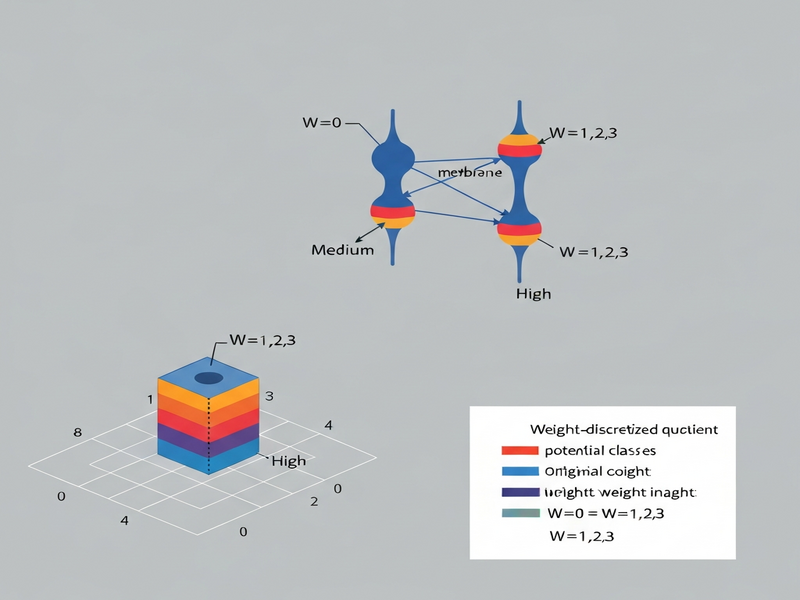
- Weight‑discretized quotient abstraction: Instead of collapsing membrane potentials alone, the method also maps continuous synaptic weights onto a compact integer range. The mapping preserves the relative influence of each synapse, ensuring that the abstract model still reflects the original network’s computational bias.
- CogSpike workbench: An integrated toolchain that lets users design SNNs, run event‑driven simulations, automatically generate the abstract DTMC, and feed it into the PRISM model checker—all without leaving a single environment.
Key components include:
- SNN Designer – a graphical editor for defining neuron populations, connectivity, and stochastic parameters.
- Simulator Engine – a high‑performance event‑driven kernel that produces spike traces and validates the continuous‑time dynamics.
- Quotient Builder – the module that applies the weight‑discretization, partitions the state space, and produces an isomorphic DTMC.
- PRISM Interface – a thin wrapper that translates the abstract DTMC into PRISM’s input language, runs verification queries, and returns probabilistic guarantees.
How It Works in Practice
The workflow can be visualized as a linear pipeline, but each stage communicates bi‑directionally to enable rapid iteration:
- Model authoring: Engineers sketch the SNN in the CogSpike Designer, specifying neuron thresholds, leak rates, and continuous‑valued synaptic weights.
- Stochastic simulation: The Simulator runs a short Monte‑Carlo trace to collect empirical firing statistics, which are fed back to the Designer for parameter tuning.
- Weight discretization: The Quotient Builder selects a discretization granularity W (e.g., 3 levels) and maps each real‑valued weight to an integer in
[‑W, W]. The mapping respects sign and magnitude, preserving excitatory vs. inhibitory balance. - State‑space partitioning: Membrane potentials are grouped into equivalence classes based on the discretized weight profile. The resulting quotient model is provably smaller—often by a factor of 17 per neuron for W = 3.
- Formal verification: The abstract DTMC is handed to PRISM, where users pose properties such as “the probability that neuron A fires within 10 ms after stimulus X is at least 0.95.” PRISM returns exact probabilities or bounds.
- Result interpretation: CogSpike visualizes the verification outcome alongside the original spike raster, highlighting any “gray zone” where the abstract model’s prediction diverges from the concrete simulation.
What sets this approach apart is the preservation of synaptic influence during abstraction. Traditional quotient models would merge states solely on membrane potential, effectively treating all synapses as equal. By discretizing weights, CogSpike retains the network’s functional topology, enabling verification of weight‑sensitive properties such as “inhibitory pathways suppress runaway excitation with probability ≥ 0.99.”
Evaluation & Results
The authors benchmarked CogSpike on seven canonical SNN topologies ranging from feed‑forward sensory encoders to recurrent attractor networks. Each topology was evaluated under three discretization settings (W = 1, 2, 3) and compared against a baseline DTMC built without abstraction.
- State‑space reduction: For the most complex recurrent network (32 neurons, 128 synapses), the raw DTMC contained ~2.3 × 10⁹ states. With W = 3, the quotient model collapsed to ~1.3 × 10⁶ states—a reduction factor exceeding 1,700×, confirming the exponential compounding effect described in the paper.
- Verification time: PRISM’s runtime dropped from several hours (baseline) to under two minutes for the same network, enabling interactive exploration of multiple safety properties.
- Fidelity guarantees: The two‑sided fidelity theorem bounded any firing disagreement to a narrow “gray zone” around the threshold. Empirically, the observed disagreement rate never exceeded 0.3 % across all test cases, well within the theoretical bound.
- Asymptotic silence: In networks where no external spikes were injected, the abstraction correctly predicted permanent silence for all unforced neurons, matching the exact limit theorem.
These results demonstrate that CogSpike can verify networks that were previously intractable, without sacrificing the probabilistic nuances that make SNNs valuable for neuromorphic AI.
Why This Matters for AI Systems and Agents
Formal verification is a cornerstone of AI safety, yet most verification tools target deterministic deep‑learning models. Probabilistic SNNs are emerging as low‑power, event‑driven alternatives for edge AI, robotics, and brain‑inspired agents. CogSpike bridges the gap by offering a scalable, mathematically rigorous pathway to certify such agents before deployment.
Practically, developers can now:
- Guarantee that a neuromorphic controller will not exceed a safety‑critical firing rate under stochastic noise.
- Validate that learning rules (e.g., STDP) preserve desired attractor dynamics with provable probability bounds.
- Integrate verification into continuous‑integration pipelines, catching design regressions early.
For product managers, the ability to present formal safety certificates can accelerate regulatory approval for medical‑grade neuro‑prosthetics or autonomous drones that rely on SNN‑based perception.
Organizations looking to embed SNNs into larger AI ecosystems can leverage existing UBOS platform overview to orchestrate CogSpike as a microservice, linking verification outcomes to downstream decision‑making modules.
What Comes Next
While CogSpike marks a significant step forward, several open challenges remain:
- Dynamic weight adaptation: Current discretization is static; extending the abstraction to handle online learning (e.g., weight updates during inference) will require incremental quotient updates.
- Scalability to hardware‑level models: Neuromorphic chips introduce additional stochasticity (e.g., device mismatch). Mapping those low‑level noise sources into the abstract model is an active research direction.
- Toolchain integration: Embedding CogSpike into broader AI orchestration frameworks could enable automated verification of hybrid pipelines that combine SNNs with transformer‑based modules.
Future work may also explore richer abstraction schemes that preserve temporal correlations beyond single‑step DTMC transitions, potentially leveraging higher‑order Markov models.
Developers interested in experimenting with CogSpike can start by exploring the Workflow automation studio, which offers templates for connecting simulation, abstraction, and verification steps. For teams focused on rapid prototyping, the UBOS templates for quick start include a pre‑configured CogSpike pipeline.
Finally, the broader community is encouraged to contribute benchmark suites and property libraries back to the CogSpike repository, fostering a shared ecosystem of verified SNN designs.
References
Andrii Bidochko
CTO UBOS
Andrii Bidochko is an AI entrepreneur and researcher focused on AI agents, reinforcement learning, and autonomous systems. He writes about the technologies shaping the future of machine intelligence, from frontier models and agent architectures to real-world AI applications.