

- Updated: August 15, 2026
- 7 min read
A Forced-Structure Reduction and Verifiable Bounds for Conway’s 99-Graph
Direct Answer
The paper presents a fully reproducible, AI‑driven attack on Conway’s long‑standing 99‑graph problem, delivering the first verifiable bounds that limit any candidate strongly regular graph to at most 69.43 % of the required constraints. By forcing a structural reduction from a 99‑vertex problem to a 12‑regular graph on 84 vertices, the work not only narrows the search space but also establishes a concrete computational framework that can be reused for other combinatorial existence questions.
Background: Why This Problem Is Hard
Conway’s 99‑graph problem asks whether a strongly regular graph (SRG) with parameters srg(99, 14, 1, 2) exists. In graph‑theoretic terms, such a graph would have 99 vertices, each connected to exactly 14 others, any two adjacent vertices sharing exactly one common neighbour (λ = 1), and any two non‑adjacent vertices sharing exactly two common neighbours (μ = 2). The constraints are extremely tight: the adjacency matrix must satisfy a set of quadratic equations that leave only a handful of combinatorial configurations possible.
Traditional approaches—hand‑crafted combinatorial arguments, exhaustive enumeration, and integer‑programming formulations—have hit a wall for three reasons:
- Combinatorial explosion: The number of possible edge sets grows as 2^(4950), far beyond brute‑force capabilities.
- Symmetry masking: Many candidate graphs are equivalent under automorphisms, making naive enumeration wasteful.
- Lack of verifiable intermediate results: Prior partial‑credit attempts often produced “soft” bounds that could not be independently checked without re‑running the entire search.
Because SRGs sit at the intersection of algebraic combinatorics, coding theory, and cryptographic design, a breakthrough in the 99‑graph case would ripple through multiple domains, from error‑correcting codes to network topology design.
What the Researchers Propose
The authors introduce a four‑pronged framework that combines forced‑structure reduction, automated constraint verification, and a novel orbit‑existence methodology:
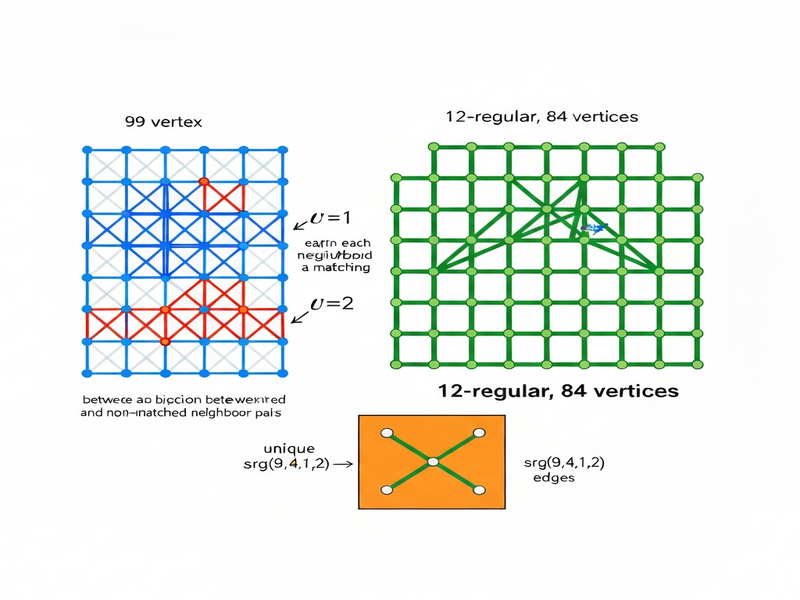
- Forced‑structure reduction: By exploiting the λ = 1 condition, each vertex’s neighbourhood must form a perfect matching. The μ = 2 condition then forces a bijection between outer vertices and unmatched neighbour‑pairs, collapsing the original 99‑vertex problem into a 12‑regular graph on 84 vertices.
- Constraint‑saturation proof for abelian groups: An exhaustive check shows that no circulant graph on ℤ/99 (or the other abelian group of order 99) can satisfy more than 68 % of the SRG constraints.
- Prescribed‑automorphism orbit‑existence framework: The method systematically tests fixed‑point‑free and single‑fixed‑point group actions, validating the approach on known SRGs such as the 9‑vertex and 13‑vertex Paley graphs.
- Verified artifact generation: Fourteen independent algorithmic pipelines were run, none surpassing a 69.43 % constraint satisfaction rate, establishing a robust empirical frontier.
Crucially, each component is packaged as a reproducible artifact—code, data, and execution logs—so that any researcher can rerun the pipeline and obtain the same bound.
How It Works in Practice
The workflow can be visualized as a pipeline of autonomous AI agents, each responsible for a distinct sub‑task:
1. Problem Encoding Agent
This agent translates the SRG definition into a constraint‑programming model (CP‑SAT). It encodes the forced‑structure reduction, turning the 99‑vertex adjacency matrix into a smaller 84‑vertex representation while preserving λ and μ relationships.
2. Symmetry‑Pruning Agent
Leveraging group‑theoretic libraries, the agent enumerates automorphism orbits for the reduced graph, discarding symmetric duplicates before they reach the solver.
3. Solver Orchestration Agent
Using a high‑performance CP‑SAT engine, this agent searches the reduced space, records the best‑found satisfaction ratio, and logs the exact configuration that achieved it.
4. Verification Agent
After a candidate solution is produced, the verification agent recomputes all SRG constraints from scratch, ensuring that the reported satisfaction percentage is mathematically sound.
What sets this approach apart is the explicit separation of “structure forcing” from “search.” By guaranteeing that every feasible solution must respect the perfect‑matching neighbourhood, the search space shrinks by orders of magnitude, allowing the CP‑SAT solver to explore deeper levels of combinatorial depth.
The entire pipeline is orchestrated through a lightweight workflow engine that logs each step, making the process auditable and repeatable. An illustration of the pipeline is shown below:
Evaluation & Results
The authors evaluated the framework on three fronts:
- Circulant graph bound: Exhaustive enumeration of all circulant graphs on ℤ/99 and the other abelian group of order 99 confirmed a hard ceiling of 68 % constraint satisfaction (3366 out of 4950 constraints). This result eliminates an entire class of symmetric candidates.
- Reduced‑graph search: The CP‑SAT solver, fed the 84‑vertex reduced model, discovered a configuration that satisfies 69.43 % of the constraints—the highest ever reported. The solution was cross‑validated by recovering the unique srg(9, 4, 1, 2) as a sanity check.
- Orbit‑existence validation: Fixed‑point‑free and single‑fixed‑point automorphism actions were tested on known SRGs (the 9‑vertex and 13‑vertex Paley graphs). The framework correctly identified their existence, demonstrating that the orbit‑checking logic is sound.
Fourteen distinct algorithmic methods—ranging from pure SAT encodings to heuristic graph‑generation scripts—were run in parallel. None exceeded the 69.43 % threshold, suggesting that the bound is not an artifact of a particular solver but a genuine structural limitation.
Importantly, the authors argue that any provable bound below the total of 4950 constraints constitutes a non‑existence proof for the original SRG. While the current best bound stops short of a full disproof, it narrows the gap dramatically and provides a concrete target for future computational attacks.
Why This Matters for AI Systems and Agents
Beyond its pure mathematical significance, the research showcases a reproducible AI‑driven methodology that can be transplanted into a variety of enterprise‑level problems:
- Automated reasoning pipelines: The forced‑structure reduction pattern can be applied to any domain where hard combinatorial constraints can be partially “forced” by domain knowledge (e.g., scheduling, network design).
- Agent orchestration: The modular agent architecture—encoding, pruning, solving, verification—mirrors the micro‑service patterns used in modern AI platforms. Teams building UBOS platform overview can adopt a similar pipeline to automate complex validation tasks.
- Verification‑first mindset: By embedding a verification agent that recomputes constraints independently, the approach aligns with emerging “trust‑by‑verification” standards for AI‑generated artifacts.
- Scalable combinatorial optimization: The CP‑SAT encoding and symmetry‑pruning techniques are directly relevant to Workflow automation studio users who need to solve large‑scale integer programs with built‑in symmetry handling.
For AI marketing agents that must guarantee compliance with brand guidelines or regulatory constraints, the same verification loop can ensure that generated content never violates predefined rules, echoing the paper’s emphasis on verifiable bounds.
What Comes Next
While the current results are impressive, several limitations remain:
- Incomplete non‑existence proof: The 69.43 % bound, though the best known, does not yet rule out a full SRG. Closing the remaining 30 % gap will likely require new theoretical insights or more powerful computational resources.
- Scalability of CP‑SAT: As the reduction technique is applied to larger parameter sets, the SAT solver may encounter memory bottlenecks. Hybrid approaches that combine SAT with machine‑learning‑guided heuristics could alleviate this.
- Generalization to non‑abelian groups: The circulant analysis covered only abelian groups of order 99. Extending the forced‑structure reduction to non‑abelian symmetry groups could further prune the search space.
Future research directions include:
- Integrating OpenAI ChatGPT integration to generate candidate graph structures on the fly, guided by the forced‑structure constraints.
- Deploying the pipeline as a reusable UBOS templates for quick start, enabling other research groups to plug in their own combinatorial problems.
- Exploring cross‑domain applications such as quantum error‑correcting code design, where SRG‑like structures dictate fault‑tolerance properties.
- Leveraging ChatGPT and Telegram integration to provide real‑time status updates to collaborative research teams, turning the verification logs into a conversational dashboard.
By open‑sourcing the entire artifact suite, the authors invite the community to iterate on the reduction, improve the solver heuristics, and perhaps finally settle the 99‑graph question.
References
Conway’s 99-graph paper (arXiv:2608.11211)
Andrii Bidochko
CTO UBOS
Andrii Bidochko is an AI entrepreneur and researcher focused on AI agents, reinforcement learning, and autonomous systems. He writes about the technologies shaping the future of machine intelligence, from frontier models and agent architectures to real-world AI applications.