

- Updated: June 24, 2026
- 6 min read
A-Evolve-Training: Autonomous Post-Training of a 30B Model
Direct Answer
The paper introduces A‑Evolve‑Training, an autonomous loop that iteratively post‑trains a 30‑billion‑parameter Nemotron model without any human intervention. By automatically proposing data, adjusting training recipes, and re‑evaluating performance, the system reaches a public benchmark score of 0.86—just shy of the top human‑submitted 0.87—demonstrating that large‑scale recursive self‑improvement is feasible.
Background: Why This Problem Is Hard
Post‑training frontier models traditionally requires weeks of manual effort: researchers must curate new data, design curriculum schedules, launch expensive compute jobs, and then painstakingly interpret evaluation metrics. The process is brittle because:
- Metric drift: internal validation scores often diverge from real‑world performance, leading teams to chase misleading proxies.
- Scale constraints: each training run for a 30B+ model can cost thousands of dollars, making trial‑and‑error impractical.
- Human bandwidth: expert time is a scarce resource, and coordinating multiple iterations across teams introduces delays and errors.
Existing automation efforts—such as hyperparameter search or data‑centric AI pipelines—still rely on humans to define the search space, interpret results, and decide when to stop. As models grow, the gap between what a human can manually oversee and what the system needs to explore widens, creating a critical bottleneck for rapid model improvement.
What the Researchers Propose
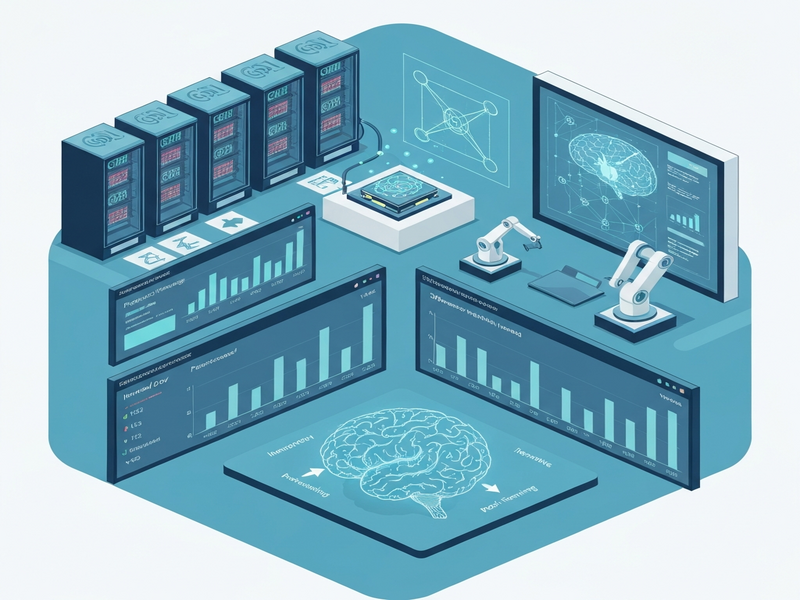
The authors present a fully autonomous framework called A‑Evolve‑Training. At a high level, the system consists of three interacting agents:
- Data Generator: continuously curates and augments training data from public sources, applying filters to maintain relevance and diversity.
- Recipe Optimizer: proposes modifications to the training schedule—learning‑rate schedules, regularization settings, and curriculum ordering—based on a meta‑learning policy.
- Evaluation Oracle: runs a suite of internal and external benchmarks, detects when internal metrics become misaligned with external targets, and signals the need to shift the optimization objective.
Crucially, the loop includes a self‑diagnostic step: when the internal dev metric stops correlating with the public Nemotron‑Reasoning Challenge score, the system automatically switches from “maximizing dev” to “exploring interventions that lower the misleading proxy while improving the true target.” This meta‑level adaptation is the core novelty that moves the system beyond simple optimization into genuine discovery.
How It Works in Practice
The autonomous cycle proceeds through four rounds, each spanning several days of compute:
- Initialize: Start from a pre‑trained 30B Nemotron checkpoint.
- Data Refresh: The Data Generator scrapes new web text, filters for quality, and creates domain‑balanced mini‑batches.
- Recipe Proposal: The Recipe Optimizer samples a set of training hyper‑parameters from a learned distribution, then launches parallel fine‑tuning jobs.
- Evaluation & Feedback: The Evaluation Oracle aggregates internal validation scores and external leaderboard results. If a divergence is detected, it triggers a policy shift.
- Policy Update: The system updates its search policy—biasing toward interventions that previously reduced proxy drift—and repeats the loop.
What distinguishes this approach from prior automated ML pipelines is the closed‑loop meta‑learning capability. Instead of treating the evaluation metric as static, the system treats it as a dynamic signal that can become unreliable, and it has a built‑in mechanism to recognize and correct that.
Evaluation & Results
The authors evaluated A‑Evolve‑Training on the public NVIDIA Nemotron‑Reasoning Challenge, which measures reasoning ability across multiple domains (e.g., mathematics, commonsense, code). Key findings include:
- The autonomous model achieved a held‑out score of 0.86, placing 8th out of roughly 4,000 submissions at the time of writing.
- During the third round, the internal dev metric plateaued while the external leaderboard score continued to improve, prompting the system to adjust its objective.
- When the system switched its policy, subsequent rounds produced a modest dip in dev score but a measurable gain in the external benchmark, confirming that the loop successfully identified and corrected a misleading proxy.
- Infrastructure tests showed the same autonomous loop could close on larger models (120B and 550B), proving scalability even though competitive baselines for those sizes are not yet public.
These results matter because they provide auditable evidence that an autonomous system can not only optimize but also discover when its own measurement framework is failing—a prerequisite for true recursive self‑improvement.
Why This Matters for AI Systems and Agents
For practitioners building AI agents, the ability to continuously refine a backbone model without human bottlenecks unlocks several practical advantages:
- Rapid iteration: Agents can be updated with the latest data and training tricks on a weekly cadence, keeping them competitive in fast‑moving domains like finance or cybersecurity.
- Robust evaluation pipelines: By embedding a self‑diagnostic oracle, developers can avoid the trap of over‑fitting to internal metrics, leading to more reliable downstream behavior.
- Cost efficiency: Automating the search for effective recipes reduces the need for expert time, allowing teams to allocate resources to higher‑level product work.
- Scalable orchestration: The loop’s modular agents map naturally onto existing workflow automation tools, such as the Workflow automation studio, enabling seamless integration into enterprise pipelines.
- Enhanced agent capabilities: Continuous post‑training can be paired with AI marketing agents to keep conversational bots up‑to‑date with brand language and market trends.
In short, A‑Evolve‑Training demonstrates a path toward self‑sustaining model improvement that aligns with the operational realities of modern AI product teams.
What Comes Next
While the study marks a significant milestone, several open challenges remain:
- Generalization across tasks: The current loop focuses on a single reasoning benchmark; extending it to multimodal or reinforcement‑learning tasks will require richer evaluation oracles.
- Safety and alignment: Autonomous data curation can inadvertently introduce harmful content; future work must embed robust content filters and alignment checks.
- Transparency: Providing human‑readable explanations for why the system altered its policy will be essential for trust in high‑stakes deployments.
- Resource optimization: Scaling to trillion‑parameter models will demand smarter allocation of compute, perhaps via predictive cost‑benefit models.
Addressing these issues will likely involve tighter integration with platform‑level services. For example, the Enterprise AI platform by UBOS can host the autonomous loop, offering secure data pipelines and monitoring dashboards. Startups looking to experiment with autonomous post‑training can leverage the UBOS for startups offering, which provides managed compute and pre‑built evaluation suites.
References
For the full technical details, see the original arXiv paper.
Andrii Bidochko
CTO UBOS
Andrii Bidochko is an AI entrepreneur and researcher focused on AI agents, reinforcement learning, and autonomous systems. He writes about the technologies shaping the future of machine intelligence, from frontier models and agent architectures to real-world AI applications.