

- Updated: August 19, 2026
- 7 min read
TangPoetryBench: A Multi-Dimensional Benchmark and Rubric-Conditioned Evaluator for Poetry-to-Image Generation
Direct Answer
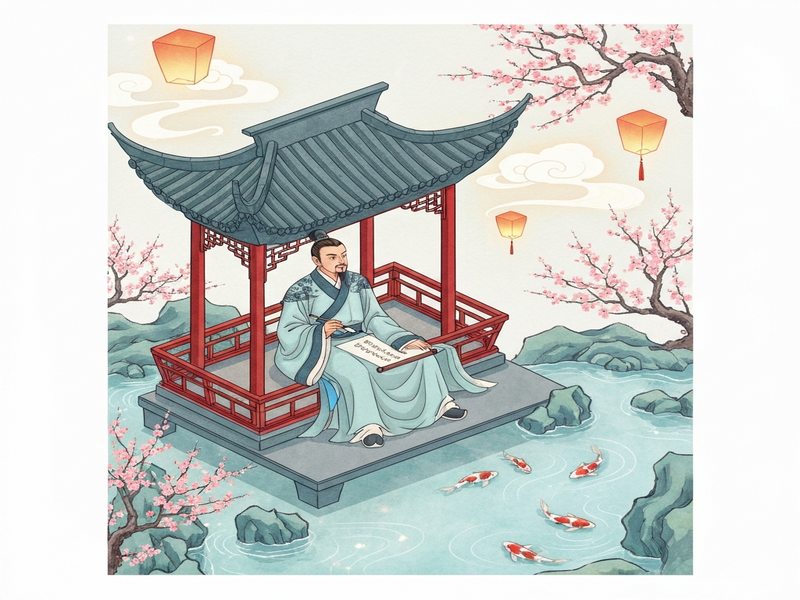
TangPoetryBench is a newly released, multi‑dimensional benchmark that evaluates how well text‑to‑image (T2I) models illustrate classical Chinese Tang poems. It matters because it provides the first large‑scale, human‑annotated yardstick for measuring visual fidelity, cultural appropriateness, emotional resonance, and other nuanced aspects that existing metrics completely miss.
Background: Why This Problem Is Hard
Illustrating poetry is fundamentally different from generating images for straightforward captions. A poem packs layers of meaning—explicit imagery, cultural references, stylistic conventions, and often a hidden emotional current that is never spelled out. Traditional T2I evaluation metrics such as CLIPScore, BLIPScore, or VQAScore focus on literal word‑image overlap. They reward a model for reproducing a literal object (“mountain”, “river”) but cannot judge whether the generated picture captures the poem’s tone, the subtle symbolism of a “lonely crane”, or the aesthetic conventions of Tang dynasty art.
Because of this mismatch, researchers have struggled to answer two critical questions:
- Faithfulness vs. Creativity: Does the image stay true to the poem’s scene while also offering a visually compelling composition?
- Implicit Emotion: Can the model convey the poem’s underlying feeling—melancholy, awe, or wistfulness—when the emotion is never directly named?
Without a benchmark that captures these dimensions, progress in poetry‑to‑image generation has been anecdotal, relying on subjective human judgments that are costly and hard to reproduce. This bottleneck limits both academic research and commercial applications such as cultural heritage visualisation, AI‑driven storytelling, and educational tools that aim to bring classic literature to life.
What the Researchers Propose
The authors introduce two tightly coupled contributions:
- TangPoetryBench: A curated dataset of 1,280 images—four state‑of‑the‑art T2I models each generating 320 illustrations for a selection of classical Chinese Tang poems. Each image is annotated by expert human raters across ten distinct dimensions, ranging from “visual quality” to “cultural style” and “implicit emotion”.
- PoemAutoEvaluator (PAE): An open‑source, rubric‑conditioned evaluator that ingests an image, the source poem, and a set of rubric prompts, then produces scores that align with the human annotations. PAE is trained to emulate a strong proprietary judge (Claude) and can generalise to unseen generators and even a different poetic tradition (Song Ci).
Key components of the framework include:
- Rubric Engine: A collection of natural‑language prompts that define each evaluation dimension (e.g., “Does the image respect the poem’s cultural motifs?”).
- LLM‑backed Scorer: A large language model that reads the rubric, the poem, and the image description (generated via an image captioner) to output a calibrated score.
- Calibration Layer: A lightweight regression that aligns raw LLM scores with the human rating scale, ensuring parity with the proprietary benchmark.
How It Works in Practice
The end‑to‑end workflow can be visualised as a three‑stage pipeline:
- Image Generation: A T2I model receives a poem as input and produces an illustration. In the benchmark, four leading models (e.g., Stable Diffusion, DALL·E‑3, Midjourney, and a Chinese‑trained diffusion model) are used.
- Caption Extraction: An off‑the‑shelf vision‑language model (such as BLIP) generates a concise textual description of the image, preserving visual details that the evaluator can reason about.
- Rubric‑Conditioned Scoring: For each of the ten dimensions, the PoemAutoEvaluator feeds the poem, the caption, and the rubric prompt into a large language model (e.g., Claude‑2 or GPT‑4). The LLM returns a raw score, which the calibration layer maps onto the 1‑5 human rating scale.
What sets this approach apart is the explicit conditioning on a human‑crafted rubric. Rather than learning a monolithic similarity function, PAE decomposes the judgment into interpretable sub‑tasks, mirroring how a human expert would assess an illustration. This modularity also enables easy extension: new rubrics (e.g., “historical accuracy”) can be added without retraining the entire system.
Evaluation & Results
The researchers conducted a comprehensive set of experiments to answer three questions:
- How well does PAE replicate human judgments?
- What strengths and weaknesses emerge across the four T2I models?
- Can PAE generalise to unseen generators and a different poetic tradition?
Key findings include:
- Human‑Level Correlation: PAE achieved a Pearson correlation of 0.84 with the human annotations, statistically indistinguishable from the proprietary Claude judge (0.86). This demonstrates that the rubric‑conditioned approach can serve as a reliable proxy for costly human evaluation.
- Model‑Specific Profiles: While all models produced high visual quality scores, they diverged sharply on cultural style and implicit emotion. The Chinese‑trained diffusion model excelled at “cultural fidelity” (average 4.2/5) but lagged in “emotional resonance” (3.1/5). Conversely, the general‑purpose models captured emotion better but occasionally introduced anachronistic elements (e.g., modern clothing).
- Cross‑Tradition Generalisation: When evaluated on a set of Song Ci poems generated by a fifth, unseen model, PAE’s correlation remained robust (0.81), confirming that the rubric‑based design is not over‑fitted to Tang poetry alone.
These results matter because they provide the first quantitative evidence that T2I systems can be dissected along culturally and emotionally meaningful axes, rather than a single “overall quality” score.
Why This Matters for AI Systems and Agents
For practitioners building AI agents that interact with literary content, TangPoetryBench offers a ready‑made evaluation harness that can be plugged into any generation pipeline. Consider a conversational agent that answers user queries about Chinese poetry by generating illustrative images on the fly. Using PAE, developers can automatically verify that the agent’s visual output respects cultural norms and conveys the intended mood, reducing the risk of misrepresentation.
Beyond poetry, the rubric‑conditioned paradigm can be adapted to other domains where subjective quality matters—fashion design, architectural visualisation, or medical illustration. By exposing a clear API, PAE enables Workflow automation studio users to chain generation, captioning, and evaluation steps into a single orchestrated workflow, ensuring consistent quality checks before images are published.
From a business perspective, the benchmark helps product teams benchmark competing T2I providers, choose the model that best aligns with brand voice, and justify licensing decisions with data‑driven evidence. It also opens the door for AI marketing agents to generate culturally resonant visual assets at scale, a capability that was previously impossible to validate automatically.
What Comes Next
While TangPoetryBench marks a significant step forward, several limitations remain:
- Scope of Poetry: The current dataset focuses exclusively on Tang dynasty poems. Extending the benchmark to other languages, eras, or poetic forms (e.g., haiku, sonnets) would test the universality of the rubric approach.
- Dynamic Context: Poems often rely on historical or biographical context that is not present in the text alone. Future work could incorporate knowledge graphs to enrich the evaluation rubric.
- Real‑Time Constraints: PAE’s reliance on LLM inference adds latency, which may be prohibitive for interactive agents. Optimising the scoring pipeline or distilling the rubric‑conditioned model into a lightweight classifier are promising avenues.
Potential research directions include:
- Developing a multimodal rubric generator that automatically crafts evaluation prompts for new domains.
- Integrating Chroma DB integration to store and retrieve poem‑image pairs, enabling rapid similarity search and curriculum learning for T2I models.
- Exploring ChatGPT and Telegram integration to let end‑users submit poems and receive evaluated illustrations in a conversational interface.
By addressing these challenges, the community can move toward a universal, rubric‑conditioned evaluation framework that supports any creative generation task where nuance matters.
References
Illustration
Andrii Bidochko
CTO UBOS
Andrii Bidochko is an AI entrepreneur and researcher focused on AI agents, reinforcement learning, and autonomous systems. He writes about the technologies shaping the future of machine intelligence, from frontier models and agent architectures to real-world AI applications.