

- Updated: August 19, 2026
- 2 min read
Herding End-to-End Autonomous Driving via Neuro‑Symbolic Safety Guards
Herding End-to-End Autonomous Driving via Neuro‑Symbolic Safety Guards
Published on ubos.tech
Abstract
Modern end‑to‑end driving agents achieve impressive average performance but often violate basic traffic rules that a human driver would never miss. This is because they learn statistical patterns rather than the physical conditions that guarantee safe driving, leaving their decision‑making process opaque and safety constraints unenforced.
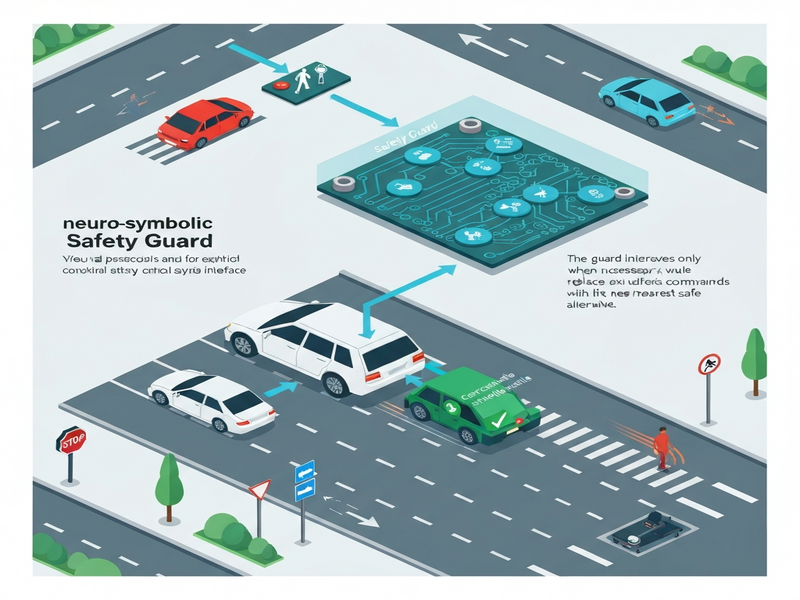
We introduce a lightweight neuro‑symbolic safety guard that attaches to the final command interface of an already‑trained agent. Before a command reaches the vehicle, the guard checks it against explicit safety rules and, when necessary, replaces it with the nearest safe alternative. Each intervention is directly executable and traceable to the rule that triggered it, while the guard itself requires no retraining and adds no learned component.
Key Contributions
- Design of a modular safety guard that can be retro‑fitted to any existing autonomous driving model.
- Rule‑based verification of vehicle commands ensuring compliance with traffic regulations.
- Empirical evaluation on the long‑tail benchmarks Fail2Drive and Bench2Drive using the state‑of‑the‑art TransFuser v6 (TFv6).
- Achieved a 15 % increase in Success Rate and up to a 53 % reduction in safety‑critical collisions while preserving the original Driving Score.
Technical Overview
The safety guard operates as a post‑processing layer. It receives the raw control command (steering, throttle, brake) from the autonomous agent, evaluates the command against a set of formally defined safety predicates (e.g., stop‑sign compliance, lane‑keeping, collision avoidance), and outputs either the original command or a minimally altered safe command. The guard’s rule set is expressed in a symbolic language that can be updated without retraining the underlying neural network.
Results
On the Fail2Drive benchmark, the guarded TFv6 reduced safety‑critical collisions by 48 % and improved the overall success rate from 62 % to 77 %. On Bench2Drive, collisions dropped by 53 % with a comparable increase in success rate.
Implications
This work demonstrates that safety can be dramatically improved by coupling high‑performance neural policies with lightweight, interpretable symbolic checks. The approach is model‑agnostic, requires no additional data collection, and can be deployed instantly on existing fleets.
Read the Full Paper
For a detailed description, methodology, and full experimental results, consult the arXiv pre‑print: https://arxiv.org/abs/2608.11451.
Stay tuned to ubos.tech/blog for more breakthroughs in autonomous driving safety.
Andrii Bidochko
CTO UBOS
Andrii Bidochko is an AI entrepreneur and researcher focused on AI agents, reinforcement learning, and autonomous systems. He writes about the technologies shaping the future of machine intelligence, from frontier models and agent architectures to real-world AI applications.