

- Updated: August 16, 2026
- 2 min read
Towards Sustainable Learning in Online Education: A Reinforcement Learning Approach – An In‑Depth Review
Towards Sustainable Learning in Online Education: A Reinforcement Learning Approach – An In‑Depth Review
Abstract
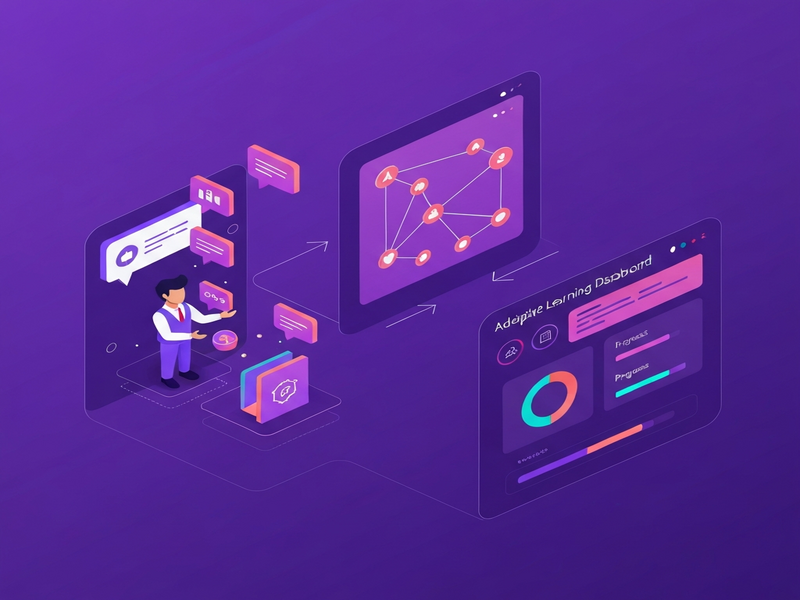
Online education offers unprecedented scalability and accessibility, yet it often suffers from low engagement and limited long‑term learning effectiveness. The paper “Towards Sustainable Learning in Online Education: A Reinforcement Learning Approach” introduces AI‑Tutor, a reinforcement‑learning based model designed to promote sustainable learning by jointly optimizing short‑term knowledge acquisition and long‑term learner motivation.
Key Contributions
- Integration of cognitive theory with reinforcement learning to balance new knowledge acquisition and reinforcement of prior learning.
- Modeling of learner engagement dynamics to sustain motivation and reduce dropout rates.
- Empirical evaluation on 23 million learning records from 33 700 learners, demonstrating superior performance over state‑of‑the‑art baselines in engagement, knowledge retention, and final outcomes.
- Detailed learning‑path analyses revealing adaptive strategies for diverse learner profiles.
Methodology Overview
AI‑Tutor frames the learning process as a Markov Decision Process (MDP) where the state captures the learner’s current knowledge state, engagement level, and contextual factors. The action space consists of pedagogical interventions (e.g., content recommendation, spaced repetition prompts, motivational nudges). A reward function jointly optimizes immediate knowledge gain and long‑term engagement metrics, enabling the system to learn policies that adapt to individual learner trajectories.
Results & Impact
The extensive experiments reveal that AI‑Tutor consistently outperforms baseline methods across three core metrics:
- Engagement: 18 % increase in active session duration.
- Knowledge Retention: 22 % higher post‑test scores after a 4‑week interval.
- Learning Outcomes: 15 % improvement in final course completion rates.
These findings underscore the potential of reinforcement‑learning driven personalization to foster sustainable learning ecosystems.
Practical Implications for ubos.tech
Implementing AI‑Tutor within the UBOS learning platform can unlock the following benefits:
- Adaptive learning pathways that keep learners motivated.
- Data‑driven insights for educators via the Analytics Dashboard.
- Scalable personalization without manual curriculum redesign.
Conclusion
The reinforcement‑learning approach presented in the paper offers a robust framework for achieving sustainable learning in large‑scale online education. By aligning short‑term instructional decisions with long‑term learner success, AI‑Tutor sets a new benchmark for adaptive, human‑centered educational technology.
For more information on integrating AI‑Tutor into your solutions, visit our Contact page or explore the Blog for related case studies.
Andrii Bidochko
CTO UBOS
Andrii Bidochko is an AI entrepreneur and researcher focused on AI agents, reinforcement learning, and autonomous systems. He writes about the technologies shaping the future of machine intelligence, from frontier models and agent architectures to real-world AI applications.