

- Updated: August 16, 2026
- 6 min read
BEST-KAG: Enhancing Question Answering of Building Engineering Standards with Multimodal Knowledge Graph Modeling and Large Language Model
Direct Answer
BEST‑KAG introduces a multimodal knowledge‑graph‑driven framework that lets large language models answer clause‑level questions about building engineering standards with traceable evidence. By unifying textual, tabular, and diagrammatic information into a single graph and coupling it with a retrieval‑augmented generation pipeline, the system dramatically improves accuracy and interpretability for compliance‑focused AI assistants.
Background: Why This Problem Is Hard
Construction standards—such as fire safety codes, structural load tables, and energy‑efficiency regulations—are massive, hierarchical documents that blend prose, tables, and schematic drawings. Professionals spend hours navigating cross‑references, interpreting ambiguous clauses, and manually stitching together evidence to answer compliance questions. Existing AI‑assisted workflows typically rely on keyword search or plain‑text retrieval, which suffer from three fundamental shortcomings:
- Fragmented knowledge representation: Text‑only indexes cannot capture the relational semantics between clauses, tables, and diagrams, leading to missed connections during reasoning.
- Limited multi‑clause reasoning: Real‑world queries often require aggregating information from several non‑adjacent sections; keyword retrieval returns isolated snippets without context.
- Untraceable answers: Current LLM‑based QA systems generate fluent responses but provide no clause‑level citations, making it impossible for auditors to verify compliance claims.
These gaps matter because construction projects are high‑risk, high‑cost endeavors where a single misinterpretation can trigger costly rework, legal penalties, or safety hazards. As AI agents become more prevalent in enterprise compliance, the need for a system that can reason over the full multimodal fabric of standards—and surface the exact source clauses—has become urgent.
What the Researchers Propose
The authors present BEST‑KAG (Knowledge‑Augmented Generation for Building Engineering Standards), a three‑layer architecture designed to bridge the gap between raw standards and trustworthy AI answers:
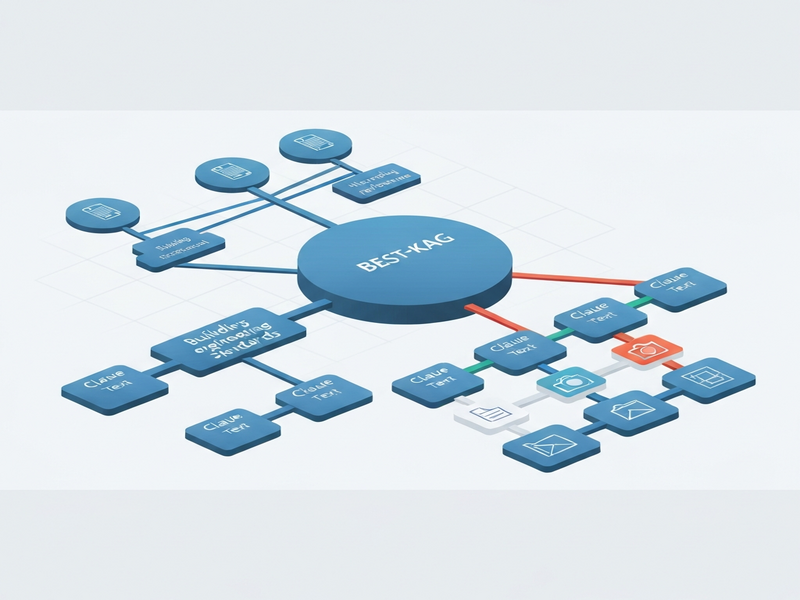
- Multimodal Knowledge Graph (MKG): A unified graph that encodes the hierarchical structure of each standard (parts, sections, clauses) together with heterogeneous nodes for tables, figures, and cross‑references.
- Rule‑LLM Hybrid Construction Pipeline: A scalable extraction workflow that combines deterministic rule‑based parsers (for tables, figure captions, and clause identifiers) with a large language model that resolves ambiguous language and extracts semantic relations.
- Graph‑Retrieval‑Based Knowledge‑Augmented Generation (GR‑KAG): An inference engine that first retrieves a subgraph relevant to a user query, then feeds the retrieved context into a LLM to generate a clause‑grounded answer, complete with citations.
Each component plays a distinct role: the MKG acts as a persistent, queryable knowledge base; the hybrid pipeline ensures the graph stays up‑to‑date as new standards are released; and the GR‑KAG layer provides the natural‑language interface while preserving traceability.
How It Works in Practice
The end‑to‑end workflow can be broken down into four conceptual steps:
1. Ingestion & Normalization
Raw PDF or HTML versions of standards are fed into a preprocessing module that extracts structural markers (e.g., “Section 3.2.1”, table numbers, figure legends). Rule‑based parsers handle deterministic patterns such as numeric tables, while a LLM interprets free‑form prose to identify implicit relationships (e.g., “as specified in Clause 5.4”).
2. Graph Construction
The extracted entities become nodes in the MKG. Edges encode:
- Hierarchical containment (standard → part → clause).
- Cross‑clause references (Clause A ↔ Clause B).
- Semantic links (table ↔ clause, figure ↔ clause).
Because the pipeline is hybrid, deterministic rules guarantee high precision for well‑structured elements, while the LLM adds recall for ambiguous or context‑dependent links.
3. Query‑Driven Subgraph Retrieval
When a user asks, “What fire‑resistance rating is required for exterior walls in high‑rise buildings?”, the system first transforms the natural‑language query into a set of graph‑search predicates (e.g., topic=fire‑resistance AND building_type=high‑rise). A graph engine then extracts the minimal subgraph that satisfies these predicates, typically spanning multiple clauses and associated tables.
4. Knowledge‑Augmented Generation
The retrieved subgraph is serialized into a concise context block (including clause numbers, table excerpts, and figure captions) and passed to a LLM (e.g., GPT‑4 or Claude). The model generates a fluent answer and appends explicit citations like “See Clause 4.3.2 and Table 4‑1”. This “grounded generation” ensures that every factual claim can be traced back to a specific node in the MKG.
What sets BEST‑KAG apart is the tight coupling between graph retrieval and generation: the LLM never operates on the full corpus, reducing hallucination risk, while the graph guarantees that the answer is anchored to the original standard.
Evaluation & Results
The researchers evaluated BEST‑KAG on a benchmark of 250 real‑world compliance questions drawn from construction firms and regulatory agencies. They compared three configurations:
- Baseline LLMs (GPT‑4, Claude, LLaMA) using plain‑text retrieval.
- BEST‑KAG without graph grounding (i.e., only the hybrid pipeline, no retrieval).
- Full BEST‑KAG (graph retrieval + knowledge‑augmented generation).
Key findings include:
- Expert Evaluation: Human judges rated answers from BEST‑KAG as “accurate and traceable” 74 % more often than the best baseline LLM.
- BLEU & ROUGE Improvements: BEST‑KAG achieved a BLEU increase of up to 0.42 and ROUGE‑L gains of 0.38 over plain‑text LLMs, indicating better lexical overlap with reference answers.
- Hallucination Reduction: The rate of unsupported claims dropped from 18 % (baseline) to 3 % with the graph‑augmented approach.
- Scalability: The constructed MKG spans 251 standards, 171,652 nodes, and 310,914 edges, demonstrating that the pipeline can handle nation‑wide code libraries.
These results collectively show that grounding LLM output in a multimodal knowledge graph not only boosts raw performance metrics but also delivers the auditability that compliance professionals demand.
Why This Matters for AI Systems and Agents
For AI practitioners building enterprise agents, BEST‑KAG offers a concrete blueprint for marrying symbolic knowledge structures with generative models. The approach addresses two perennial challenges:
- Reliability: By constraining generation to retrieved graph nodes, agents can provide verifiable answers, a prerequisite for regulated industries such as construction, finance, and healthcare.
- Modularity: The rule‑LLM hybrid pipeline can be swapped for domain‑specific parsers, enabling rapid adaptation to new standards without retraining the entire LLM.
Practically, a compliance‑focused AI assistant built on BEST‑KAG could be integrated into existing workflows through the UBOS platform overview, allowing teams to query standards via chat, voice, or API. The Workflow automation studio can orchestrate the retrieval‑generation loop, while the Enterprise AI platform by UBOS ensures secure, multi‑tenant deployment for large construction firms.
What Comes Next
Despite its strong performance, BEST‑KAG leaves several avenues open for future research:
- Dynamic Standard Updates: Standards evolve annually; incremental graph updates and version‑control mechanisms are needed to keep the MKG current without full re‑ingestion.
- Cross‑Domain Fusion: Integrating related domains (e.g., environmental impact assessments, cost estimation) could enable multi‑objective compliance queries.
- Explainable Retrieval: Visualizing the subgraph path that led to an answer would further enhance trust for auditors.
- Low‑Resource Languages: Extending the pipeline to non‑English standards would broaden global applicability.
Developers interested in prototyping these extensions can start with the Chroma DB integration for vector‑based graph storage, or explore the OpenAI ChatGPT integration to experiment with different LLM back‑ends.
References
For a complete technical description, see the original BEST‑KAG paper.
Andrii Bidochko
CTO UBOS
Andrii Bidochko is an AI entrepreneur and researcher focused on AI agents, reinforcement learning, and autonomous systems. He writes about the technologies shaping the future of machine intelligence, from frontier models and agent architectures to real-world AI applications.