

- Updated: August 15, 2026
- 6 min read
Dynamic Governance of Multi-LLM Agent Systems for Collaborative Conversational Outcomes
Direct Answer
The paper introduces the Experience Orchestrator (EO), a control‑theoretic governance layer that coordinates multiple large language model (LLM) agents toward a shared conversational outcome. By embedding a contextual bandit, a PID controller, and a POMDP belief tracker, EO lifts high‑intent advisor‑contact rates by more than 30 percentage points in a simulated financial‑services scenario, demonstrating that dynamic governance can replace an explicit joint goal function.
Background: Why This Problem Is Hard
Enterprises increasingly deploy pairs or clusters of LLM agents—customer‑facing bots, internal assistants, and recommendation engines—to handle complex, multi‑turn dialogues. When each agent pursues its own objective (e.g., a “site” agent trying to push a service, a “visitor” agent modeling user resistance), the interaction often collapses:
- Goal misalignment: Without a shared utility, agents default to self‑preserving strategies, causing premature termination.
- Turn‑level volatility: LLMs generate stochastic outputs; small phrasing changes can swing the conversation dramatically.
- Feedback latency: Real‑world web analytics provide delayed signals, making it hard to adapt in real time.
Current mitigation tactics—prompt engineering, static rule‑sets, or single‑agent reinforcement learning—address only one side of the problem. They cannot guarantee that two independently trained agents will converge on a mutually beneficial trajectory, especially when one agent must simulate realistic user resistance. This gap limits the scalability of AI‑driven conversational commerce, customer support, and advisory services.
What the Researchers Propose
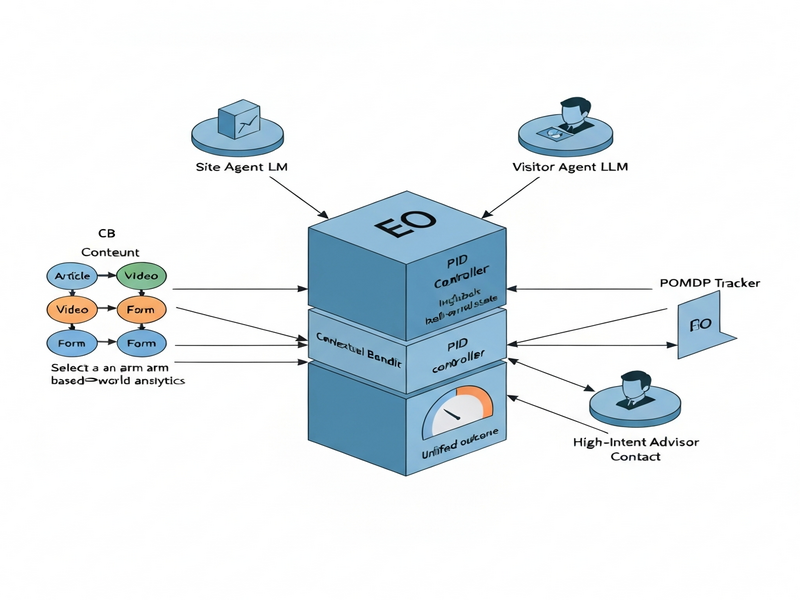
The authors propose a three‑pronged governance framework called the Experience Orchestrator (EO). EO sits between the agents and the environment, continuously shaping the dialogue path without altering the underlying LLM weights. Its core components are:
- Contextual Bandit (CB) selector: Chooses from a catalog of pre‑validated content “arms” (e.g., headline variations, call‑to‑action snippets) based on real‑world web‑analytics priors.
- PID (Proportional‑Integral‑Derivative) controller: Enforces behavioral consistency by dynamically adjusting schema constraints such as tone, formality, and compliance limits.
- POMDP belief tracker: Maintains a probabilistic estimate of the visitor’s latent intent, updating beliefs after each turn using observed token probabilities and meta‑features.
Collectively, these modules replace the missing joint goal function with a feedback loop that nudges both agents toward a target conversion metric while preserving the illusion of a natural, resistant user.
How It Works in Practice
Imagine a financial‑services website where a “site” LLM greets a visitor and a “visitor” LLM simulates a skeptical user. EO orchestrates the exchange as follows:
- Initialization: EO loads a set of content arms derived from historic click‑through data (e.g., “Speak to an advisor now,” “Learn more about rates”). The PID controller establishes baseline constraints (e.g., maximum three persuasive statements per minute).
- Turn 1 – Site Agent: The site LLM proposes a greeting. EO intercepts the output, maps it to the nearest content arm, and feeds the selected arm back to the site agent as a soft prompt.
- Turn 2 – Visitor Agent: The visitor LLM generates a resistance statement. EO’s belief tracker updates the probability distribution over intent states (e.g., “curious,” “skeptical,” “ready”).
- Feedback Loop: Based on the updated belief, the CB selects the next arm that maximizes expected conversion while respecting PID‑enforced constraints. The PID controller also adjusts the “aggressiveness” parameter if the visitor shows increasing resistance.
- Iterative Convergence: This cycle repeats for up to ten turns. EO continuously refines the belief state and arm selection, steering the dialogue toward a high‑intent advisor‑contact outcome without any single agent “knowing” the final goal.
The key differentiator is that EO does not rewrite the LLMs’ internal policies; it merely modulates the context and constraints in real time, allowing each agent to remain autonomous while still cooperating toward a measurable business KPI.
Evaluation & Results
The authors evaluated EO in a high‑fidelity simulation of a financial‑services landing page. They ran 60,000 conversation episodes, comparing three configurations:
- Naïve LLM control: Two agents interact without any governance layer.
- EO with full stack (CB + PID + POMDP): The proposed system.
- Ablation variants: EO with one component disabled to isolate contribution.
Key findings include:
- Conversion lift: High‑intent advisor contact rose from 46.1 % (naïve) to 78.1 % with EO—a 32‑point improvement.
- Component impact: The contextual bandit accounted for 97 % of outcome variance, confirming that strategic content selection drives most of the gain.
- Persona regimes: For visitors with low baseline intent, EO was the decisive factor that turned a non‑functional dialogue into a successful conversion. For already‑aligned visitors, a simple empathetic LLM performed comparably.
All experiments were conducted in a fully simulated LLM‑to‑LLM environment, ensuring reproducibility while acknowledging that real‑human unpredictability remains an open variable.
Why This Matters for AI Systems and Agents
Dynamic governance addresses a fundamental scalability bottleneck for enterprises that rely on conversational AI:
- Modular orchestration: EO demonstrates that a thin, external layer can harmonize heterogeneous agents without retraining them, reducing engineering overhead.
- Business‑level KPIs: By tying governance decisions to measurable outcomes (e.g., advisor contact), organizations can directly align AI behavior with revenue goals.
- Risk mitigation: The PID controller enforces compliance constraints in real time, helping firms meet regulatory standards for financial advice.
- Reusability across domains: The same governance stack can be repurposed for e‑commerce checkout flows, HR onboarding bots, or health‑care triage systems.
Practically, teams building AI marketing agents can plug EO‑style controllers into existing pipelines to boost conversion without rewriting prompts. Large enterprises can leverage the Enterprise AI platform by UBOS to host the governance services at scale, while the Workflow automation studio offers a visual interface for defining content arms and constraint policies. For early‑stage ventures, the UBOS for startups program provides sandbox environments to experiment with multi‑agent orchestration before committing to production resources.
What Comes Next
While the simulation results are compelling, several open challenges remain:
- Human‑in‑the‑loop validation: Real users exhibit non‑stationary behavior, emotional nuance, and multi‑modal inputs (voice, video). Calibrating the PID controller against live traffic is essential.
- Scalability of belief tracking: The POMDP model grows with the number of intent dimensions. Future work could explore hierarchical belief representations or neural belief networks.
- Cross‑domain transfer: Adapting the content‑arm library to new industries (e.g., healthcare) will require domain‑specific analytics pipelines.
Potential next steps for practitioners include:
- Deploying a pilot on the UBOS solutions for SMBs to test EO in a live e‑commerce setting.
- Exploring pricing models that reflect the added value of governance, using the UBOS pricing plans as a reference.
- Integrating specialized agents such as Openclaw (Clawdbot, MoltBot) to enrich the content‑arm catalog with domain‑specific expertise.
In summary, the Experience Orchestrator offers a pragmatic pathway to turn multi‑LLM chaos into coordinated, outcome‑driven conversations. As enterprises continue to layer more autonomous agents into their digital front doors, dynamic governance will likely become a standard architectural component rather than an experimental add‑on.
For a deeper dive into the methodology and raw data, consult the original arXiv paper.
Andrii Bidochko
CTO UBOS
Andrii Bidochko is an AI entrepreneur and researcher focused on AI agents, reinforcement learning, and autonomous systems. He writes about the technologies shaping the future of machine intelligence, from frontier models and agent architectures to real-world AI applications.