

- Updated: August 14, 2026
- 7 min read
DragonCrawl: A Generative, Intent-Based Framework for Scalable Mobile End-to-End Testing
Direct Answer
DragonCrawl is an AI‑driven, intent‑based framework that automates mobile end‑to‑end (E2E) regression testing by using large language models (LLMs) to generate, execute, and validate user flows on every code change. It matters because it replaces brittle, manually scripted UI tests with a scalable, self‑healing system that cuts onboarding time from days to hours and delivers >90% pass rates across iOS and Android in production CI/CD pipelines.
Background: Why This Problem Is Hard
Mobile applications have become multi‑layered ecosystems where UI components, backend services, and third‑party SDKs evolve in lockstep. Traditional E2E testing frameworks—often built on record‑and‑playback tools like Appium or Espresso—suffer from three inter‑related pain points:
- UI volatility: Small visual changes (e.g., a button label or layout shift) break selectors, causing test flakiness and massive maintenance overhead.
- Cross‑platform divergence: Maintaining parallel test suites for iOS and Android doubles effort, while platform‑specific quirks (gesture handling, permission dialogs) require bespoke code.
- Regression bottleneck: Continuous integration pipelines must run hundreds of tests on every pull request; flaky or slow tests delay releases and erode developer confidence.
Existing AI‑augmented testing research has focused on exploratory testing—using LLMs to discover crashes or generate random UI interactions. While valuable for finding edge‑case bugs, those approaches do not guarantee that critical user journeys (e.g., checkout flow, authentication) remain functional after each commit. Consequently, teams still rely on fragile scripted tests to protect core functionality, creating a paradox where AI helps find bugs but cannot reliably prevent regressions.
What the Researchers Propose
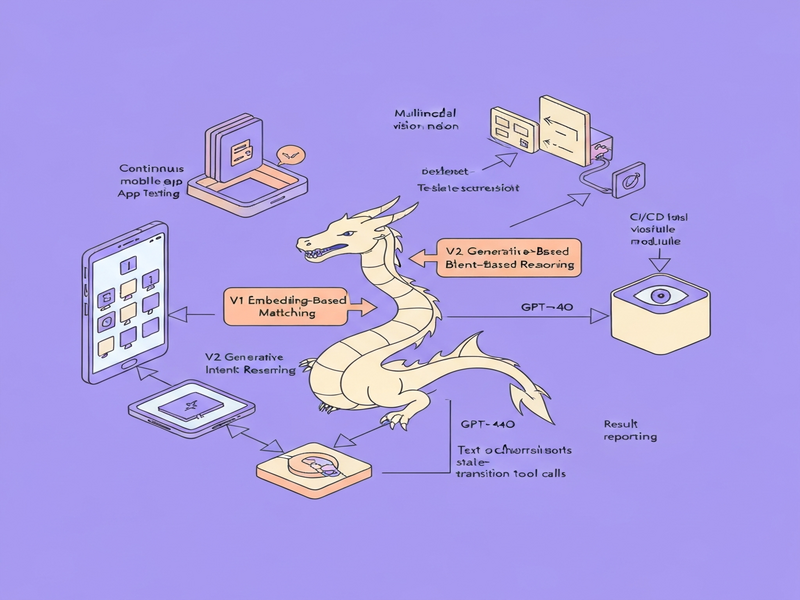
DragonCrawl introduces a two‑stage, intent‑centric architecture that reframes mobile testing as a reasoning problem rather than a pattern‑matching problem. The framework consists of three logical agents:
- Intent Extractor: Uses multimodal GPT‑4o to read design specifications, user stories, or screenshots and distill them into high‑level intents such as “log in”, “add item to cart”, or “sync data”.
- Test Generator: Takes the intents and, via chain‑of‑thought prompting, synthesizes step‑by‑step UI actions, including gestures, text entry, and conditional branching. The generator also calls external tools (e.g., device emulators, backend APIs) to set up preconditions.
- Validator & Orchestrator: Executes the generated script on real or virtual devices, captures multimodal evidence (screenshots, accessibility trees), and uses vision‑enabled LLMs to compare the observed end state against the expected intent.
Crucially, DragonCrawl moves away from static embedding similarity (its V1) toward generative reasoning (V2). Instead of matching a new UI screen to a stored vector, the system asks “What does the user expect to see after this intent?” and lets the LLM answer, making the test resilient to visual changes.
How It Works in Practice
Conceptual Workflow
The end‑to‑end pipeline can be visualized as a loop that runs on every pull request:
- Change Detection: CI/CD detects a new commit affecting the mobile codebase.
- Intent Refresh: The Intent Extractor re‑parses updated UI mockups or storybook entries, producing a refreshed intent catalog.
- Script Synthesis: For each intent, the Test Generator creates a deterministic script, optionally invoking tool‑calling APIs to seed backend state (e.g., create a test user, preload a cart).
- Execution Engine: Scripts are dispatched to device farms (real devices or emulators). Each action is logged, and visual frames are streamed back.
- Multimodal Validation: The Validator feeds screenshots and UI hierarchies into GPT‑4o’s vision model, which answers “Did the final screen satisfy the intent?” If the answer is negative, the orchestrator flags the commit and surfaces a concise failure report.
- Self‑Healing Loop: When a failure is due to UI selector drift, the system attempts an automatic selector rewrite using the LLM’s understanding of the new layout, reducing manual triage.
Key Differentiators
- Generative Intent Reasoning: By asking “what should happen” instead of “does this pixel match”, the framework tolerates UI redesigns.
- Multimodal Vision Integration: GPT‑4o’s image understanding enables end‑state verification without hard‑coded assertions.
- Tool‑Calling for Backend State: The system can invoke REST endpoints or database fixtures directly from the LLM prompt, bridging UI actions with server‑side conditions.
- Scalable CI/CD Integration: Tests run in parallel across device farms, and the orchestrator aggregates results into a single pass/fail badge for each PR.
Evaluation & Results
To validate the approach, the authors deployed DragonCrawl on two large‑scale mobile products (one iOS‑only, one Android‑only) over a six‑month period. The evaluation focused on three dimensions:
Test Coverage & Pass Rate
Across 1,013 generated tests covering core user journeys, the system achieved a 91.6% pass rate on iOS and 92.2% on Android. Importantly, the pass rate remained stable as UI designs evolved, demonstrating resilience to visual churn.
Onboarding & Maintenance Efficiency
Initial test suite creation, which traditionally required 96–120 hours of manual scripting, was reduced to under 4 hours using the intent‑based generator. Over the study period, the team logged an estimated 27 developer‑years saved in test maintenance, a figure derived from the average time spent fixing flaky tests in comparable projects.
Resource Utilization
Token explosion—a common LLM bottleneck—was mitigated by chunking intents and employing a hierarchical prompting strategy. Memory constraints on the vision model were addressed by down‑sampling screenshots to 720p before inference, preserving enough detail for state verification while keeping latency under 2 seconds per frame.
Collectively, these results illustrate that an intent‑driven, generative testing pipeline can replace brittle scripted suites without sacrificing coverage or speed.
Why This Matters for AI Systems and Agents
DragonCrawl showcases a concrete pattern for turning LLMs into autonomous test agents that reason about system behavior, not just generate text. For AI practitioners, the framework provides a blueprint for:
- Agent‑Centric Orchestration: The three‑agent design (extractor, generator, validator) can be repurposed for other domains such as API contract testing or robotic process automation.
- Closed‑Loop Feedback: By feeding validation results back into the generation step, the system embodies a self‑correcting loop—a hallmark of robust autonomous agents.
- Multimodal Grounding: Leveraging vision models for state verification bridges the gap between textual intent and visual UI, a capability increasingly relevant for agents that must interact with GUIs.
- Scalable CI Integration: Embedding LLM‑driven agents directly into CI pipelines demonstrates that generative AI can operate at production scale, a milestone for enterprise AI adoption.
Organizations looking to embed AI into their quality‑assurance workflows can draw on DragonCrawl’s architecture to accelerate release cycles while maintaining high confidence in product stability. For teams already using the UBOS platform overview, DragonCrawl’s intent‑based approach aligns naturally with UBOS’s low‑code workflow automation capabilities, enabling rapid composition of test pipelines without deep programming expertise.
What Comes Next
Despite its successes, DragonCrawl leaves several open challenges:
- Token Efficiency: Even with hierarchical prompting, large intents can exceed model context windows. Future work may explore retrieval‑augmented generation or specialized fine‑tuned models.
- Cross‑Device Consistency: While the current system validates on a single device type per run, extending validation to a matrix of screen sizes and OS versions remains an engineering hurdle.
- Security & Privacy: Automated tool‑calling to backend services must respect authentication scopes and data protection policies, especially in regulated industries.
- Explainability: Providing developers with human‑readable rationales for why a test failed (beyond “intent not satisfied”) will improve trust and adoption.
Addressing these gaps could unlock broader applications such as:
- Continuous compliance testing for fintech and health‑tech mobile apps.
- Automated UI regression for low‑code app builders, where UI changes are frequent.
- Integration with Workflow automation studio to let non‑technical product owners define intents via natural language.
Developers interested in experimenting with generative intent testing can start by exploring the Enterprise AI platform by UBOS, which offers built‑in LLM orchestration, device farm connectors, and secure tool‑calling APIs—all the building blocks needed to prototype a DragonCrawl‑style pipeline.
References
For a complete technical description, see the original preprint: DragonCrawl paper on arXiv.
Ready to modernize your mobile testing strategy? Contact UBOS today to discuss how AI‑driven regression can accelerate your release pipeline.
Andrii Bidochko
CTO UBOS
Andrii Bidochko is an AI entrepreneur and researcher focused on AI agents, reinforcement learning, and autonomous systems. He writes about the technologies shaping the future of machine intelligence, from frontier models and agent architectures to real-world AI applications.