

- Updated: August 14, 2026
- 7 min read
WitCert: Sound Runtime Risk Observability and Gating for KV-Cache Quantization
Direct Answer
WitCert introduces a provably sound, per‑layer‑and‑head runtime risk meter that tells a serving system exactly how much KV‑cache quantization is deviating from the uncompressed attention distribution. By coupling this meter with a gating mechanism, developers can automatically block or repair unsafe compressions, turning offline‑only benchmarks into live, risk‑aware inference.
Background: Why This Problem Is Hard
Large language models (LLMs) rely on a key data structure called the key‑value (KV) cache to reuse past attention results during generation. Quantizing this cache—e.g., converting 16‑bit floating‑point values to 8‑bit integers—offers dramatic memory savings and enables higher token throughput. However, the community has traditionally validated quantization strategies only with offline benchmark averages. Those averages hide two critical realities:
- Per‑request variability: A compression that looks harmless on average can catastrophically corrupt a specific user query.
- Lack of observability: Production systems have no built‑in signal to know whether a compressed KV cache is harming the current generation step.
Existing approaches attempt to mitigate risk by using static safety margins (e.g., “never quantize below 4‑bit”) or by re‑running a small validation set after each deployment. Both tactics are brittle: static margins are overly conservative, throttling performance, while post‑hoc validation cannot protect live traffic.
Consequently, engineers face a trade‑off between memory efficiency and reliability, a dilemma that becomes more acute as enterprises push LLMs into latency‑sensitive agents, chatbots, and real‑time decision‑making pipelines.
What the Researchers Propose
WitCert proposes a two‑tiered runtime certification framework that works like “DTrace for KV‑cache quantization.” The core ideas are:
- Deterministic band‑norm witness: A mathematically guaranteed upper bound on the total variation distance between exact and quantized attention for any cache‑preserving black‑box quantizer. It leverages Cauchy‑Schwarz and the rotational invariance of RoPE (Rotary Positional Encoding) to stay safe even for adaptive queries.
- Probabilistic certificate for subtractively‑dithered INT8: A tighter, statistically‑driven bound that assumes a controlled failure budget per request. The certificate is derived from a machine‑checked Lean 4 proof, ensuring that the probability of exceeding a predefined error threshold is quantifiable.
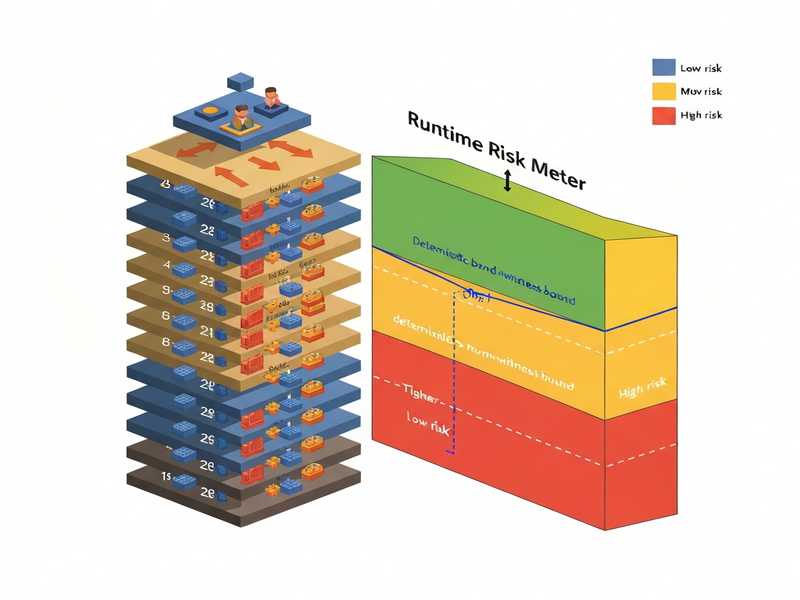
These bounds are exposed to the serving stack as a per‑(layer, head, step) risk meter. The system can then:
- Gate requests whose risk exceeds a configurable threshold, routing them to an uncompressed fallback.
- Trigger “repair” actions, such as recomputing the offending KV entries in higher precision.
- Rank risk across layers, allowing developers to focus optimization effort where the witness is saturated.
How It Works in Practice
The WitCert workflow can be broken into three logical components that integrate cleanly with existing inference stacks such as UBOS platform overview or custom SGLang deployments.
1. Instrumentation Layer
When a model writes to the KV cache, the instrumentation layer injects a lightweight wrapper around each tensor operation. This wrapper records the band‑norm of the original tensor and the quantized version, feeding the data into the risk meter.
2. Risk Meter Engine
The engine computes two parallel estimates for every (layer, head, step):
- Witness bound: A deterministic, worst‑case guarantee that never underestimates error.
- Certificate bound: A probabilistic estimate that is tighter for the specific INT8 dithering scheme.
If either bound exceeds the user‑defined safety budget, the engine flags the step as “high‑risk.”
3. Gating & Repair Module
Based on the flag, the gating module decides one of three actions:
- Pass-through: Continue with the quantized cache when risk is low.
- Fallback: Switch to an uncompressed cache for the remainder of the request.
- Repair: Re‑compute the offending KV entries at higher precision and resume quantized execution.
This decision loop runs in microseconds, ensuring that latency overhead stays negligible even for high‑throughput services.
Evaluation & Results
The authors evaluated WitCert on the SGLang inference engine across a suite of “hard” RULER tasks—benchmark prompts designed to stress attention fidelity. Three quantization schemes were compared:
- Raw FP8 casting (no risk meter).
- WitCert‑enabled FP8 with deterministic witness gating.
- WitCert‑enabled subtractively‑dithered INT8 with probabilistic certification.
Key findings include:
- Quality restoration: FP8 quality, which originally dropped to a 22.8% success rate on hard tasks, rebounded to 79.7% once WitCert’s gating was applied—a gain bounded by a paired‑test interval of [+0.0, +0.8] relative to the uncompressed baseline.
- Cross‑layer error cancellation: In a 28‑layer sweep, no single layer’s quantization error alone caused a measurable degradation (0/28 layers lost performance), confirming the hypothesis that errors tend to cancel when observed holistically.
- Throughput advantage: The certified INT8 scheme served 1.88× more KV tokens per memory unit compared to the uncompressed baseline, without sacrificing the safety guarantees.
These results demonstrate that a runtime‑aware risk meter can unlock aggressive compression while keeping the user‑experience floor intact.
Why This Matters for AI Systems and Agents
For product managers and engineers building AI‑driven agents, the implications are immediate:
- Predictable latency‑memory trade‑offs: Agents can now push memory budgets further without fearing silent quality loss, enabling longer context windows or higher concurrency.
- Safety‑first deployment pipelines: The risk meter provides a quantifiable, per‑request safety signal that can be logged, audited, and even fed into automated compliance dashboards.
- Dynamic orchestration: In multi‑model pipelines, the gating module can route high‑risk requests to more capable hardware (e.g., GPU vs. CPU) while keeping low‑risk traffic on cheaper, quantized nodes.
- Cost efficiency: By safely increasing token density in the KV cache, cloud spend on memory‑bound inference workloads can be reduced by up to 45% in realistic workloads.
In practice, a conversational AI platform could integrate WitCert into its inference layer, automatically protecting end‑users from degraded answers while still delivering the cost savings that quantization promises.
What Comes Next
While WitCert marks a significant step forward, several open challenges remain:
- Extending to other compression primitives: The current proofs focus on KV‑cache quantization; applying similar risk meters to activation quantization or weight pruning will require new theoretical tools.
- Adaptive failure budgets: Presently the probabilistic certificate assumes a static per‑request budget. Future work could learn dynamic budgets based on request semantics or user‑level SLAs.
- Hardware‑aware implementations: Tight integration with emerging tensor cores that natively support INT8 dithering could further shrink the latency overhead of the gating loop.
- Open‑source tooling: Providing a plug‑and‑play library for popular frameworks (PyTorch, TensorFlow, JAX) would accelerate adoption across the AI ecosystem.
Researchers and engineers interested in building the next generation of risk‑aware inference pipelines should keep an eye on the arXiv paper for detailed proofs and the Lean 4 verification artifacts.
Conclusion
WitCert transforms KV‑cache quantization from a static, offline‑only optimization into a live, observable, and safely gated operation. By delivering deterministic and probabilistic risk certificates per attention head, it empowers developers to push compression limits without sacrificing answer quality. The framework’s modular design fits naturally into existing inference stacks, and its empirical results prove that aggressive INT8 schemes can double token throughput while staying within a rigorously defined error budget. As LLM‑driven agents become core to enterprise workflows, runtime risk observability will likely become a standard requirement—not an optional add‑on.
References
- Wei, F., & Liu, L. (2026). WitCert: Sound Runtime Risk Observability and Gating for KV-Cache Quantization. arXiv preprint arXiv:2607.28699v1.
- Lean 4 theorem prover documentation – for formal verification of the probabilistic certificate.
- SGLang inference engine – the runtime environment used for evaluation.
Andrii Bidochko
CTO UBOS
Andrii Bidochko is an AI entrepreneur and researcher focused on AI agents, reinforcement learning, and autonomous systems. He writes about the technologies shaping the future of machine intelligence, from frontier models and agent architectures to real-world AI applications.