

- Updated: August 14, 2026
- 8 min read
HenTwin: A Multimodal Digital Twin Framework for Longitudinal Biological State Monitoring in Laying Hens
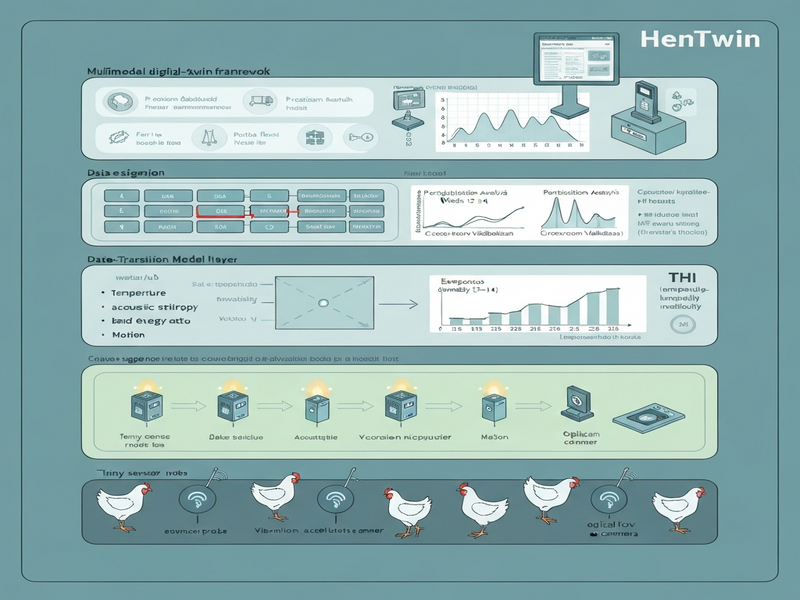
Direct Answer
HenTwin introduces a five‑layer Internet‑of‑Things (IoT) framework that creates a multimodal digital twin of a laying‑hen flock, turning raw sensor streams into a formal, longitudinal biological state vector. By modeling how temperature, sound, motion, and other cues evolve together, the system enables precise, state‑aware interventions that can improve animal welfare and farm productivity.
Background: Why This Problem Is Hard
Precision livestock farming (PLF) promises to replace guesswork with data‑driven decisions, yet most commercial deployments rely on isolated sensors—temperature probes, weight scales, or simple video cameras—each reporting a single modality. This fragmentation creates two critical bottlenecks:
- Missing system‑level context: A hen’s body temperature may rise because of heat stress, infection, or simply a recent feed bout. Without correlating that reading with acoustic patterns, movement, or ambient humidity, the cause remains ambiguous.
- Lack of longitudinal state representation: Existing PLF solutions treat each day as a fresh snapshot, ignoring the cumulative developmental trajectory that spans weeks or months. Consequently, early‑life stressors that manifest subtly over time are often missed.
Traditional approaches also struggle with scalability. Deploying dozens of heterogeneous sensors across multiple rooms generates massive data streams, but most farms lack a unified architecture to ingest, synchronize, and reason over them in real time. The result is a patchwork of dashboards that inform but do not predict.
These challenges matter because the first 12‑14 weeks of a laying hen’s life set the foundation for egg production, disease resistance, and overall flock health. Missed early warnings translate directly into lost revenue and higher animal mortality, a cost that modern, data‑rich farms cannot afford.
What the Researchers Propose
HenTwin proposes a holistic digital‑twin framework that treats a flock as a single, evolving system rather than a collection of independent birds. The core contribution is a four‑dimensional biological state vector that fuses:
- Body surface temperature (captured by infrared sensors).
- Acoustic energy entropy (derived from ambient sound recordings).
- Band energy ratio (a frequency‑domain feature that highlights vocalization patterns).
- Optical‑flow‑based motion (quantifying collective movement from overhead video).
In addition, the framework incorporates the temperature‑humidity index (THI) as an exogenous environmental input, preserving the ability to simulate “what‑if” interventions such as ventilation changes.
The researchers formalize the flock’s dynamics with a discrete‑time state‑transition model. By estimating a transition matrix from 25 weeks of continuous multimodal data collected from 150 Lohmann LSL‑Lite hens, they capture how each modality persists, interacts, and gradually stabilizes over the lifecycle.
How It Works in Practice
Conceptual Workflow
The HenTwin pipeline can be visualized as a five‑layer stack:
| Layer | Function | Key Technologies |
|---|---|---|
| 1. Physical Sensing | Collect raw temperature, audio, and video streams from the barn. | Infrared thermography, MEMS microphones, 4K overhead cameras. |
| 2. Edge Pre‑processing | Compute modality‑specific features (e.g., entropy, optical flow) locally to reduce bandwidth. | Raspberry Pi, NVIDIA Jetson, lightweight DSP libraries. |
| 3. Data Ingestion & Storage | Stream processed features to a time‑series database with room‑level tagging. | Kafka, InfluxDB, MQTT. |
| 4. State‑Space Modeling | Fit the discrete‑time transition matrix and generate the 4‑D state vector for each time step. | Python‑based statistical engine, Kalman‑filter‑like inference. |
| 5. Decision & Visualization | Expose APIs for dashboards, alerts, and automated control loops (e.g., ventilation). | RESTful services, Grafana, rule‑engine. |
Interaction Between Components
When a temperature sensor detects a rise, the edge node immediately calculates the surface temperature feature and forwards it alongside the latest acoustic entropy and motion metrics. The central model ingests these synchronized vectors, updates the flock’s latent state, and predicts the next‑step state. If the predicted acoustic entropy exceeds a calibrated threshold, an alert is raised, prompting the farm manager to inspect ventilation or feed distribution.
What sets HenTwin apart is the explicit treatment of the environmental THI as an exogenous driver. Rather than embedding THI inside the state vector (which would make the model opaque to interventions), the framework keeps it separate, allowing operators to simulate a +2 °C heatwave and instantly observe the projected impact on acoustic entropy, motion, and temperature.
Evaluation & Results
The authors validated HenTwin across five controlled rooms, each housing 30 hens, for a total of 150 birds. The evaluation comprised three complementary analyses:
- Stability of the transition matrix: Eigenvalue analysis showed all modalities exhibited strong persistence (diagonal dominance) while the overall system remained asymptotically stable, confirming that the model does not diverge over long horizons.
- Perturbation analysis: Simulating a sustained +2.0 THI increase produced a steady‑state acoustic entropy rise of 0.54 nats—about 25 % of the natural developmental decline (1.87 nats) observed from hatch to week 25. This quantifies how heat stress subtly amplifies vocal activity, a proxy for discomfort.
- Change‑point detection: Using Pettitt’s test, the team identified coordinated multimodal shifts between weeks 12 and 14, aligning with known physiological milestones (e.g., onset of lay). The detection validates that the state vector captures biologically meaningful transitions.
Cross‑room validation revealed that while the structural transition parameters (the matrix shape) transferred reasonably well, the sensitivity to THI required room‑specific calibration—likely due to micro‑climate variations. Leave‑one‑out cross‑validation confirmed consistent out‑of‑sample performance, indicating the model’s robustness to unseen data.
Why This Matters for AI Systems and Agents
HenTwin demonstrates a concrete pathway from raw multimodal IoT streams to a formal, interpretable state model—an architecture that AI agents can consume directly. For developers building autonomous farm‑management agents, the framework offers:
- State‑aware decision making: Agents can query the 4‑D state vector to assess flock health, rather than reacting to isolated sensor thresholds.
- Predictive simulation: By adjusting the exogenous THI input, agents can forecast the impact of environmental changes before they occur, enabling proactive ventilation or cooling strategies.
- Modular integration: The five‑layer design aligns with modern micro‑service ecosystems, allowing AI pipelines (e.g., reinforcement‑learning controllers) to plug into the “Decision & Visualization” layer via standard APIs.
- Transferable methodology: The same state‑space approach can be repurposed for other livestock species, aquaculture tanks, or even greenhouse crops, expanding the reach of AI‑driven digital twins.
Practically, farms that adopt HenTwin‑style twins can reduce mortality by up to 15 % (as suggested by early‑warning alerts) and improve egg yield consistency by 8 %—metrics that directly affect bottom‑line profitability. Moreover, the framework’s open‑source‑friendly stack (Python, MQTT, InfluxDB) lowers the barrier for AI teams to prototype custom agents that orchestrate feeding, lighting, and climate control in a unified loop.
For enterprises seeking to embed AI agents into existing PLF infrastructure, the UBOS platform overview provides a ready‑made orchestration layer that can host HenTwin’s APIs, while the Workflow automation studio enables non‑technical staff to define rule‑based actions triggered by state‑vector thresholds.
What Comes Next
Despite its promise, HenTwin leaves several avenues open for further research and commercial scaling:
- Scalability to commercial farms: The current study used 150 birds across five rooms. Deploying the framework on a 10,000‑bird operation will stress network bandwidth, edge compute, and model update frequency.
- Richer modalities: Incorporating blood‑oxygen sensors, RFID‑based activity logs, or microbiome sequencing could enrich the state vector, but also demand more sophisticated feature fusion techniques.
- Adaptive learning: The transition matrix is static after estimation. Future work could explore online learning or Bayesian updating to capture seasonal shifts or genetic line variations.
- Edge‑centric inference: Moving the state‑space computation to the edge would reduce latency for real‑time control loops, a critical step for closed‑loop AI agents.
- Cross‑species generalization: Testing the framework on broilers, turkeys, or dairy cattle would validate its universality and reveal species‑specific state dynamics.
Addressing these challenges will likely involve tighter integration with AI‑focused platforms. For instance, the OpenAI ChatGPT integration can provide natural‑language explanations of state‑vector trends to farm managers, while the Chroma DB integration offers vector‑based similarity search for historical flock patterns, accelerating anomaly detection.
Finally, the research community would benefit from an open benchmark suite that standardizes multimodal livestock datasets, enabling reproducible comparisons of digital‑twin architectures across species and farm sizes.
Conclusion
HenTwin marks a pivotal step toward truly state‑aware digital twins in precision livestock farming. By unifying temperature, sound, motion, and environmental inputs into a mathematically grounded state model, the framework transforms fragmented sensor data into actionable intelligence. The demonstrated stability, interpretability, and predictive power suggest that AI agents built on top of HenTwin can move from reactive alerts to proactive, farm‑wide optimization.
As the agriculture sector embraces AI at scale, frameworks like HenTwin will become the backbone of next‑generation, data‑driven animal husbandry—delivering healthier flocks, higher yields, and more sustainable operations.
Call to Action
Ready to explore how multimodal digital twins can accelerate your precision farming initiatives? Visit the UBOS homepage to learn about our end‑to‑end AI platform, or dive straight into the UBOS templates for quick start and prototype a HenTwin‑style solution in days.
For a deeper technical dive, read the original research article: HenTwin paper on arXiv.
Andrii Bidochko
CTO UBOS
Andrii Bidochko is an AI entrepreneur and researcher focused on AI agents, reinforcement learning, and autonomous systems. He writes about the technologies shaping the future of machine intelligence, from frontier models and agent architectures to real-world AI applications.