

- Updated: August 14, 2026
- 7 min read
ConnectED: A Curriculum-Aligned AI System for Vietnamese Instructional Lesson Planning and Student Learning
Direct Answer
ConnectED is a human‑centered AI system that automates the entire lesson‑planning lifecycle for Vietnamese K‑12 education, linking curriculum‑aligned design, interactive student learning, and data‑driven refinement. By embedding a Vietnamese‑specific large language model (VietEduQwen) within the ADDIE instructional framework, the platform cuts teacher preparation time from hours to minutes while preserving pedagogical rigor.
Background: Why This Problem Is Hard
Vietnam’s national curriculum is dense, regularly updated, and delivered in a language that has historically lagged behind English‑centric AI research. Teachers must translate official dispatches into classroom‑ready lesson plans, create assessment items, and adapt materials for diverse learner profiles—all under tight time constraints. Existing AI‑assisted authoring tools either operate in English, ignore local standards, or provide generic content that fails to meet the Ministry of Education’s strict alignment criteria. Moreover, most large language models (LLMs) are trained on multilingual corpora that under‑represent Vietnamese educational terminology, leading to factual inaccuracies, cultural mismatches, and unsafe student interactions.
These gaps manifest in three concrete bottlenecks:
- Curriculum misalignment: Automated generators often produce content that deviates from the prescribed learning outcomes, forcing teachers to spend additional hours editing.
- Lack of pedagogical safety: Generic LLMs can hallucinate facts or suggest inappropriate language, which is unacceptable in a classroom setting.
- Feedback loop scarcity: Traditional tools do not capture real‑time student performance data, preventing iterative improvement of instructional materials.
Addressing these challenges requires a solution that is simultaneously language‑aware, curriculum‑aware, and feedback‑aware—a combination that has been missing from prior research.
What the Researchers Propose
The authors introduce ConnectED, an end‑to‑end AI ecosystem that embeds a Vietnamese educational LLM (VietEduQwen) into the classic ADDIE instructional design cycle (Analysis, Design, Development, Implementation, Evaluation). Each phase is operationalized as a structured prompt template that both generates content and serves as a validation gate for teachers. The system’s core components are:
- VietEduQwen: A 7‑billion‑parameter LLM fine‑tuned on Vietnamese curricula, exam questions, and pedagogical guidelines, further refined through Direct Preference Optimization (DPO) to prioritize teacher‑approved outputs.
- Prompt orchestration engine: Encodes the ADDIE phases into reusable templates, ensuring that every generated artifact (learning objectives, lesson scripts, assessment items) complies with Official Dispatch No. 5512/BGDDT‑GDTrH.
- Teacher‑in‑the‑loop interface: Allows educators to review, edit, and approve each generation step before it proceeds, preserving human oversight.
- Student interaction layer: A web‑based learning environment where learners engage with AI‑driven exercises, producing fine‑grained performance signals.
- Feedback‑driven refinement module: Consumes student data to automatically suggest revisions to lesson components in the next ADDIE cycle.
By weaving these agents together, ConnectED transforms the static, one‑off lesson‑plan authoring process into a dynamic, data‑rich workflow.
How It Works in Practice
Conceptual Workflow
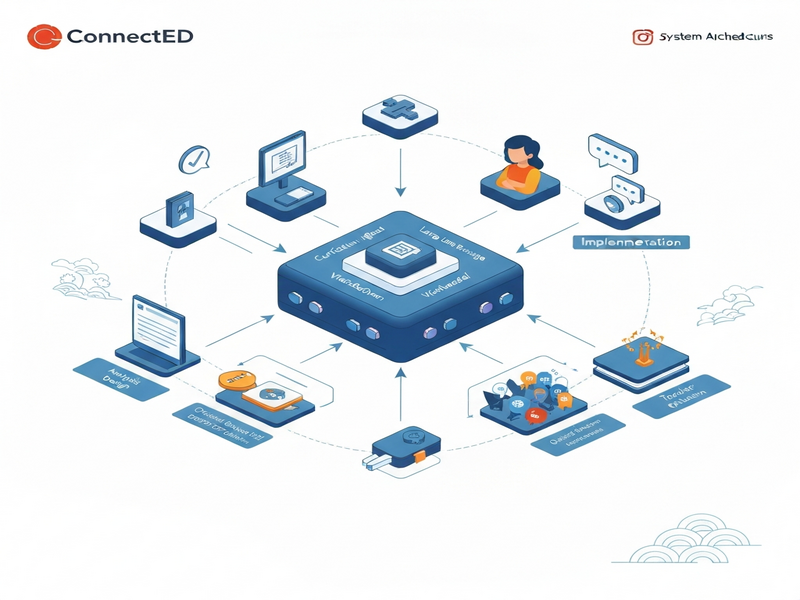
The end‑to‑end pipeline can be visualized as a loop:
- Analysis: Teachers input the target curriculum unit, student demographics, and learning objectives. The system extracts key standards from the official dispatch.
- Design: Using a design‑prompt, VietEduQwen drafts a high‑level lesson outline, suggested teaching methods, and assessment criteria.
- Development: Detailed lesson scripts, slide content, and practice questions are generated. Each artifact is presented to the teacher for approval.
- Implementation: Approved materials are published to the student‑facing portal, where learners interact with AI‑mediated quizzes, simulations, and conversational agents.
- Evaluation: Student responses are logged, scored, and fed back into a refinement engine that flags misconceptions, difficulty spikes, and alignment gaps.
- The loop restarts, allowing the teacher to iteratively improve the lesson based on real‑world evidence.
Component Interactions
Figure 1 (illustrated below) shows the data flow between the LLM, orchestration engine, teacher UI, and student portal. The orchestration engine acts as a conductor, invoking VietEduQwen with phase‑specific prompts and awaiting human confirmation before moving forward. The student portal captures interaction logs, which are anonymized and aggregated for the evaluation module. This module runs statistical analyses (e.g., item‑response theory) and surfaces actionable insights to the teacher dashboard.
What distinguishes ConnectED from generic AI authoring tools is the tight coupling of three safeguards:
- Curriculum alignment checks: Prompt templates embed official learning outcomes, and the system automatically flags any deviation.
- Pedagogical safety filters: DPO‑trained VietEduQwen prefers responses that have been explicitly approved by educators during fine‑tuning.
- Human‑in‑the‑loop gates: No content reaches students without teacher sign‑off, preserving professional accountability.
Evaluation & Results
Test Scenarios
The research team evaluated ConnectED on two fronts:
- Knowledge accuracy: VietEduQwen answered 3,119 questions drawn from the 2025 Vietnamese National High School Examination, a benchmark that mirrors real‑world assessment standards.
- Usability and satisfaction: Surveys were conducted with 18 teachers and 214 high‑school students who used the system for a semester‑long pilot.
Key Findings
- Accuracy boost: VietEduQwen achieved 87.02% correct answers, surpassing the baseline Qwen‑3‑8B model by 6.10 percentage points. This demonstrates that curriculum‑specific fine‑tuning and DPO substantially improve factual reliability.
- Time savings: Teachers reported that lesson‑preparation time dropped from an average of 3–4 hours to 30–45 minutes per unit, a reduction of roughly 80%.
- Positive user sentiment: 94% of teachers rated the generated lessons as “well aligned” with the national curriculum, while 89% of students found the interactive exercises “clear” and “engaging.”
- Ablation insights: Removing DPO training reduced accuracy by 3.4 points; disabling ADDIE‑based orchestration increased teacher editing time by 45%, confirming that both components independently contribute to performance.
Collectively, these results validate that a structured, teacher‑guided AI pipeline can deliver both high‑quality content and operational efficiency.
Why This Matters for AI Systems and Agents
ConnectED exemplifies a blueprint for building AI‑augmented workflows that respect domain‑specific constraints while leveraging large language models. For AI practitioners, the paper offers three actionable takeaways:
- Framework‑driven prompting: Embedding established instructional design models (ADDIE) into prompt engineering provides a systematic guardrail that can be adapted to other regulated domains such as healthcare or finance.
- Human‑in‑the‑loop orchestration: The dual‑gate approach—automatic generation followed by expert validation—balances speed with accountability, a pattern that can be replicated in enterprise AI agents.
- Feedback‑centric refinement: Closing the loop with real‑time user data transforms static AI outputs into continuously improving services, a principle that aligns with modern reinforcement‑learning‑from‑human‑feedback pipelines.
Organizations looking to embed AI into mission‑critical processes can draw on ConnectED’s architecture to design UBOS platform overview solutions that integrate large language models, workflow automation, and domain‑specific safety layers.
What Comes Next
While ConnectED marks a significant step forward, several limitations remain:
- Language scope: The current model focuses exclusively on Vietnamese; extending to minority languages or dialects will require additional data collection.
- Scalability of teacher review: As the system scales to thousands of classrooms, the manual validation step could become a bottleneck. Semi‑automated quality scoring may be needed.
- Rich multimodal content: Presently, the system generates text‑based assets. Incorporating video, audio, and interactive simulations would broaden pedagogical impact.
Future research directions include:
- Integrating ChatGPT and Telegram integration to enable real‑time teacher support via messaging platforms.
- Leveraging Chroma DB integration for efficient retrieval of curriculum metadata and past lesson versions.
- Embedding ElevenLabs AI voice integration to produce narrated lessons for auditory learners.
- Exploring Workflow automation studio capabilities to automate the teacher‑review gate with confidence scoring.
By addressing these challenges, ConnectED could evolve into a fully autonomous, multilingual educational AI platform that serves not only Vietnam but also other emerging markets with similar curriculum‑centric needs.
References
- ConnectED paper
- UBOS solutions for SMBs
- About UBOS
- Telegram integration on UBOS
- Enterprise AI platform by UBOS
Andrii Bidochko
CTO UBOS
Andrii Bidochko is an AI entrepreneur and researcher focused on AI agents, reinforcement learning, and autonomous systems. He writes about the technologies shaping the future of machine intelligence, from frontier models and agent architectures to real-world AI applications.