

- Updated: August 14, 2026
- 7 min read
Seeing Differently: Modeling Interpretive Perspectives in Computational Creativity using a Four-World Framework
Direct Answer
The paper introduces a Four‑World Framework that models how different interpretive perspectives—formal, social‑historical, and iconographic—evaluate artistic creativity, showing that creativity is not a single objective metric but a relational construct that shifts with the viewer’s stance. This matters because it provides a concrete computational method for embedding multiple, human‑like viewpoints into AI‑driven creative systems, enabling richer co‑creative experiences and more nuanced evaluation pipelines.
Background: Why This Problem Is Hard
Computational creativity (CC) has traditionally treated creativity as an intrinsic property of an artifact or as a performance score generated by a single algorithmic evaluator. In practice, however, artistic meaning is deeply perspective‑dependent. A painting praised for its formal composition may be dismissed by a historian who values sociopolitical context, while a religious scholar might focus on iconographic symbolism. Existing CC benchmarks—such as the Turing Test for art or novelty‑value metrics—ignore this multiplicity, leading to evaluations that are blind to the cultural and disciplinary lenses through which humans actually interpret art.
Two core bottlenecks arise:
- Evaluation bias: Single‑metric scores conflate diverse aesthetic criteria, making it impossible to diagnose why a system succeeds or fails for a particular audience.
- Lack of relational modeling: Current frameworks do not represent the dynamic interaction between an artifact and its interpreters, limiting the ability of AI agents to adapt their output to different stakeholder needs.
Addressing these gaps is crucial for enterprises that aim to deploy AI‑generated content across global markets, where cultural nuance and domain‑specific expectations can make or break user adoption.
What the Researchers Propose
The authors propose a Four‑World Framework that organizes twelve creativity traits into four conceptual domains: Formal, Social‑Historical, Iconographic, and Meta‑Creative. Each domain is instantiated through a persona—a computational proxy for a human evaluator with a distinct interpretive stance. The three personas used in the study are:
- Formalist: Prioritizes compositional balance, color harmony, and technical execution.
- Social‑Historical: Emphasizes cultural relevance, historical references, and societal impact.
- Iconographic: Focuses on symbolic meaning, narrative content, and mythological references.
Each persona scores an artwork on the twelve traits (e.g., Originality, Social Reflexivity, Emotional Resonance) using a shared underlying representation derived from CLIP image embeddings. By projecting these embeddings onto persona‑specific orientation vectors, the system surfaces which visual features become salient under each interpretive lens.
How It Works in Practice
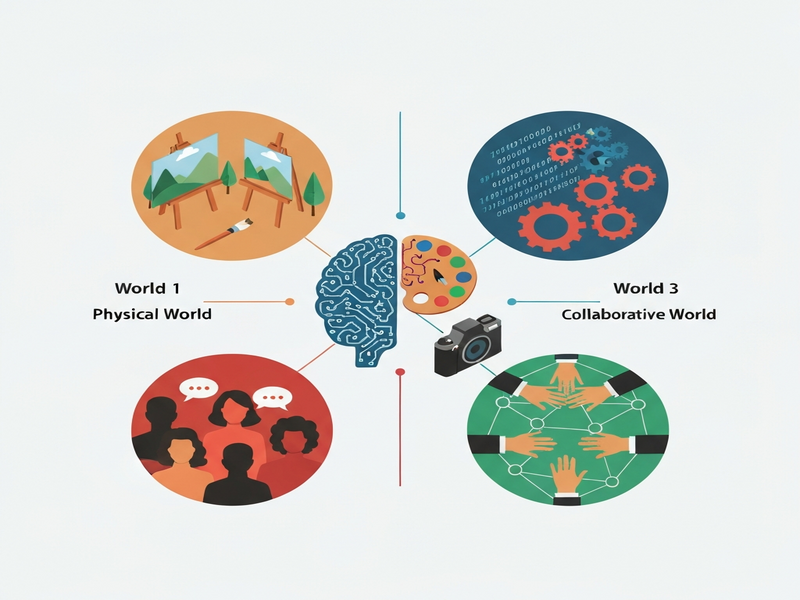
The operational pipeline can be broken down into four stages, illustrated below:
1. Data Ingestion
Images are drawn from the SemArt dataset, which pairs artworks with textual metadata. Each image is encoded with the CLIP model, producing a high‑dimensional vector that captures both visual and semantic cues.
2. Persona Vector Construction
For each persona, the researchers train a linear probe that learns an orientation vector in the CLIP space. This vector aligns the embedding with the traits most relevant to that perspective. For example, the Formalist vector amplifies edges and symmetry, while the Social‑Historical vector highlights contextual tags like “industrial revolution”.
3. Trait Scoring
Once an image is projected onto a persona vector, the resulting scalar values are fed into a lightweight regression head that outputs scores for the twelve traits. The process is repeated for all three personas, yielding a 36‑dimensional persona‑trait profile per artwork.
4. Aggregation & Analysis
The final step aggregates the persona‑specific profiles across the 1,069 artworks, producing 38,484 individual evaluations. Statistical analysis then reveals systematic divergences—e.g., Social Reflexivity scores vary dramatically between Formalist and Social‑Historical personas, confirming viewpoint sensitivity.
What sets this approach apart is its relational grounding: rather than imposing a monolithic “creativity score”, it lets the evaluation surface emerge from the interaction between the artifact’s representation and the persona’s orientation vector.
Evaluation & Results
Scenario and Tasks
The authors conducted three primary experiments:
- Persona Divergence Analysis: Measuring how trait scores differ across the three personas for the same artwork.
- Linear Probing Validation: Testing whether simple linear classifiers can reliably separate persona‑specific orientations in CLIP space.
- Qualitative Case Studies: Selecting artworks with high disagreement to illustrate how perspective reshapes perceived creativity.
Key Findings
- Systematic Divergence: Traits such as Social Reflexivity and Symbolic Depth showed the greatest variance across personas, confirming that certain creative dimensions are highly viewpoint‑dependent.
- Distinct Orientation Vectors: Linear probes achieved >85% accuracy in classifying which persona generated a given score, indicating that each perspective occupies a separable subspace within CLIP embeddings.
- Feature Salience Shifts: Visualization of activation maps revealed that Formalist projections emphasized geometric patterns, while Social‑Historical projections highlighted contextual text cues embedded in the image metadata.
- Co‑creative Potential: By exposing these divergent profiles to a downstream generative model, the authors demonstrated that the model could be nudged to produce variants tailored to a chosen persona, effectively “speaking” the language of that perspective.
Collectively, the results validate the hypothesis that creativity evaluation is relational and that computational personas can capture the nuanced lenses through which humans interpret art.
Why This Matters for AI Systems and Agents
For AI practitioners building creative agents—whether for marketing copy, visual design, or content recommendation—the Four‑World Framework offers a practical toolkit to embed human‑like interpretive diversity directly into the evaluation loop.
- Personalized Content Generation: Agents can select a persona that matches a target audience (e.g., a Formalist lens for a design‑focused brand) and generate outputs that score highly on the relevant traits.
- Multi‑Stakeholder Orchestration: In enterprise settings, different departments (legal, branding, cultural compliance) often require distinct creative criteria. The framework enables a single system to produce a portfolio of variants, each optimized for a specific stakeholder’s viewpoint.
- Feedback‑Driven Iteration: By exposing persona‑specific scores to a reinforcement learning loop, agents can iteratively refine their outputs to satisfy competing criteria, leading to more robust co‑creative workflows.
- Integration with Existing Platforms: The modular nature of the persona vectors makes them compatible with UBOS’s Workflow automation studio, allowing developers to chain evaluation, generation, and deployment steps without custom code.
- Enhanced Explainability: Because each score is tied to an explicit perspective, system designers can surface transparent rationales (“This design scores high on Formalist balance but low on Social Reflexivity”), supporting compliance and audit requirements.
What Comes Next
While the Four‑World Framework marks a significant step toward relational creativity, several avenues remain open for exploration:
- Expanding Persona Taxonomy: Incorporating additional viewpoints—such as feminist critique, post‑colonial analysis, or user‑generated community sentiment—could further enrich the evaluation space.
- Dynamic Persona Adaptation: Future work could enable agents to infer a user’s preferred perspective on the fly, adjusting the orientation vectors in real time based on interaction cues.
- Cross‑Modal Extensions: Extending the approach to music, literature, or multimodal installations would test the generality of the framework beyond visual art.
- Scalable Deployment: Embedding persona‑aware evaluation into production pipelines can be accelerated using UBOS’s OpenAI ChatGPT integration for natural‑language feedback loops, or the ChatGPT and Telegram integration for real‑time collaborative sessions.
- Human‑in‑the‑Loop Studies: Conducting user studies with artists and curators will validate whether persona‑driven scores align with expert judgments, closing the loop between computational metrics and lived artistic practice.
By addressing these challenges, the community can move toward AI systems that not only generate creative artifacts but also understand and adapt to the rich tapestry of human interpretive traditions.
Conclusion
The Four‑World Framework reframes computational creativity as a dialogue between artifacts and interpretive agents, rather than a static measurement of novelty. Through persona‑specific orientation vectors in CLIP space, the authors demonstrate that creativity assessment is inherently perspective‑sensitive and that these perspectives can be modeled, probed, and leveraged for co‑creative AI. For businesses and researchers alike, this opens a pathway to more nuanced, culturally aware, and stakeholder‑responsive creative AI systems.
References & Further Reading
- Seeing Differently: Modeling Interpretive Perspectives in Computational Creativity using a Four-World Framework (arXiv)
- UBOS platform overview
- AI marketing agents
- UBOS templates for quick start
Andrii Bidochko
CTO UBOS
Andrii Bidochko is an AI entrepreneur and researcher focused on AI agents, reinforcement learning, and autonomous systems. He writes about the technologies shaping the future of machine intelligence, from frontier models and agent architectures to real-world AI applications.