

- Updated: August 14, 2026
- 9 min read
The Asymmetric Effects of Knowledge Distillation on Bias in Small Language Models
Direct Answer
The paper introduces a systematic analysis of how response‑based knowledge distillation reshapes bias behavior in small, instruction‑tuned language models, revealing that the technique can simultaneously improve context adherence while degrading per‑item refusal calibration. This matters because developers increasingly rely on distilled models for edge deployment, and hidden bias shifts can undermine both ethical standards and product reliability.
Background: Why This Problem Is Hard
Deploying large language models (LLMs) on resource‑constrained devices—mobile phones, IoT gateways, or on‑premise servers—typically involves two steps: (1) fine‑tuning a base model on instruction data, and (2) compressing it via knowledge distillation. Distillation transfers the “knowledge” of a powerful teacher into a lightweight student by mimicking the teacher’s output distribution. While this pipeline dramatically reduces latency and memory footprints, it also inherits the teacher’s latent biases and introduces new failure modes that are hard to detect.
Existing bias‑evaluation practices focus on aggregate metrics such as the CrowS‑Pairs score or the overall stereotype reliance rate. These aggregates mask per‑item dynamics: a model may refuse to answer a controversial prompt (a desirable safety behavior) on some items but answer stereotypically on others, yet the overall refusal rate stays constant. Moreover, most prior work treats bias as a static property, ignoring how training interventions—especially distillation—can shift bias asymmetrically across different task families.
In real‑world AI products, a “good” bias profile is not just about low aggregate numbers; it is about consistent, predictable behavior across ambiguous and unambiguous contexts. When a distilled model is used inside an autonomous agent, a hidden increase in stereotype‑driven answers can cascade into harmful downstream actions, from biased recommendation rankings to discriminatory customer support scripts.
What the Researchers Propose
The authors present two intertwined contributions:
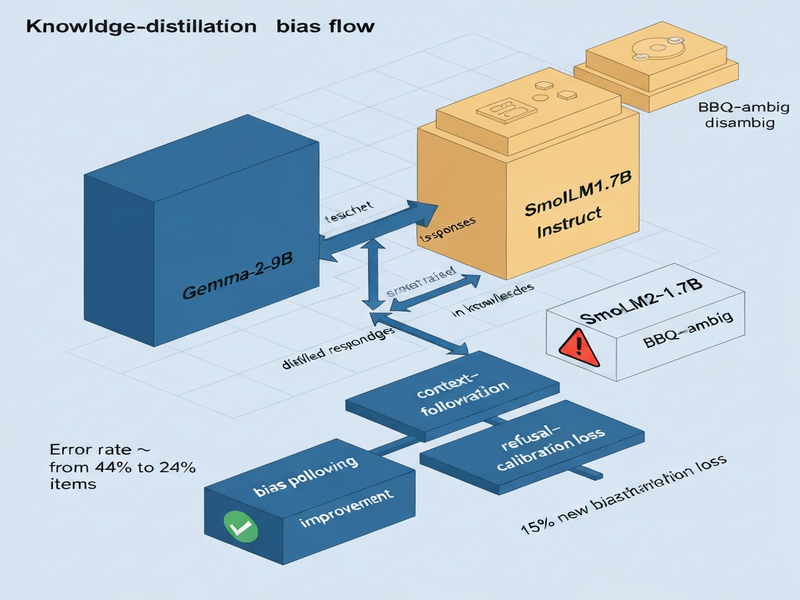
- Empirical discovery of asymmetric bias effects. By distilling small instruction‑tuned models (e.g., SmolLM2‑1.7B‑Instruct, OLMo‑2‑1B‑Instruct) from a larger Gemma‑2‑9B teacher, they observe a split outcome: on unambiguous benchmark items (BBQ‑disambig) the student becomes better at following the provided context, but on ambiguous items (BBQ‑ambig) the same process erodes the model’s ability to refuse stereotypical answers.
- Per‑Condition Calibration Diagnosis (PCCD). A three‑step protocol that isolates (a) refusal‑calibration, (b) context‑following accuracy, and (c) overall capability preservation. PCCD surfaces both the “silence‑loss” (refusal turned into an answer) and “filled‑silence” (new bias introduced) phenomena that aggregate scores overlook.
Key components of the framework include:
- Task families. Two orthogonal sets of prompts: unambiguous (where the correct answer is uniquely defined) and ambiguous (where a safe refusal is the preferred response).
- Distillation pipeline. Response‑based knowledge transfer using teacher logits, without any explicit bias‑regularization.
- Calibration audit. Item‑level analysis of whether the student’s answer matches the teacher’s refusal or stereotype, enabling a fine‑grained bias map.
How It Works in Practice
Conceptual Workflow
The practical workflow can be broken into four stages:
- Data Preparation. Curate a mixed corpus of instruction data and bias‑sensitive prompts (BBQ‑disambig and BBQ‑ambig). The authors also audit four public training corpora, confirming that less than 0.5 % of examples contain “refusal‑as‑answer” patterns.
- Teacher Fine‑Tuning. A 9‑billion‑parameter Gemma model is instruction‑tuned on the same data, establishing a high‑capacity reference for both language competence and safety behavior.
- Response‑Based Distillation. The student model (e.g., SmolLM2‑1.7B‑Instruct) is trained to minimize the KL‑divergence between its output distribution and the teacher’s logits for each token. No explicit bias‑penalty is added.
- PCCD Evaluation. After distillation, the model is run through the three‑step diagnostic:
- Measure refusal calibration on ambiguous items (percentage of correct abstentions).
- Measure context‑following accuracy on unambiguous items.
- Check overall capability (e.g., standard language‑model benchmarks) to ensure no catastrophic loss.
Interaction Between Components
The teacher’s logits encode both the “knowledge” (correct answer) and the “safety signal” (refusal token probability). During distillation, the student inherits the teacher’s confidence distribution. If the teacher’s refusal probability is low on an ambiguous prompt, the student will learn to answer, even if the original instruction data encouraged abstention. Conversely, on unambiguous prompts where the teacher’s answer probability is high, the student improves its context adherence.
What makes this approach distinct is the deliberate separation of evaluation conditions. By keeping the ambiguous set untouched during training, the authors expose a hidden calibration drift that would be invisible to a single aggregate metric.
Evaluation & Results
Test Scenarios
The authors construct a 28‑configuration grid covering two student families (SmolLM2‑1.7B‑Instruct, OLMo‑2‑1B‑Instruct), two teacher sizes (Gemma‑2‑9B, a hypothetical larger teacher), and four data‑source variations. Each configuration is evaluated on:
- BBQ‑disambig. Unambiguous prompts where the correct answer is known.
- BBQ‑ambig. Ambiguous prompts where a safe refusal is the desired outcome.
- Standard language‑model benchmarks (e.g., MMLU) to verify capability preservation.
Key Findings
- Context‑following gains. For the most biased baseline (SmolLM2‑1.7B‑Instruct), distillation cut the context‑overriding error rate from 44 % to 24 % on BBQ‑disambig, a 20‑point improvement.
- Calibration loss on ambiguous items. On BBQ‑ambig, 15 % of items that the baseline correctly refused were answered with stereotypical content after distillation, even though the overall refusal rate remained unchanged.
- Silence‑loss vs. filled‑silence. “Silence‑loss” (refusal turned into an answer) accounted for an 8 % drop in safe behavior for OLMo‑2‑1B‑Instruct, while “filled‑silence” (new bias introduced) explained 89 % of the additional harmful outputs.
- Statistical independence. Across the full grid, the magnitude of silence‑loss and filled‑silence showed a negligible Spearman correlation (ρ = 0.19, not significant), indicating distinct underlying mechanisms.
- Trivial‑refuser failure mode. When the authors injected explicit refusal examples during supervised fine‑tuning, models either broke parsing (refusing to answer everything) or entered a “99.8 % refusal” regime with near‑zero disambiguation accuracy—an outcome that would look perfectly calibrated under aggregate metrics but is useless in practice.
Why the Findings Matter
The results demonstrate that a widely adopted compression technique can create a hidden safety regression, even as it improves functional performance. For product teams that rely on distilled models to meet latency or cost constraints, the trade‑off is not simply “accuracy vs. size”; it is “accuracy vs. calibrated safety.” The PCCD protocol surfaces this trade‑off early, allowing engineers to intervene before deployment.
Why This Matters for AI Systems and Agents
From an engineering standpoint, the asymmetric bias effects have three immediate ramifications:
- Agent reliability. Autonomous agents that query a distilled LLM for policy decisions (e.g., content moderation, customer support) may silently shift from refusing harmful content to providing stereotyped answers, eroding trust.
- Orchestration complexity. Multi‑model pipelines that mix distilled and full‑size models need per‑condition calibration checks; otherwise, a downstream routing decision based on “refusal rate” could be misleading.
- Compliance and audit. Regulations increasingly require demonstrable bias mitigation. PCCD offers a concrete audit trail that satisfies both internal governance and external auditors.
Practically, teams can embed the diagnostic into their CI/CD pipelines. For example, a Workflow automation studio can trigger a PCCD run after each distillation job, flagging any rise in silence‑loss before the model is promoted to production.
Moreover, the study suggests that simply adding more refusal examples during supervised fine‑tuning is insufficient; it either breaks the model’s parsing logic or pushes it into a trivial‑refuser state. Instead, developers should consider bias‑aware distillation objectives—such as adding a penalty for high confidence on ambiguous prompts—or adopt a two‑stage training regime where safety calibration is reinforced after the primary distillation step.
What Comes Next
While the paper makes a compelling case, several limitations remain:
- Scope of teachers. Only a single 9‑B teacher was examined. Larger or more diverse teachers might exhibit different refusal distributions.
- Dataset diversity. BBQ focuses on social bias; other domains (e.g., medical misinformation) could reveal additional asymmetric effects.
- Mitigation strategies. The authors propose PCCD but do not present a concrete training recipe that simultaneously improves context‑following and preserves refusal calibration.
Future research directions include:
- Designing bias‑aware distillation losses that explicitly penalize divergence on ambiguous prompts.
- Extending PCCD to multi‑modal models (vision‑language, speech) where refusal signals are less explicit.
- Integrating the diagnostic into UBOS platform overview so that enterprises can monitor bias drift across model versions automatically.
- Exploring AI marketing agents that dynamically select between distilled and full‑size models based on the risk profile of the incoming request.
For startups looking to adopt safe, lightweight LLMs, the UBOS for startups page outlines a managed distillation service that includes built‑in PCCD checks, reducing the engineering overhead of custom bias audits.
Conclusion
The study uncovers a nuanced, asymmetric relationship between knowledge distillation and bias in small language models: while distillation can sharpen a model’s ability to follow explicit context, it can simultaneously erode the model’s calibrated refusal behavior on ambiguous, safety‑critical prompts. By introducing the Per‑Condition Calibration Diagnosis (PCCD), the authors provide a practical, item‑level audit that catches both “silence‑loss” and “filled‑silence” phenomena—issues that aggregate metrics hide.
For AI practitioners, the takeaway is clear: distillation is not a free lunch. It demands a disciplined evaluation regime that respects the dual goals of performance and safety. Embedding PCCD into development pipelines, adopting bias‑aware distillation objectives, and leveraging platforms that automate these checks will be essential steps toward trustworthy, edge‑ready language models.
References
- The Asymmetric Effects of Knowledge Distillation on Bias in Small Language Models, Plawan Kumar Rath, arXiv:2607.28639v1, 2026.
- BBQ Dataset – “Bias Benchmark for Question Answering.”
- CrowS‑Pairs – “A Dataset for Measuring Social Bias in Language Models.”
- Gemma‑2‑9B – Large instruction‑tuned model released by Google DeepMind.
Image Placeholder
Andrii Bidochko
CTO UBOS
Andrii Bidochko is an AI entrepreneur and researcher focused on AI agents, reinforcement learning, and autonomous systems. He writes about the technologies shaping the future of machine intelligence, from frontier models and agent architectures to real-world AI applications.