

- Updated: August 13, 2026
- 2 min read
COntExt: Towards Context‑Aware Ontology Extension from Operational Metrics – A Deep Dive
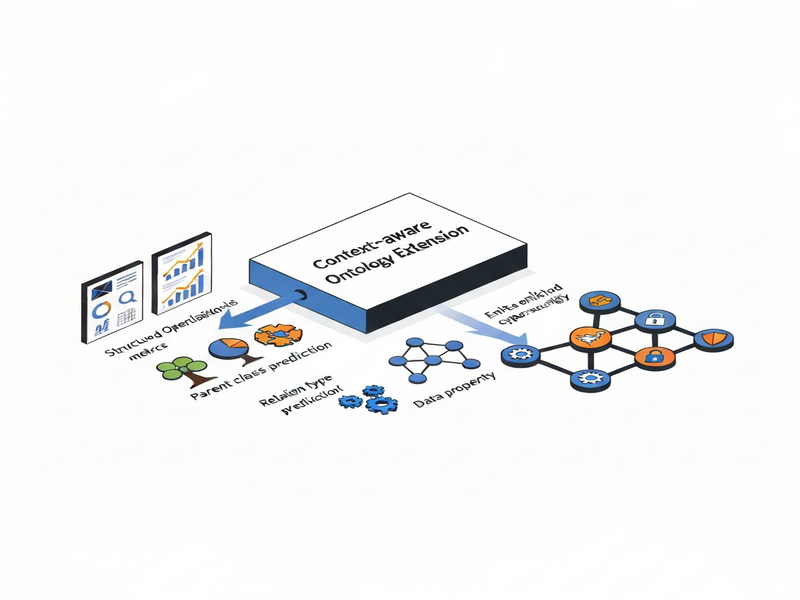
COntExt: Towards Context‑Aware Ontology Extension from Operational Metrics
In today’s fast‑moving cyber‑security landscape, organizations constantly collect structured operational metrics to monitor systems, processes, and compliance. These metrics encode valuable domain knowledge that can be leveraged to keep ontologies up‑to‑date automatically. The recent arXiv paper COntExt: Towards Context‑Aware Ontology Extension from Operational Metrics introduces a novel framework that bridges this gap.
Abstract
COntExt treats ontology extension as three sub‑tasks – parent class prediction, relation type prediction, and data property assignment – and demonstrates that metric‑derived context significantly improves suggestion quality across four cybersecurity ontologies.
Methodology
The framework ingests metric definitions, extracts contextual cues, and feeds them into machine‑learning models tailored for each sub‑task. Evaluation against ontology‑only baselines shows clear gains, especially for relation type prediction and data property assignment.
Key Results
- Metric‑derived context boosts prediction accuracy by up to 15% over baseline.
- Automated suggestions reduce manual ontology engineering effort dramatically.
- Demonstrated scalability across multiple cybersecurity ontologies.
Implications for Practitioners
By integrating COntExt, organizations can maintain richer, more accurate ontologies with minimal human intervention, leading to faster threat detection, compliance reporting, and knowledge reuse. Learn more about implementing COntExt on ubos.tech.
Conclusion & Call‑to‑Action
COntExt showcases the untapped potential of operational metrics as a source for ontology enrichment. Visit ubos.tech to explore the framework, access the full paper, and start automating your ontology extension today.
Andrii Bidochko
CTO UBOS
Andrii Bidochko is an AI entrepreneur and researcher focused on AI agents, reinforcement learning, and autonomous systems. He writes about the technologies shaping the future of machine intelligence, from frontier models and agent architectures to real-world AI applications.