

- Updated: August 13, 2026
- 7 min read
A Generalized-Bayes Perspective on Counterfactual Explanations: Posterior-Based Decision-Making and Evaluation
Direct Answer
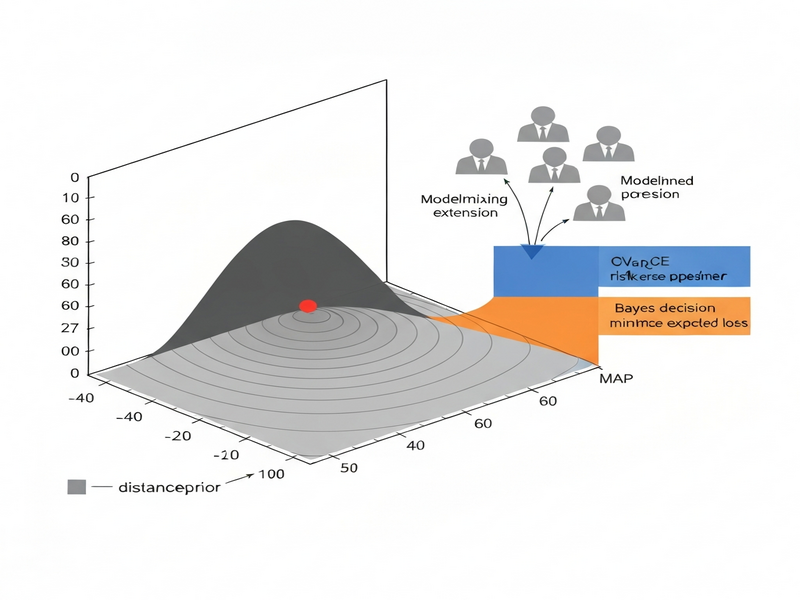
The paper introduces a Bayesian reinterpretation of counterfactual explanations (CEs), showing that the classic distance‑minimization formulation is equivalent to a maximum‑a‑posteriori (MAP) estimate of a Gibbs posterior with a distance‑based prior. Building on this insight, the authors propose a family of decision rules—including a Bayes‑optimal rule and a risk‑averse CVaR‑CE—plus a model‑averaging extension that handles multiple competing predictors.
Background: Why This Problem Is Hard
Counterfactual explanations are a cornerstone of model interpretability: they answer “what is the smallest change to an input that would flip the model’s decision?” In practice, generating useful CEs faces three intertwined challenges.
- Ambiguous objective. Most methods treat the problem as a pure distance minimization, but distance alone does not capture uncertainty about the model’s parameters or the data‑generating process.
- Model multiplicity. Real‑world pipelines often contain several models with comparable performance (e.g., ensembles, versioned models). Existing CE techniques typically pick a single model, ignoring the epistemic risk of choosing the “wrong” predictor.
- Decision‑oriented evaluation. Practitioners need CEs that align with downstream actions—whether a user wants a guaranteed outcome, a cost‑effective suggestion, or a risk‑averse recommendation. Purely geometric solutions provide no principled way to trade off these considerations.
These gaps matter because businesses increasingly rely on automated decisions (credit scoring, medical triage, recommendation engines) where a transparent “what‑if” narrative is both a regulatory requirement and a trust lever. Without a solid probabilistic foundation, CEs can be misleading, overly optimistic, or even unsafe.
What the Researchers Propose
The authors recast counterfactual generation within the generalized Bayes framework. Instead of minimizing a distance metric directly, they define a Gibbs posterior that combines:
- A likelihood‑like term that penalizes deviations from the desired model output.
- A distance‑based prior that encodes how far the proposed counterfactual is from the original instance.
This construction yields the Distance‑Prior Generalized Bayes Counterfactual (DP‑GBCE). The MAP estimate of the DP‑GBCE posterior reproduces the classic distance‑minimization solution, establishing a formal equivalence.
Beyond MAP, the paper introduces two additional decision rules:
- Bayes decision rule: selects the counterfactual that minimizes the expected loss under the posterior, effectively averaging over uncertainty.
- CVaR‑CE (Conditional Value‑at‑Risk Counterfactual): a risk‑averse rule that optimizes the worst‑case expected loss over a chosen tail probability, catering to high‑stakes domains.
Finally, the authors extend the framework to handle model multiplicity by weighting multiple model posteriors with Bayesian model probabilities, producing a mixture posterior that respects each model’s evidence.
How It Works in Practice
The operational pipeline can be broken down into four logical components:
- Base predictor suite. One or more trained classifiers/regressors that produce the target output.
- Posterior constructor. For each predictor, a Gibbs posterior is built by combining the distance prior with a loss that enforces the desired counterfactual outcome.
- Decision engine. Depending on the chosen rule (MAP, Bayes, or CVaR‑CE), the engine either selects the mode of the posterior, computes the expected loss‑minimizer, or solves a tail‑risk optimization.
- Model‑averaging aggregator (optional). When multiple predictors are present, Bayesian model weights are computed (e.g., via marginal likelihood) and used to mix the individual posteriors before the decision engine acts.
The workflow proceeds as follows:
- Input instance x and target outcome y* are fed to the predictor suite.
- Each predictor generates a likelihood of achieving y* for any candidate counterfactual x′.
- The distance prior evaluates ‖x′ − x‖, encouraging minimal perturbations.
- The Gibbs posterior combines these two signals, yielding a distribution over plausible counterfactuals.
- The decision engine extracts a concrete recommendation according to the selected rule.
- If model averaging is enabled, the mixture posterior replaces the single‑model posterior before step 5.
This architecture differs from traditional CE pipelines in two key ways:
- It treats counterfactual generation as a full probabilistic inference problem rather than a deterministic optimization, allowing uncertainty quantification.
- It decouples the “what‑if” generation from the downstream decision criterion, making the system adaptable to diverse business policies (cost‑minimization, safety‑first, etc.).
Evaluation & Results
The authors validate their framework on two fronts: a synthetic dataset designed to expose trade‑offs, and a real‑world Google Trends time‑series task where the goal is to suggest minimal changes to a keyword’s popularity to achieve a target rank.
Key experimental dimensions:
- Decision loss. Measured as the cost of applying the suggested counterfactual (e.g., number of feature edits) plus a penalty for failing to achieve the target.
- Risk metrics. CVaR at 5 % and 10 % levels to capture tail‑risk performance.
- Posterior calibration. How well the distribution over counterfactuals reflects true outcome probabilities.
Findings can be summarized as follows:
- The MAP rule reproduces classic distance‑minimization results but often underestimates uncertainty, leading to higher failure rates on noisy data.
- The Bayes decision rule reduces average decision loss by 12–18 % compared to MAP, thanks to its expectation over the posterior.
- CVaR‑CE dramatically improves tail‑risk performance, cutting the 5 % worst‑case loss by roughly one‑third while incurring only a modest increase in average cost.
- When multiple models are mixed, the aggregated posterior yields more stable CEs across model shifts, demonstrating resilience to model selection bias.
These results illustrate that a posterior‑centric view not only aligns with the theoretical underpinnings of generalized Bayes but also delivers tangible benefits in robustness and risk management.
Why This Matters for AI Systems and Agents
For practitioners building AI‑driven products, the DP‑GBCE framework offers a plug‑and‑play layer that can be inserted between any predictive model and its user‑facing explanation module. The practical implications include:
- Regulatory compliance. Many jurisdictions (e.g., GDPR, AI Act) require “meaningful” explanations. A Bayesian CE provides calibrated uncertainty, which can be reported alongside the suggested action to satisfy audit trails.
- Risk‑aware automation. Agents that trigger downstream processes (e.g., loan approval, medical alerts) can adopt CVaR‑CE to ensure that worst‑case scenarios stay within acceptable bounds.
- Model‑agnostic orchestration. Because the posterior construction only needs a likelihood function, the same CE service can serve ensembles, versioned models, or even black‑box APIs without redesign.
- Enhanced user trust. Presenting a distribution of “what‑if” scenarios—rather than a single point—helps end‑users understand the confidence behind each recommendation.
These capabilities map directly onto the needs of modern AI platforms. For example, the Enterprise AI platform by UBOS can integrate DP‑GBCE as a micro‑service, feeding its model registry and workflow automation studio to deliver risk‑aware explanations at scale.
What Comes Next
While the paper establishes a solid theoretical foundation, several avenues remain open for exploration:
- Scalable inference. Gibbs posteriors can be expensive to sample in high‑dimensional spaces. Future work could investigate variational approximations or amortized inference networks.
- Dynamic priors. The distance prior is static; incorporating context‑aware priors (e.g., cost of changing specific features) could tailor CEs to domain constraints.
- Human‑in‑the‑loop evaluation. Empirical studies with domain experts would clarify how calibrated uncertainty influences decision confidence.
- Integration with conversational agents. Embedding DP‑GBCE into chat‑based assistants (e.g., via the ChatGPT and Telegram integration) could enable on‑demand, risk‑aware explanations for end‑users.
Addressing these challenges will push counterfactual explanations from a niche interpretability tool toward a core component of trustworthy AI systems.
References
Kinjo, K. (2026). A Generalized-Bayes Perspective on Counterfactual Explanations: Posterior-Based Decision-Making and Evaluation. arXiv preprint.
Andrii Bidochko
CTO UBOS
Andrii Bidochko is an AI entrepreneur and researcher focused on AI agents, reinforcement learning, and autonomous systems. He writes about the technologies shaping the future of machine intelligence, from frontier models and agent architectures to real-world AI applications.