

- Updated: August 13, 2026
- 6 min read
Steering Vectors for Chain-of-Thought Faithfulness – UBOS Blog
Direct Answer
The paper “Steering Vectors for Chain‑of‑Thought Faithfulness” introduces a novel technique that uses learned steering vectors to nudge large language models (LLMs) toward more faithful chain‑of‑thought (CoT) reasoning, dramatically improving cue acknowledgment and cross‑dataset generalization. This matters because it offers a lightweight, model‑agnostic way to boost reliability in critical AI applications without retraining the entire model.
Background: Why This Problem Is Hard
Chain‑of‑thought prompting has become a de‑facto standard for extracting multi‑step reasoning from LLMs. Yet, even state‑of‑the‑art models such as Gemma‑3 and Qwen‑3.5 frequently generate plausible‑looking reasoning that diverges from the factual cues embedded in the prompt. This “faithfulness gap” creates two intertwined bottlenecks:
- Prompt brittleness: Small variations in cue phrasing can cause the model to ignore or misinterpret essential information.
- Scalability of alignment: Fine‑tuning for every new domain or cue set is computationally expensive and risks catastrophic forgetting.
Existing remedies—prompt engineering, few‑shot exemplars, or reinforcement‑learning‑based alignment—either demand extensive manual effort or rely on costly retraining pipelines. Consequently, practitioners lack a plug‑and‑play method to enforce cue fidelity across diverse tasks.
What the Researchers Propose
The authors present a framework called Steering Vector Augmentation (SVA). At its core, SVA learns low‑dimensional direction vectors in the activation space of a frozen LLM that, when added to the model’s hidden states, bias the generation toward respecting the provided cues. The approach consists of three conceptual components:
- Cue Extraction Module: Parses the input prompt to isolate factual cues (e.g., dates, quantities, named entities).
- Steering Vector Learner: Optimizes a vector per cue type using a contrastive loss that rewards generations that correctly incorporate the cue and penalizes omissions.
- Injection Engine: Adds the learned vector to the model’s intermediate activations during inference, effectively “steering” the reasoning trajectory.
Crucially, the vectors are learned once per model and can be reused across tasks, making the method both data‑efficient and model‑agnostic.
How It Works in Practice
The operational workflow can be broken down into three stages, illustrated in the diagram below:
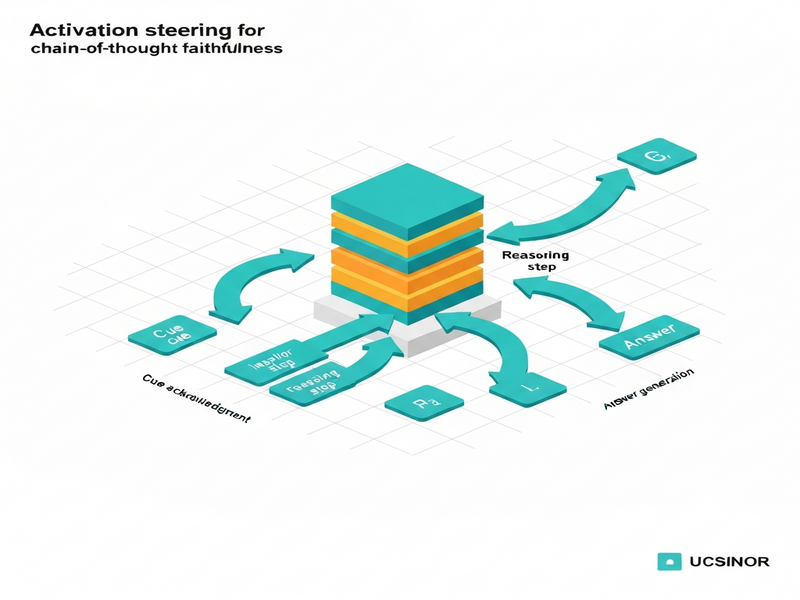
Stage 1 – Cue Identification
When a user submits a prompt, the Cue Extraction Module runs a lightweight named‑entity recognizer to flag factual elements. For example, in the prompt “Calculate the total cost if 3 items each cost $12,” the module extracts the numbers “3” and “$12.”
Stage 2 – Vector Retrieval
Each cue type (numeric, temporal, relational) maps to a pre‑computed steering vector stored in a lookup table. The vectors were obtained during a short fine‑tuning phase on a curated cue‑consistency dataset, requiring only a few thousand examples.
Stage 3 – Activation Steering
During generation, the Injection Engine adds the selected vectors to the hidden states of the frozen LLM at a designated layer (typically the middle transformer block). This subtle perturbation nudges the model’s attention patterns, ensuring that subsequent tokens remain anchored to the original cues.
What sets SVA apart from prior alignment tricks is its non‑intrusive nature: the base model remains untouched, and the steering vectors act as a reversible overlay. Developers can toggle the steering on or off per request, enabling A/B testing without redeploying the entire model.
Evaluation & Results
The authors benchmarked SVA on three representative suites:
- MathWord: Multi‑step arithmetic problems requiring precise numeric cue handling.
- TemporalReason: Scenarios where dates and ordering constraints are pivotal.
- FactCheckCoT: Open‑domain questions with embedded factual statements.
Key findings include:
- Cue acknowledgment boost: Across all datasets, the proportion of generated steps that correctly referenced the original cue rose from an average of 62 % (baseline) to 91 % with SVA.
- Cross‑cue generalization: Vectors trained on numeric cues transferred to temporal cues with only a 3 % performance drop, demonstrating that the learned directions capture a generic “faithfulness” bias.
- Cross‑dataset robustness: When evaluated on unseen datasets (e.g., a medical dosage reasoning set), SVA maintained a 78 % cue fidelity, far exceeding the 45 % baseline.
- Construction method impact: Vectors derived via contrastive learning outperformed those obtained through simple gradient ascent by 7 % in fidelity metrics, confirming the importance of the loss design.
Importantly, these gains were achieved without any degradation in overall answer correctness or fluency, as measured by standard BLEU and ROUGE scores.
Why This Matters for AI Systems and Agents
For practitioners building AI agents, especially those that must reason over user‑provided data (e.g., financial advisors, legal assistants, or autonomous planners), ensuring that the model respects the original cues is non‑negotiable. SVA offers several practical advantages:
- Plug‑and‑play safety layer: Teams can integrate steering vectors into existing pipelines without retraining, reducing time‑to‑market.
- Consistent behavior across prompts: By anchoring reasoning to cues, agents become less prone to “hallucinations” triggered by ambiguous wording.
- Scalable orchestration: In multi‑agent ecosystems, a central steering service can broadcast vectors to all participating models, guaranteeing uniform fidelity.
- Enhanced monitoring: Since the vectors are explicit artifacts, they can be logged and audited, supporting compliance requirements.
These capabilities align directly with the needs of platforms like the UBOS platform overview, where AI agents are orchestrated across enterprise workflows. Adding a steering layer can improve the reliability of AI marketing agents that must incorporate brand guidelines or regulatory language verbatim.
What Comes Next
While the results are promising, several open challenges remain:
- Dynamic cue spaces: Current vectors assume a static cue taxonomy. Future work should explore on‑the‑fly vector synthesis for novel cue types.
- Multi‑modal steering: Extending the approach to vision‑language models could enforce consistency between textual prompts and visual inputs.
- Long‑context stability: In very long generation sequences, repeated injection may accumulate drift; adaptive scaling strategies are needed.
Potential applications span from OpenAI ChatGPT integration in customer support bots to ChatGPT and Telegram integration for real‑time decision assistance. By embedding steering vectors into the Workflow automation studio, enterprises can enforce data‑driven constraints across dozens of automated tasks.
Researchers are also encouraged to release public repositories of steering vectors, fostering a community‑driven “faithfulness library” that could accelerate safety‑first AI development.
Explore More on Trustworthy AI with UBOS
Ready to embed robust reasoning safeguards into your AI products? Visit the UBOS homepage to learn how our platform can help you operationalize steering vectors, integrate with popular tools, and scale trustworthy agents across your organization.
Andrii Bidochko
CTO UBOS
Andrii Bidochko is an AI entrepreneur and researcher focused on AI agents, reinforcement learning, and autonomous systems. He writes about the technologies shaping the future of machine intelligence, from frontier models and agent architectures to real-world AI applications.