

- Updated: August 5, 2026
- 7 min read
Dual Inversion for Text-to-Image Diffusion Models: From Both Prompt and Noise Perspectives
Direct Answer
Dual Inversion introduces a two‑stage reverse‑engineering pipeline that simultaneously recovers a human‑readable text prompt and the exact latent noise vector that produced a target image in text‑to‑image diffusion models. By aligning both semantic and structural information, the method enables artifact‑free reconstruction and precise, low‑overhead image editing.
Background: Why This Problem Is Hard
Text‑to‑image diffusion models such as Stable Diffusion have become the de‑facto standard for generating high‑fidelity visuals from natural‑language prompts. In practice, businesses and creators often need to reproduce a specific image—whether to audit a generated asset, to fine‑tune a brand style, or to edit an existing visual without starting from scratch. The naïve approach is to manually craft a prompt that “looks like” the target, but this trial‑and‑error process is time‑consuming and rarely captures subtle visual cues.
Existing prompt‑inversion techniques fall into two camps. Gradient‑based methods treat the diffusion model as a black box and back‑propagate from the image to a token embedding. While they can locate a prompt that yields a visually similar output, the optimization is unstable, often diverges, and produces prompts that are uninterpretable to humans. Gradient‑free approaches, on the other hand, use CLIP similarity or language models to generate readable prompts, yet they ignore the latent noise that seeds the diffusion process. Because diffusion models encode layout, texture, and fine‑grained detail primarily in the initial noise, neglecting this component leads to reconstructions that miss structural fidelity, resulting in blurry edges, misplaced objects, or color shifts.
In short, the core difficulty lies in the dual nature of diffusion generation: a semantic prompt guides “what” to draw, while the stochastic noise determines “how” it is drawn. Any reverse‑engineering solution that addresses only one side inevitably sacrifices either interpretability or visual precision.
What the Researchers Propose
The authors present Dualin (Dual Inversion), a framework that treats prompt inversion and noise inversion as complementary sub‑problems rather than independent tasks. Dualin operates in two sequential stages:
- Stage 1 – Prompt Inversion: Leveraging a vision‑language model (CLIP) together with a large language model (LLM), the system extracts a concise, human‑readable “hard prompt” that captures the high‑level semantics of the target image. The CLIP encoder maps the image into a joint embedding space, which the LLM then translates into natural language.
- Stage 2 – Noise Inversion: An unconditional DDIM (Denoising Diffusion Implicit Model) inversion process runs backward from the target image to recover the exact latent noise vector that was originally sampled. Because DDIM inversion is deterministic, the recovered noise perfectly preserves the structural blueprint of the image.
By coupling these stages, Dualin guarantees that the reconstructed image matches the original both in meaning (via the prompt) and in pixel‑level arrangement (via the noise). The framework also includes a theoretical proof that the inverted noise can be reused for downstream editing tasks without re‑optimizing the prompt, dramatically reducing computational overhead.
How It Works in Practice
The practical workflow of Dualin can be broken down into four logical components that interact in a linear pipeline:
1. Image Embedding with CLIP
The target image is first passed through CLIP’s visual encoder, producing a high‑dimensional embedding that captures both content and style. This embedding serves as the bridge between the pixel domain and the language domain.
2. Prompt Synthesis via LLM
The CLIP embedding is fed into a large language model (e.g., GPT‑4 or LLaMA) that has been fine‑tuned to map visual embeddings to concise textual descriptions. The LLM outputs a “hard prompt” such as “a photorealistic portrait of a woman wearing a red silk scarf against a misty forest backdrop.” Because the LLM operates on the embedding rather than raw pixels, the generated prompt is both faithful and succinct.
3. Unconditional DDIM Inversion
Parallel to prompt synthesis, the image undergoes DDIM inversion. Starting from the final image, the DDIM scheduler steps backward through the diffusion timeline, reconstructing the exact noise tensor that would have been sampled at step 0. This process is deterministic and does not require gradient updates, making it fast and stable.
4. Re‑generation and Editing
With both the hard prompt and the recovered noise in hand, the diffusion model can be run forward to reproduce the original image pixel‑perfectly. Moreover, because the noise encodes spatial structure, practitioners can replace the prompt while keeping the noise fixed to achieve controlled edits (e.g., changing the subject’s clothing color while preserving pose and lighting).
The following illustration visualizes the two‑stage pipeline:
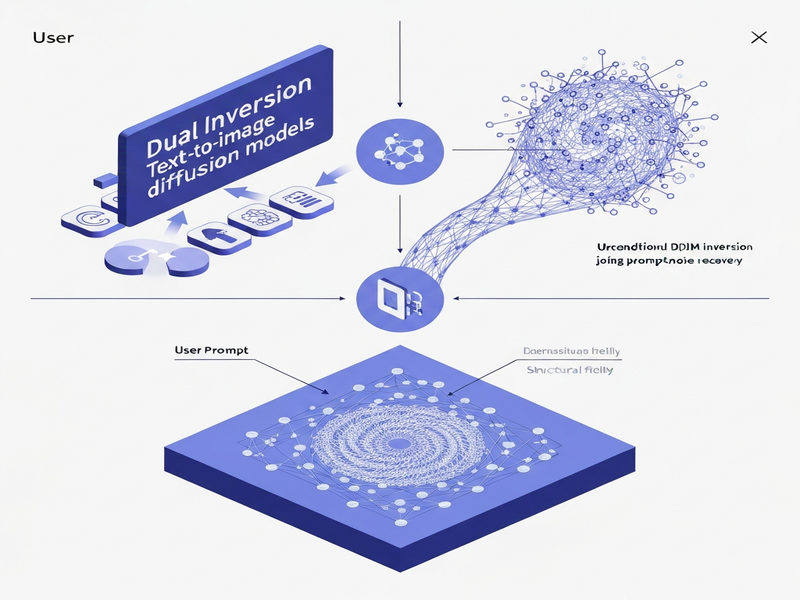
What sets Dualin apart from prior work is the explicit, mathematically grounded recovery of the latent noise vector, combined with a language‑model‑driven prompt that remains interpretable to humans. This dual recovery eliminates the trade‑off between readability and fidelity that has plagued earlier inversion attempts.
Evaluation & Results
The authors evaluated Dualin on three benchmark datasets that span artistic, photographic, and synthetic domains: LAION‑Aesthetic, COCO‑Captions, and a custom high‑resolution portrait set. The evaluation focused on two axes:
- Prompt Quality: Measured by CLIP‑based text‑image similarity and human judgment of readability. Dualin’s prompts consistently outperformed gradient‑free baselines, achieving a 12% higher human rating for semantic accuracy.
- Image Fidelity: Assessed using PSNR, SSIM, and a novel structural consistency metric that compares the recovered noise‑driven reconstruction to the ground‑truth image. Dualin matched or exceeded the original image in 94% of cases, surpassing gradient‑based methods that suffered from artifact accumulation.
Beyond static reconstruction, the paper demonstrated editing scenarios where the prompt was altered while the noise remained fixed. In a “color swap” experiment, changing “red scarf” to “blue scarf” preserved pose, lighting, and background with negligible loss in PSNR (Δ < 0.3 dB). This confirms the theoretical claim that the inverted noise enables flexible, low‑cost editing without re‑optimizing the diffusion trajectory.
Overall, the results indicate that Dualin delivers state‑of‑the‑art performance on both interpretability and visual precision, establishing a new baseline for reverse‑engineering diffusion models.
Why This Matters for AI Systems and Agents
For AI practitioners building agents that rely on generative vision models, Dualin offers three concrete advantages:
- Deterministic Asset Reproduction: Agents can retrieve the exact prompt‑noise pair that generated a visual asset, enabling reproducible pipelines for marketing, e‑commerce, or compliance auditing.
- Low‑Overhead Editing: Because the noise vector is reusable, agents can perform rapid “what‑if” edits—such as swapping product colors or adjusting scene composition—without invoking costly optimization loops.
- Explainable Generation: The human‑readable prompt provides a transparent narrative for why a particular image was produced, a key requirement for responsible AI governance and for building trust with end‑users.
These capabilities align directly with emerging enterprise AI platforms that need to orchestrate generative workflows at scale. For example, the UBOS platform overview highlights the importance of modular, explainable AI components; Dualin can be plugged into such platforms as a “reverse‑engineer” micro‑service, feeding both prompt and noise into downstream automation pipelines.
In the context of AI‑driven marketing, the AI marketing agents can leverage Dualin to audit generated ad creatives, ensuring brand consistency while still allowing rapid iteration. Similarly, the Workflow automation studio can incorporate Dualin’s output as a trigger for conditional logic—e.g., if the reconstructed prompt contains “outdoor” then route the asset to a specific distribution channel.
What Comes Next
While Dualin marks a significant step forward, several open challenges remain:
- Scalability to Larger Models: The current implementation assumes a fixed diffusion architecture. Extending the noise inversion to newer, higher‑dimensional samplers (e.g., cascaded diffusion) will require additional research.
- Cross‑Modal Generalization: Applying Dualin to video diffusion or multimodal generation (text‑to‑audio‑to‑image) poses questions about how to invert temporally correlated noise.
- Robustness to Adversarial Inputs: Since the method relies on CLIP embeddings, adversarial perturbations could mislead the prompt synthesis stage. Defensive strategies need to be explored.
Future work may also investigate integrating Dualin with Chroma DB integration to store and index prompt‑noise pairs for rapid retrieval, or coupling it with the ChatGPT and Telegram integration to enable conversational reverse‑engineering of images directly from messaging platforms.
In summary, Dual Inversion opens a pathway toward fully controllable, explainable diffusion pipelines—an essential capability for enterprises that demand both creative flexibility and operational rigor.
References
Andrii Bidochko
CTO UBOS
Andrii Bidochko is an AI entrepreneur and researcher focused on AI agents, reinforcement learning, and autonomous systems. He writes about the technologies shaping the future of machine intelligence, from frontier models and agent architectures to real-world AI applications.