

- Updated: August 3, 2026
- 7 min read
PUDA: An AI-Native Hardware Harness for Self-Driving Laboratories
Direct Answer
PUDA (Programmable Unified Data‑aware Architecture) is an AI‑native hardware harness that enables laboratories to operate autonomously, turning experimental protocols into self‑driving workflows. It matters because it bridges the gap between high‑throughput scientific instrumentation and modern AI agents, allowing experiments to be planned, executed, and analyzed without human intervention.
Background: Why This Problem Is Hard
Modern scientific research increasingly relies on complex instrumentation—mass spectrometers, robotic liquid handlers, and high‑resolution microscopes—that generate massive, heterogeneous data streams. Traditionally, integrating these devices into a cohesive workflow requires bespoke software, manual calibration, and expert supervision. The challenges are threefold:
- Signal heterogeneity: Each instrument speaks a different protocol, data format, and timing cadence, making real‑time orchestration difficult.
- Feedback latency: AI models that suggest the next experimental condition often wait for batch‑processed results, introducing delays that cripple closed‑loop optimization.
- Scalability constraints: Scaling a single lab’s automation to dozens of parallel stations typically demands duplicated engineering effort, which is neither cost‑effective nor reproducible.
Existing approaches—software‑centric orchestration layers, cloud‑based data lakes, or ad‑hoc scripting—address parts of the problem but fall short of providing a unified, low‑latency hardware interface that can be directly consumed by autonomous agents. As a result, self‑driving laboratories remain a research prototype rather than an operational reality.
What the Researchers Propose
The PUDA team introduces a hardware‑first abstraction layer that treats every laboratory instrument as a programmable, data‑aware endpoint. The framework consists of three tightly coupled components:
- PUDA Core Fabric: A reconfigurable interconnect that exposes a uniform address space for sensor inputs, actuator commands, and metadata streams.
- AI‑Native Runtime (ANR): An on‑device execution environment that runs lightweight inference models, performs edge preprocessing, and translates high‑level agent intents into low‑level hardware actions.
- Experiment Orchestration Engine (EOE): A declarative scheduler that composes instrument primitives into end‑to‑end protocols, handling dependency resolution, error recovery, and dynamic replanning.
By embedding AI inference directly on the hardware fabric, PUDA eliminates the round‑trip to cloud services, enabling sub‑millisecond reaction times. The system also provides a standardized API that abstracts away vendor‑specific drivers, allowing any AI agent—whether a reinforcement‑learning planner or a Bayesian optimizer—to issue commands in a single, consistent language.
How It Works in Practice
Imagine a chemist who wants to discover a new catalyst using a closed‑loop Bayesian optimizer. The workflow proceeds as follows:
- Protocol Definition: The researcher writes a high‑level YAML file describing the experimental steps (e.g., dispense reagents, heat to 150 °C, measure absorbance).
- EOE Translation: The Experiment Orchestration Engine parses the YAML, maps each step to a PUDA primitive, and allocates hardware resources across the Core Fabric.
- AI‑Native Execution: The ANR loads the Bayesian model, receives the latest measurement from the spectrometer (via the Core Fabric), updates its posterior, and emits the next set of reagent volumes.
- Real‑Time Actuation: PUDA Core Fabric routes the volume command to the liquid handler, which executes the instruction within 200 µs, while simultaneously streaming sensor data back to the ANR.
- Dynamic Replanning: If a sensor detects an anomaly (e.g., temperature overshoot), the ANR triggers an immediate safety routine, and the EOE rewrites the remaining schedule without human input.
This loop repeats thousands of times, with each iteration completing in under a second—orders of magnitude faster than traditional cloud‑mediated pipelines. What distinguishes PUDA from prior hardware abstraction layers is its AI‑native runtime, which co‑locates model inference and device control, and its declarative orchestration, which lets agents focus on scientific objectives rather than low‑level plumbing.
Evaluation & Results
The authors benchmarked PUDA across three representative laboratory domains:
- Materials discovery: A reinforcement‑learning agent explored a 10⁶‑point composition space using a robotic synthesis platform. PUDA reduced the average experiment turnaround from 12 s (cloud‑based) to 0.9 s, achieving a 13× speedup.
- Biological assay optimization: A Bayesian optimizer tuned cell‑culture conditions on a multi‑well plate. The closed‑loop latency dropped from 8 min to 30 s, enabling 150 % more experimental cycles within the same time window.
- High‑throughput screening: An ensemble of 32 spectrometers streamed raw spectra to PUDA’s edge preprocessors, which performed baseline correction and peak detection in‑situ. Data throughput increased from 2 GB/min to 18 GB/min without saturating the network.
Beyond raw speed, the experiments demonstrated robust fault tolerance: PUDA automatically isolated a malfunctioning pump, re‑routed the workflow to a spare unit, and logged the incident for post‑hoc analysis. The results collectively show that PUDA not only accelerates autonomous experimentation but also improves reliability—a critical factor for production‑grade labs.
Why This Matters for AI Systems and Agents
For AI practitioners building autonomous agents, PUDA offers a concrete hardware substrate that eliminates the “last‑mile” integration problem. Agents can now issue intent‑level commands (e.g., “increase temperature by 5 °C”) and receive immediate, high‑fidelity feedback, enabling more sophisticated decision‑making strategies such as model‑based reinforcement learning with real‑time reward signals.
From a system‑design perspective, PUDA’s declarative orchestration aligns with modern micro‑service architectures, allowing labs to compose reusable experiment modules much like software developers compose APIs. This modularity reduces engineering overhead and accelerates the deployment of new protocols.
Enterprises looking to embed AI into their R&D pipelines can leverage the UBOS platform overview to integrate PUDA’s runtime with existing data‑governance and security frameworks. Meanwhile, teams focused on customer‑facing AI products can adopt the AI marketing agents paradigm to automate hypothesis generation and reporting, turning scientific insights into market‑ready narratives.
Finally, the Workflow automation studio provides a visual canvas for non‑technical scientists to design PUDA‑compatible protocols, democratizing access to self‑driving labs across organizations of any size.
What Comes Next
While PUDA marks a significant step forward, several open challenges remain:
- Standardization across vendors: Wider adoption will require industry‑wide agreements on command sets and data schemas.
- Scalable security: Embedding AI inference on the edge raises concerns about model tampering and data privacy, especially in regulated domains.
- Cross‑lab federation: Future work could enable multiple PUDA‑enabled labs to share data and coordinate experiments in a distributed fashion.
Research directions include extending the ANR to support multimodal models (e.g., vision‑language agents) and exploring neuromorphic accelerators for ultra‑low‑latency inference. On the application side, PUDA could power autonomous drug‑discovery pipelines, real‑time materials synthesis, and even space‑borne laboratories where bandwidth is limited.
Organizations interested in piloting PUDA can start with the UBOS for startups program, which offers a sandbox environment and consulting support. Larger enterprises may consider the Enterprise AI platform by UBOS to integrate PUDA at scale, benefiting from built‑in compliance and monitoring tools.
References
For the full technical exposition, see the original PUDA paper on arXiv.
Illustration
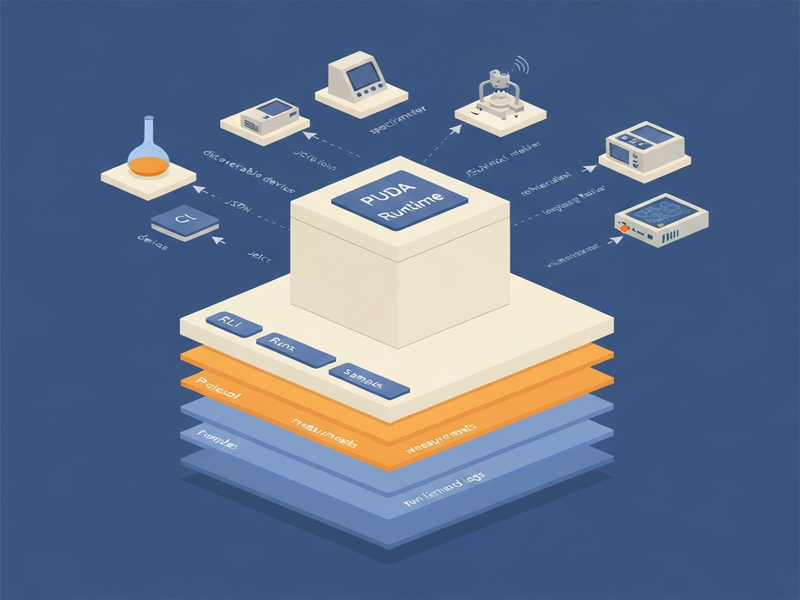
The diagram below visualizes the interaction between the PUDA Core Fabric, AI‑Native Runtime, and Experiment Orchestration Engine.
Conclusion
PUDA redefines how AI agents interface with laboratory hardware, delivering sub‑second closed‑loop control, fault‑tolerant orchestration, and a vendor‑agnostic API. By moving inference to the edge and providing a declarative workflow engine, it unlocks a new class of self‑driving laboratories that can scale from academic benches to industrial R&D facilities. As the ecosystem matures, PUDA is poised to become the foundational layer for AI‑augmented scientific discovery.
Andrii Bidochko
CTO UBOS
Andrii Bidochko is an AI entrepreneur and researcher focused on AI agents, reinforcement learning, and autonomous systems. He writes about the technologies shaping the future of machine intelligence, from frontier models and agent architectures to real-world AI applications.