

- Updated: July 31, 2026
- 6 min read
CRiT-QA: Evaluating Multi-hop Reasoning with Counterfactual Chains and Distractor Traps
Direct Answer
CRiT‑QA is a newly released benchmark that forces large language models (LLMs) to perform genuine multi‑hop reasoning by inserting counterfactual entities and multi‑anchor distractor chains into question‑answer pairs. It matters because it exposes two hidden weaknesses—over‑reliance on memorized knowledge and shortcut exploitation—allowing researchers to measure how well models truly ground their answers in the supplied context.
Background: Why This Problem Is Hard
Multi‑hop question answering (QA) has become a standard proxy for testing a model’s ability to stitch together evidence from several documents. In practice, enterprises use such capabilities for tasks ranging from compliance checks to investigative analytics. Yet, existing benchmarks (e.g., HotpotQA, MultiRC) suffer from two systemic blind spots:
- Parametric knowledge leakage: Models often answer correctly by recalling facts stored in their weights, bypassing the need to read the provided passages.
- Shortcut heuristics: Many datasets contain surface cues—such as a single “anchor” document that contains the answer type or a distinctive keyword—that let a model guess correctly without truly aggregating evidence across hops.
These issues inflate reported scores while hiding the models’ inability to reason under realistic constraints, where the context may be noisy, incomplete, or deliberately misleading. For businesses that rely on AI agents to synthesize reports from heterogeneous data sources, such hidden fragilities can translate into costly misinformation.
What the Researchers Propose
The authors introduce CRiT‑QA (Counterfactual Reasoning with Traps), a dataset engineered to neutralize memorized knowledge and eliminate shortcut pathways. The core ideas are twofold:
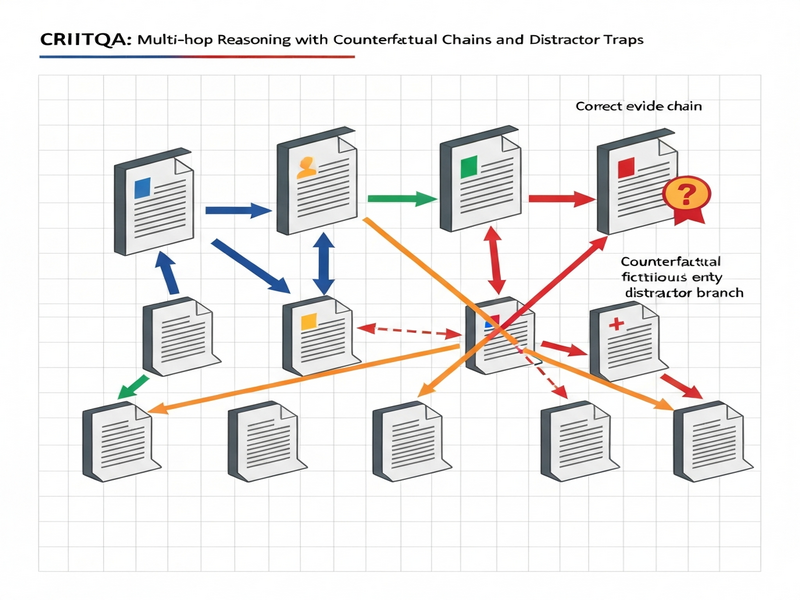
- Counterfactual reasoning chains: Each factual chain in the original source is altered by swapping one or more entities with plausible but false alternatives (e.g., replacing “Paris” with “Lyon”). The surrounding context is updated consistently, ensuring that the only way to answer correctly is to follow the modified chain.
- Multi‑anchor distractor traps: For every correct chain, the dataset injects several parallel chains that diverge at different hops. These distractors are syntactically and semantically coherent, making them indistinguishable from the true path without a full traversal of the evidence.
By intertwining these two mechanisms, CRiT‑QA forces a model to verify each intermediate step against the supplied documents, rather than relying on a single “aha!” cue.
How It Works in Practice
Conceptual Workflow
Creating a CRiT‑QA instance follows a pipeline that can be summarized in four stages:
- Source selection: Choose a multi‑document reasoning scenario from an existing QA corpus.
- Counterfactual injection: Identify a pivotal entity in the reasoning chain and replace it with a plausible alternative. All downstream references are updated to maintain internal consistency.
- Distractor generation: Construct one or more alternate chains that share the initial hop(s) with the correct path but branch off at later hops. Each branch ends with a wrong answer that is still logically sound given its own (incorrect) premises.
- Verification & filtering: Human annotators or automated validators confirm that the counterfactual and distractor chains are both believable and that the correct answer is uniquely reachable only by following the full chain.
Component Interaction
The dataset generation system consists of three interacting agents:
- Entity‑Swap Engine: Uses a knowledge graph to propose alternative entities that preserve type and relational constraints.
- Chain‑Builder Module: Takes the swapped entity and re‑assembles the reasoning steps, ensuring logical continuity.
- Distractor‑Validator: Employs a separate LLM to draft plausible distractor hops, then runs a consistency checker to avoid accidental leakage of the correct answer.
What sets CRiT‑QA apart from prior benchmarks is the deliberate coupling of counterfactual manipulation with multi‑anchor distractors, creating a “double‑trap” that penalizes shallow pattern matching.
Evaluation & Results
Test Scenarios
The authors evaluated a suite of state‑of‑the‑art LLMs—including GPT‑4, Claude‑2, LLaMA‑2‑70B, and open‑source alternatives—on three settings:
- Standard multi‑hop datasets: Baseline performance on HotpotQA and WikiMultiHop.
- CRiT‑QA (original): Full counterfactual + distractor version.
- CRiT‑QA (ablations): Versions with only counterfactuals or only distractors to isolate each factor’s impact.
Key Findings
Across the board, models experienced a steep drop—often 30‑45 percentage points—in exact‑match accuracy when moving from standard datasets to the full CRiT‑QA benchmark. Ablation studies revealed that:
- Counterfactual chains alone reduced performance by ~20 pp, confirming that memorized knowledge cannot rescue the model.
- Distractor traps alone caused a ~15 pp decline, indicating that shortcut heuristics were previously inflating scores.
- The combination of both yielded the greatest degradation, suggesting a synergistic effect where models that survived one trap fell to the other.
Qualitative analysis showed that failure modes clustered around two patterns: (1) premature answer selection after the first hop, and (2) reliance on entity‑type matching rather than evidence verification. Even the most capable closed‑source models exhibited these weaknesses, underscoring the benchmark’s diagnostic power.
Why This Matters for AI Systems and Agents
For practitioners building AI agents that must synthesize information from multiple sources—think legal research assistants, financial analysts, or customer‑support bots—CRiT‑QA offers a realistic stress test. The benchmark highlights gaps that could surface in production when an agent encounters:
- Incorrect or outdated knowledge bases that require on‑the‑fly verification.
- Documents containing misleading cues designed to trap naïve retrieval pipelines.
Integrating CRiT‑QA into a model‑validation pipeline can therefore reduce the risk of deploying agents that hallucinate or shortcut critical reasoning steps. Moreover, the dataset aligns well with emerging UBOS platform overview features that let developers plug in custom retrieval modules and chain‑of‑thought orchestrators. By testing against counterfactual and distractor scenarios, teams can iteratively improve evidence‑grounded prompting strategies, retrieval‑augmented generation (RAG) pipelines, and tool‑use policies.
In concrete terms, a company that uses the Workflow automation studio to coordinate multiple LLM calls can embed CRiT‑QA style checks as a “sanity‑gate” before finalizing a response. This reduces downstream errors in high‑stakes domains such as compliance reporting or medical triage.
What Comes Next
While CRiT‑QA marks a significant step forward, several limitations remain:
- Domain coverage: The current release focuses on encyclopedic knowledge; extending the methodology to specialized corpora (e.g., legal statutes, biomedical literature) will require domain‑specific entity graphs.
- Scalability of human verification: As the dataset grows, fully manual validation becomes costly. Semi‑automated consistency checks powered by LLMs could alleviate this bottleneck.
- Dynamic contexts: Real‑world agents often operate on streaming data. Future benchmarks should incorporate temporal distractors that evolve over time.
Research directions that naturally follow include:
- Designing training objectives that explicitly penalize shortcut reliance, such as contrastive evidence‑ranking losses.
- Developing retrieval‑augmented architectures that can flag counterfactual inconsistencies before generation.
- Exploring meta‑learning approaches where an agent learns to recognize and avoid distractor traps across tasks.
Organizations interested in experimenting with CRiT‑QA can leverage the Enterprise AI platform by UBOS to host custom evaluation suites, integrate with existing data pipelines, and monitor performance drift over time. By treating CRiT‑QA as a continuous integration test, teams can ensure that new model releases maintain robust multi‑hop reasoning capabilities.
Finally, the broader AI community is invited to contribute additional counterfactual scenarios and distractor designs, turning CRiT‑QA into an evolving benchmark that mirrors the ever‑changing landscape of real‑world information retrieval.
References
Andrii Bidochko
CTO UBOS
Andrii Bidochko is an AI entrepreneur and researcher focused on AI agents, reinforcement learning, and autonomous systems. He writes about the technologies shaping the future of machine intelligence, from frontier models and agent architectures to real-world AI applications.