

- Updated: July 31, 2026
- 7 min read
Co4ICF: Co‑evolving Physics‑Informed Surrogate and RL‑Based Pulse Optimizer for Inertial Confinement Fusion – UBOS Blog
Direct Answer
Co4ICF introduces a co‑evolving framework that jointly refines a physics‑informed surrogate model and a Proximal Policy Optimization (PPO)‑based pulse optimizer for inertial confinement fusion (ICF). By continuously fine‑tuning the surrogate on the optimizer’s own trajectory, the system avoids out‑of‑distribution failures and delivers laser‑pulse designs that more than double the normalized fusion yield compared with the current baseline.
Background: Why This Problem Is Hard
Inertial confinement fusion relies on precisely timed laser pulses to compress a fuel capsule to conditions where nuclear fusion can occur. Simulating this process with high‑fidelity physics codes (e.g., MULTI‑IFE) is computationally expensive—running a single 2‑D simulation can consume hours on a supercomputer. To make design iteration feasible, researchers train surrogate models that approximate the expensive simulator. However, these surrogates are typically trained offline on a static dataset. When an optimizer pushes the design into regions of the input space that were sparsely represented in the training data, the surrogate’s predictions become unreliable—a classic out‑of‑distribution (OOD) problem.
Traditional mitigation strategies—such as enlarging the training set or adding regularization—only partially address the issue. Larger datasets increase simulation cost, and regularization does not guarantee accurate extrapolation where physics is highly nonlinear. Consequently, iterative optimization pipelines often stall or converge to sub‑optimal pulses because the surrogate can no longer be trusted as the search progresses.
What the Researchers Propose
The authors of the Co4ICF paper on arXiv propose a tightly coupled, co‑evolutionary loop that treats the surrogate and the optimizer as two agents that learn from each other:
- Physics‑Informed Surrogate (PIS): A neural network that embeds known conservation laws and transport equations, providing fast approximations of the MULTI‑IFE simulation.
- PPO‑Based Pulse Optimizer: A reinforcement‑learning agent that proposes laser‑pulse parameters (e.g., rise time, foot, peak power) to maximize a reward defined by the predicted fusion yield.
- Co‑evolution Mechanism: After each optimization episode, the trajectories generated by the PPO policy are fed back to the surrogate, which is fine‑tuned on these new data points. This continual adaptation narrows the OOD gap as the optimizer explores new regions.
The key insight is that the optimizer’s policy itself becomes a source of high‑value training data, turning the surrogate’s weakness (its reliance on static data) into a strength (dynamic, policy‑driven data acquisition).
How It Works in Practice
The workflow can be broken down into four repeatable stages:
- Initialize Surrogate: Train the physics‑informed surrogate on an initial dataset of MULTI‑IFE simulations covering a broad but finite design space.
- Policy Rollout: Deploy the PPO optimizer, which queries the surrogate as a fast “environment” to evaluate candidate pulse sequences. The optimizer collects state‑action‑reward tuples during each episode.
- Data Augmentation: At the end of an episode, the collected trajectories are labeled with the high‑fidelity MULTI‑IFE simulator (or a higher‑resolution surrogate) to obtain ground‑truth yields.
- Surrogate Fine‑Tuning: The surrogate is updated on this newly labeled data, reducing its extrapolation error precisely where the optimizer is pushing the design.
These stages repeat until the optimizer’s performance plateaus. The loop creates a feedback‑driven curriculum: early iterations explore broadly, later iterations focus on promising niches, and the surrogate continuously sharpens its predictions where they matter most.
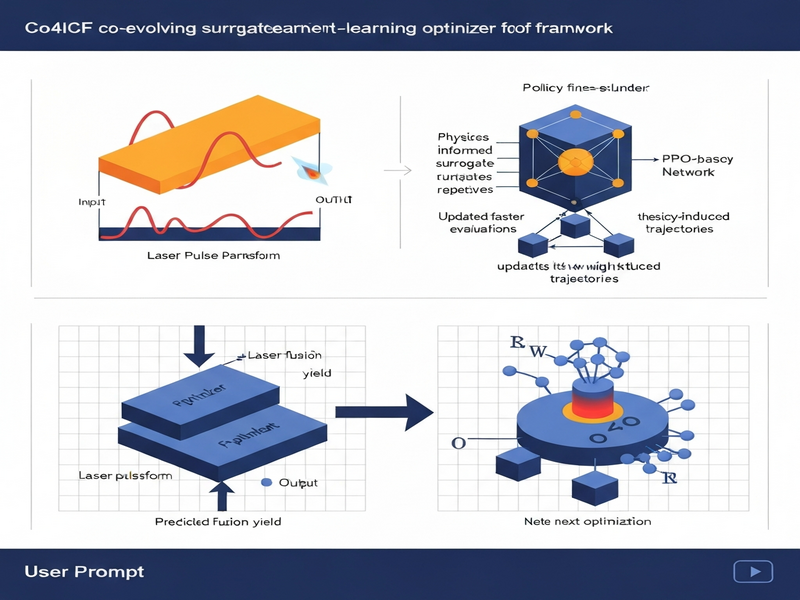
What distinguishes Co4ICF from prior surrogate‑based pipelines is the explicit, policy‑driven data acquisition step. Instead of a one‑off offline training phase, the surrogate evolves hand‑in‑hand with the optimizer, ensuring that the “fast environment” remains trustworthy throughout the search.
Evaluation & Results
The authors benchmarked Co4ICF on two versions of the MULTI simulation suite:
- 1‑D MULTI: A reduced‑dimensional model that runs in seconds, used for rapid prototyping.
- 2‑D MULTI: A more realistic, computationally intensive configuration that captures lateral effects.
Key findings include:
- When evaluated in the 1‑D environment, the co‑evolved optimizer achieved a **146.1 %** increase in normalized yield relative to the current laser‑design baseline.
- Crucially, the same optimized pulse—without any additional 2‑D training—was later run in the 2‑D MULTI simulator, delivering a **246.9 %** normalized yield. This cross‑fidelity validation demonstrates that the surrogate’s learned physics generalized beyond its original dimensionality.
- Budget‑matched ablation studies (i.e., giving competing methods the same amount of simulation data) showed that the performance gap could not be explained solely by data volume. The co‑evolutionary loop itself contributed the majority of the gain.
Beyond raw numbers, the experiments prove that a surrogate can remain accurate enough to guide a high‑stakes RL optimizer even as the optimizer deliberately explores novel design regions. This resolves a long‑standing bottleneck in AI‑driven fusion research.
Why This Matters for AI Systems and Agents
Co4ICF’s success has implications that extend far beyond inertial confinement fusion:
- Robustness of Learned Environments: Many AI agents rely on simulators that are approximated by learned models (e.g., robotics, autonomous driving). A co‑evolutionary scheme offers a systematic way to keep those models trustworthy as agents push the envelope.
- Sample‑Efficient Policy Learning: By turning the agent’s own exploratory data into high‑quality training signals, the approach reduces the need for massive offline datasets—a common pain point for industry‑scale RL deployments.
- Cross‑Domain Generalization: The fact that a pulse optimized in 1‑D transferred effectively to 2‑D suggests that physics‑informed surrogates can capture underlying invariants, a property valuable for transfer learning across simulation fidelities.
- Accelerated Innovation Pipelines: Companies building AI‑augmented design tools can embed a co‑evolution loop to continuously improve their predictive back‑ends, shortening time‑to‑market for complex engineering products.
Practitioners looking to embed such capabilities into their own platforms can start by exploring the UBOS platform overview, which supports modular integration of custom surrogates and reinforcement‑learning agents.
What Comes Next
While Co4ICF marks a significant step forward, several open challenges remain:
- Scalability to Full 3‑D Physics: Extending the co‑evolution loop to three‑dimensional, multi‑physics simulations will test the limits of both surrogate capacity and RL sample efficiency.
- Automated Curriculum Design: Currently, the surrogate is fine‑tuned after each episode. Future work could incorporate meta‑learning to decide *when* and *how much* new data to ingest, balancing stability and adaptability.
- Safety and Constraint Handling: In safety‑critical domains, the optimizer must respect hard physical constraints (e.g., laser‑damage thresholds). Integrating constraint‑aware RL or safe‑exploration techniques could make the framework more broadly applicable.
- Community Benchmarking: The authors released a large‑scale MULTI‑IFE dataset to foster reproducibility. Researchers are encouraged to benchmark alternative surrogate architectures, such as graph‑based neural operators, within the same co‑evolutionary loop.
Developers interested in building end‑to‑end AI pipelines can leverage the Workflow automation studio to orchestrate data collection, model fine‑tuning, and policy updates without writing extensive glue code.
For startups aiming to commercialize AI‑driven scientific optimization, the UBOS for startups page outlines flexible pricing and support options that align with rapid prototyping cycles.
Conclusion
Co4ICF demonstrates that a surrogate model need not be a static approximation; when it co‑evolves with a reinforcement‑learning optimizer, it can stay accurate even as the optimizer explores uncharted regions of the design space. The resulting laser‑pulse designs achieve unprecedented yield improvements, and the methodology offers a blueprint for any domain where high‑fidelity simulators are too costly for direct optimization. By releasing both the code and a comprehensive simulation dataset, the authors invite the broader AI and fusion communities to build on this foundation.
Ready to experiment with co‑evolutionary AI pipelines? Explore the UBOS solutions for SMBs or get in touch through the About UBOS page to learn how our platform can accelerate your research and product development.
Andrii Bidochko
CTO UBOS
Andrii Bidochko is an AI entrepreneur and researcher focused on AI agents, reinforcement learning, and autonomous systems. He writes about the technologies shaping the future of machine intelligence, from frontier models and agent architectures to real-world AI applications.