

- Updated: July 30, 2026
- 6 min read
Can Agentic Trading Systems Pay for Their Own Intelligence? – TradeLens Diagnostic Framework
Direct Answer
The paper introduces TradeLens, a trace‑grounded diagnostic toolkit that evaluates whether large‑language‑model (LLM) trading agents actually earn enough profit to cover the computational and operational costs of their own reasoning. It matters because it shifts the focus from raw performance numbers to a business‑critical “intelligence‑to‑profit” conversion metric, revealing which models and system designs are economically viable in real‑world finance.
Background: Why This Problem Is Hard
LLM agents have become a popular component of modern algorithmic trading stacks. Their ability to interpret news, generate hypotheses, and invoke external tools (e.g., price feeds, order execution APIs) promises a new generation of adaptive, “thinking” traders. However, three intertwined challenges make assessing their true value difficult:
- Hidden cost layers. Each inference step consumes GPU cycles, incurs API fees for tool use, and may trigger latency penalties that affect execution quality.
- Dynamic decision loops. Unlike static signal‑based strategies, LLM agents continuously re‑evaluate positions, leading to a non‑linear relationship between model calls and realized P&L.
- Lack of traceability. Traditional back‑testing frameworks record only trade outcomes, not the internal reasoning trace that generated each order. Without that trace, it is impossible to attribute profit (or loss) to a specific model call.
Existing evaluations typically report Sharpe ratios, win‑rates, or cumulative returns, but they ignore whether the agent’s “thinking” cost is justified. As a result, firms may deploy sophisticated agents that look impressive on paper yet bleed money in production.
What the Researchers Propose
To address the gap, the authors present TradeLens, a diagnostic framework that reconstructs the full lifecycle of an LLM‑driven trading day:
- Trace ingestion. TradeLens consumes raw execution logs, model inference timestamps, and tool‑usage records from any LLM‑based trading pipeline.
- Attribution engine. It maps each profit or loss event back to the specific reasoning step (e.g., market sentiment analysis, risk assessment, order sizing) that caused it.
- Cost model. The system quantifies compute spend (GPU‑seconds), API fees, and latency penalties, converting them into a monetary cost baseline.
- Viability diagnostic. By comparing attributed profit against incurred cost, TradeLens produces a binary “pay‑for‑intelligence” verdict and a detailed failure‑mode report.
The framework is model‑agnostic; it can evaluate any backbone LLM (e.g., DeepSeek‑V3.2, GLM‑4.7, Claude‑3) and any orchestration architecture (single‑agent loop vs. multi‑agent hierarchy).
How It Works in Practice
Below is a conceptual workflow that illustrates TradeLens in a live trading environment:
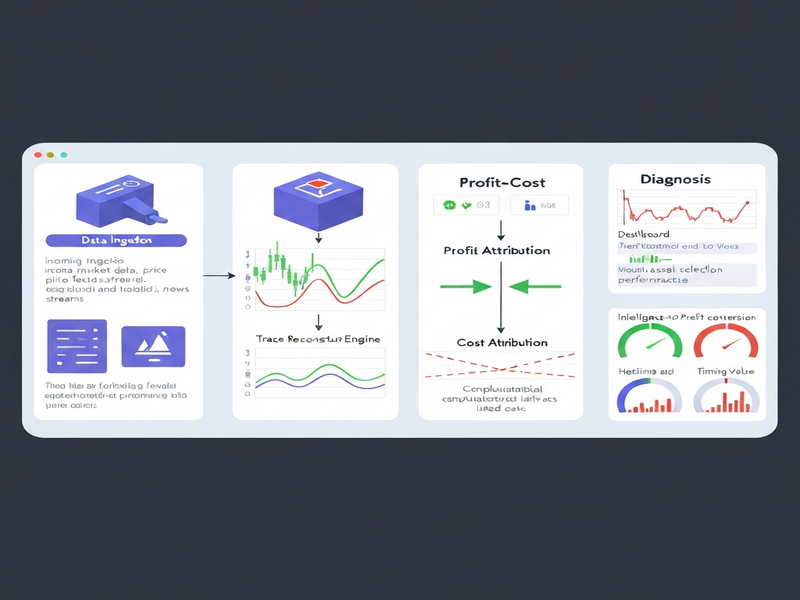
- Market feed ingestion. Real‑time price ticks and news headlines are streamed into a Data Hub.
- LLM reasoning module. The agent receives the latest context, runs a prompt chain (e.g., “Summarize sentiment → Forecast price → Propose trade”), and logs each sub‑prompt with a unique trace ID.
- Tool invocation layer. When the LLM decides to call an external API (e.g., risk calculator, order router), the call is wrapped by a Tool Wrapper that records start/end timestamps, token usage, and monetary fees.
- Execution engine. Orders generated by the LLM are sent to a broker API. Execution outcomes (fills, slippage) are logged alongside the originating trace ID.
- TradeLens aggregation. A background service pulls logs from the Data Hub, Tool Wrapper, and Execution Engine, stitching them into a unified trace graph.
- Attribution & cost analysis. The graph is traversed to assign each P&L delta to the originating reasoning node, while the cost model tallies compute and API expenses.
- Dashboard & alerts. Traders receive a live “intelligence‑to‑profit” score; if the score drops below a threshold, the system can auto‑scale down model usage or switch to a cheaper fallback model.
What sets TradeLens apart is its trace‑grounded approach: instead of treating the LLM as a black box, it treats every inference as a first‑class citizen that can be audited, costed, and linked to financial outcomes.
Evaluation & Results
The authors conducted a multi‑dimensional evaluation covering three backbone models, three capital scales (USD 10K, 100K, 1M), two trading frequencies (high‑frequency intraday vs. low‑frequency daily), and two architectural styles (single‑agent loop vs. hierarchical multi‑agent). Key aspects of the experimental design:
- Dataset. Five months of equity and futures data (2023‑2024) combined with a news‑sentiment corpus.
- Cost baseline. GPU pricing from major cloud providers, plus per‑API call fees for market data and risk services.
- Metrics. Traditional performance (Sharpe, CAGR) plus the novel Intelligence‑to‑Profit Ratio (IPR) = (Attributed Profit – Cost) / Cost.
Results highlighted three major patterns:
| Model | Failure Mode | IPR (Typical) |
|---|---|---|
| DeepSeek‑V3.2 | Poor asset selection – the model often chose low‑volatility stocks, limiting upside. | ‑0.12 (negative) |
| GLM‑4.7 | Negative timing – frequent late‑entry positions caused slippage. | ‑0.05 (negative) |
| Claude‑3.5 | Balanced – modest profit with reasonable compute cost. | 0.18 (positive) |
Capital scale and trading frequency acted as amplifiers: larger capital magnified timing errors, while high‑frequency trading inflated compute costs, pushing otherwise viable models below the profitability threshold. Architectural experiments showed that hierarchical agents could isolate expensive reasoning steps, improving IPR by up to 22% compared to a monolithic loop.
Why This Matters for AI Systems and Agents
For practitioners building AI‑driven finance products, TradeLens offers a concrete methodology to answer the question “Is my agent paying for its own intelligence?” rather than relying on opaque performance dashboards. The implications are far‑reaching:
- Cost‑aware orchestration. System designers can embed TradeLens diagnostics into orchestration layers to automatically route high‑value decisions to larger models and low‑value ones to cheaper alternatives.
- Risk management. By attributing loss to specific reasoning steps, compliance teams gain audit trails that satisfy regulatory scrutiny of AI‑generated trades.
- Product pricing. Firms can price AI‑enhanced trading services based on a transparent cost‑plus model, improving client trust.
- Strategic model selection. The IPR metric helps data scientists choose models that maximize net profit, not just raw predictive accuracy.
These capabilities align with the broader trend of Enterprise AI platform by UBOS, where traceability and cost‑efficiency are core pillars of the offering.
What Comes Next
While TradeLens marks a significant step forward, several open challenges remain:
- Real‑time attribution latency. Current implementations batch logs every few seconds; sub‑second attribution would enable instant throttling of expensive model calls.
- Cross‑asset generalization. Extending the framework to crypto, FX, and fixed‑income markets will require new cost models for differing latency regimes.
- Human‑in‑the‑loop validation. Integrating trader feedback to refine the attribution engine could improve the fidelity of profit‑to‑reasoning mapping.
- Open‑source ecosystem. Publishing standardized trace schemas would allow third‑party tools (e.g., Workflow automation studio) to plug into TradeLens without custom adapters.
Future research may explore reinforcement‑learning agents that internalize the IPR signal as part of their reward function, effectively teaching the model to “think cheap.” Additionally, hybrid architectures that combine symbolic reasoning with LLMs could reduce token usage while preserving interpretability.
References
- Duan, Q., Li, C., Wang, C., et al. “Can Agentic Trading Systems Pay for Their Own Intelligence?” arXiv:2607.10286v1, 2026.
- Additional background on LLM agents in finance: see recent surveys on AI‑driven trading (e.g., “LLM Agents for Market Prediction,” 2025).
Andrii Bidochko
CTO UBOS
Andrii Bidochko is an AI entrepreneur and researcher focused on AI agents, reinforcement learning, and autonomous systems. He writes about the technologies shaping the future of machine intelligence, from frontier models and agent architectures to real-world AI applications.