

- Updated: July 30, 2026
- 7 min read
Information-seeking failures of large language models in agentic clinical reasoning
Direct Answer
The paper introduces an agentic evaluation framework that systematically probes how large language models (LLMs) seek and use information when performing clinical reasoning tasks, revealing that current models frequently settle for incomplete data, anchor on early cues, and close investigations prematurely. This matters because such information‑seeking failures can translate into unsafe recommendations in real‑world medical decision support systems.
Background: Why This Problem Is Hard
Clinical reasoning is not a static quiz; it is an iterative process where physicians continuously generate hypotheses, order tests, interpret results, and revise plans under uncertainty. Traditional benchmarks—multiple‑choice exams or static case vignettes—measure factual recall but ignore the search behavior that underpins sound diagnosis. LLMs excel at pattern matching and can reproduce textbook knowledge, yet they lack an explicit mechanism to decide what to ask next or when to stop gathering evidence. Existing approaches typically:
- Prompt the model with a fully specified case and evaluate the final answer, bypassing the intermediate questioning steps.
- Rely on chain‑of‑thought prompting, which encourages reasoning but does not guarantee that the model will request the most informative tests.
- Assume that a single pass through the prompt captures the entire reasoning trajectory, ignoring the dynamic, feedback‑driven nature of real clinical workflows.
These simplifications mask critical failure modes that only emerge when a model must act as an autonomous “agent”—deciding which lab, imaging, or history question to request next. In high‑stakes domains like hematologic oncology, a missed test or a premature conclusion can have life‑changing consequences.
What the Researchers Propose
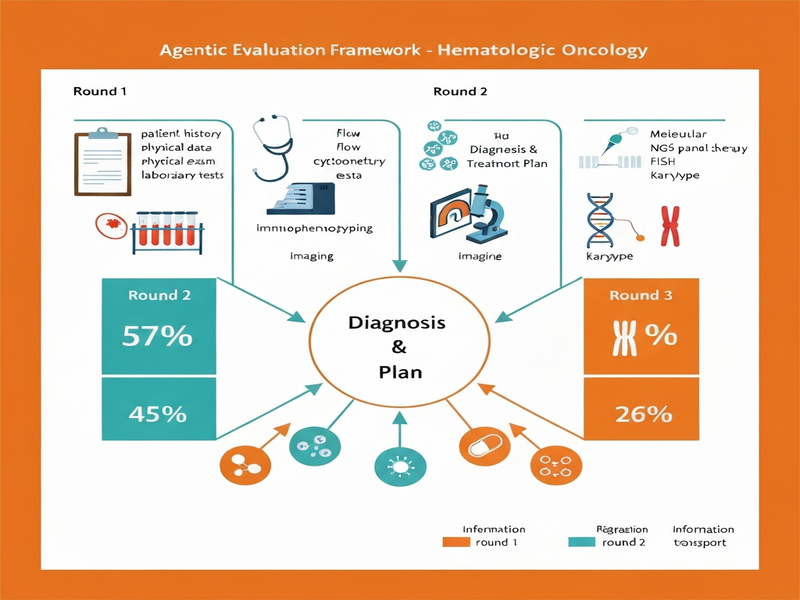
The authors present a structured agentic clinical reasoning benchmark that turns each medical case into a sequential decision‑making problem. The framework consists of three core components:
- Information‑Seeking Engine: A simulated electronic health record (EHR) that exposes a catalog of possible queries (e.g., lab panels, imaging studies, targeted questions).
- LLM Agent: The language model, equipped with a prompting schema that allows it to request information, receive the simulated result, and update its internal hypothesis.
- Evaluation Oracle: A rule‑based adjudicator that knows the ground‑truth diagnosis and can score the agent on accuracy, efficiency (number of queries), and adherence to clinical best practices.
By iterating through this loop, the benchmark captures not only the final diagnostic label but also the entire trajectory of information acquisition, enabling a fine‑grained analysis of where and why the model deviates from optimal clinical behavior.
How It Works in Practice
The workflow can be visualized as a four‑step cycle:
- Initialize: The LLM receives a brief patient presentation (age, presenting complaint, limited vitals).
- Query Generation: Using a “request‑info” prompt, the model proposes one or more diagnostic actions (e.g., “order CBC with differential”).
- Simulated Response: The Information‑Seeking Engine returns a synthetic result that mirrors real‑world lab values or imaging findings, preserving statistical realism.
- Update & Decide: The model incorporates the new data, revises its differential diagnosis, and either requests additional information or outputs a final recommendation.
What sets this approach apart is the explicit separation between knowledge recall and information acquisition. The LLM is forced to treat the EHR as an external tool, mirroring how clinicians interact with decision‑support systems. The authors also embed safeguards to prevent “cheating” (e.g., the model cannot peek at hidden data) and to enforce a maximum query budget, encouraging efficiency.
Evaluation & Results
The researchers evaluated three state‑of‑the‑art LLM families (GPT‑4, Claude‑2, and LLaMA‑2) across 200 hematologic oncology cases sourced from peer‑reviewed case repositories. Evaluation focused on three axes:
- Diagnostic Accuracy: Percentage of cases where the final recommendation matched the oracle’s ground truth.
- Query Efficiency: Average number of information requests per case, normalized against an expert baseline.
- Failure Mode Classification: Manual tagging of error patterns into categories such as “search satisficing,” “anchoring bias,” and “premature closure.”
Key findings include:
- All models achieved >85% accuracy when provided the full case upfront, confirming strong knowledge recall.
- When constrained to the agentic loop, accuracy dropped to 62% for GPT‑4, 58% for Claude‑2, and 54% for LLaMA‑2, highlighting a gap between static knowledge and dynamic reasoning.
- On average, models issued 3.2 queries per case, whereas expert clinicians used 4.7, indicating a tendency toward search satisficing—stopping early once a plausible answer appears.
- Anchoring bias was observed in 41% of erroneous runs: the model clung to an early hypothesis despite contradictory evidence.
- Premature closure—halting the information‑seeking loop before reaching a confidence threshold—accounted for 27% of failures.
These results demonstrate that while LLMs possess impressive medical knowledge, their autonomous information‑seeking behavior remains brittle and prone to classic cognitive biases.
Why This Matters for AI Systems and Agents
For practitioners building AI‑driven clinical assistants, the study offers three actionable insights:
- Design for Explicit Querying: Embedding a structured “ask‑the‑EHR” interface forces the model to externalize its uncertainty, making failures observable and correctable.
- Incorporate Bias‑Mitigation Loops: Real‑time checks—such as confidence scoring or second‑opinion prompts—can catch anchoring and premature closure before a recommendation reaches a clinician.
- Benchmark Beyond Accuracy: Evaluations should include efficiency and bias metrics, not just final diagnosis, to reflect the true cost of unsafe information‑seeking.
These principles align with emerging best practices for UBOS platform overview, where modular agents can be orchestrated to query external data sources, apply confidence thresholds, and hand off to human experts when needed. Moreover, the Workflow automation studio enables developers to embed the agentic loop into existing hospital IT stacks, ensuring that every step of the reasoning process is logged and auditable.
What Comes Next
Despite its contributions, the benchmark has limitations that open fertile ground for future research:
- Domain Generalization: The current study focuses on hematologic oncology; extending the framework to cardiology, emergency medicine, and primary care will test its scalability.
- Real‑World Data Integration: Simulated lab results are statistically plausible but lack the noise and missingness of actual EHR data. Coupling the engine with de‑identified patient records could reveal additional failure modes.
- Multi‑Agent Collaboration: Introducing specialist sub‑agents (e.g., a pathology bot) could mitigate anchoring by providing alternative perspectives.
- Human‑in‑the‑Loop Evaluation: Measuring how clinicians interact with the agentic system in a live setting will validate whether bias‑mitigation strategies translate into safer care.
Developers interested in prototyping these extensions can leverage the Chroma DB integration for vector‑based storage of patient embeddings, or explore the OpenAI ChatGPT integration to experiment with newer model versions within the UBOS ecosystem.
Visual Illustration of the Framework
Conclusion & Call to Action
The “Information‑seeking failures of large language models in agentic clinical reasoning” paper shines a light on a blind spot that could undermine the safety of AI‑augmented healthcare. By exposing how LLMs prematurely settle on hypotheses, anchor to early cues, and under‑query critical data, the work provides a roadmap for building more transparent, bias‑aware agents. Organizations aiming to deploy trustworthy medical AI should adopt the agentic evaluation paradigm, integrate robust query interfaces, and continuously monitor for cognitive‑style errors.
Ready to experiment with agentic workflows? Visit the UBOS homepage to explore tools that let you prototype, test, and scale AI agents that respect the rigorous demands of clinical reasoning.
For the full technical details, see the original preprint: Information‑seeking failures of large language models in agentic clinical reasoning.
Andrii Bidochko
CTO UBOS
Andrii Bidochko is an AI entrepreneur and researcher focused on AI agents, reinforcement learning, and autonomous systems. He writes about the technologies shaping the future of machine intelligence, from frontier models and agent architectures to real-world AI applications.