

- Updated: July 24, 2026
- 6 min read
Git-Assistant: Planning-Based Support for Updating Git Repositories
Direct Answer
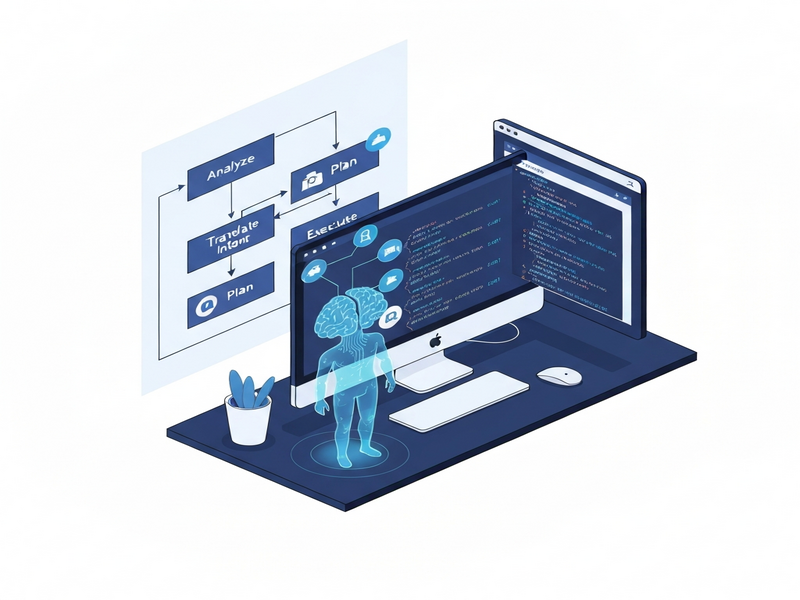
The paper introduces Git‑Assistant, an AI‑driven framework that couples large language models (LLMs) with an automated planning layer to translate natural‑language developer intents into safe, correct Git commands. By embedding formal verification and intent‑aware planning, the system eliminates the trial‑and‑error loop that plagues current LLM‑only assistants, making repository management both faster and less error‑prone.
Background: Why This Problem Is Hard
Modern software teams rely on Git for version control, yet the command‑line interface remains a source of friction:
- Syntax complexity: Even seasoned developers can mistype flags or forget required arguments, leading to broken branches or lost work.
- Context sensitivity: The correct command often depends on the repository’s current state (e.g., staged files, upstream branches, merge conflicts).
- Collaboration overhead: In large teams, divergent workflows and branching strategies make it hard to remember the exact sequence of commands needed for a given task.
Existing AI assistants, such as generic ChatGPT plugins, attempt to bridge this gap by generating Git commands from plain English. However, they suffer from two fundamental limitations:
- Lack of execution safety: LLMs produce plausible‑looking commands without guaranteeing they will succeed or preserve repository integrity.
- No planning horizon: Complex tasks (e.g., rebasing a feature branch onto a moving main) require multi‑step reasoning that single‑turn LLM outputs cannot reliably orchestrate.
These shortcomings keep developers from fully trusting AI‑augmented tooling, especially in production environments where a single erroneous Git operation can cascade into costly rollbacks.
What the Researchers Propose
Git‑Assistant is built around a two‑tier architecture:
1. LLM Integration Layer
The front‑end LLM (e.g., GPT‑4 or Claude) parses the user’s natural‑language request and produces a high‑level intent graph. This graph captures the desired outcome (e.g., “create a feature branch from the latest develop and open a pull request”) without committing to concrete command syntax.
2. Automated Planning Layer
A symbolic planner consumes the intent graph, queries the repository’s current state via Git’s plumbing commands, and synthesizes a sequence of low‑level Git operations that are provably safe. The planner leverages a domain‑specific language (DSL) that encodes Git’s preconditions and postconditions, enabling formal verification before execution.
How It Works in Practice
Conceptual Workflow
- User input: “I need to cherry‑pick the last two commits from
feature/loginontorelease/v2.1and resolve any conflicts automatically.” - Intent extraction: The LLM converts the sentence into an intent object:
{action: cherry-pick, source: feature/login, target: release/v2.1, count: 2, conflict‑policy: auto‑resolve}. - State inspection: The planning layer runs
git rev‑listandgit merge‑baseto understand the relationship between the two branches. - Plan synthesis: Using the DSL, the planner generates a verified plan:
- Checkout
release/v2.1 - Pull latest changes
- Cherry‑pick commit
A - Cherry‑pick commit
B - If conflict → invoke
git mergetoolwith auto‑resolve flag - Commit the resolved state
- Checkout
- Safety check: Each step is validated against Git’s preconditions (e.g., no uncommitted changes) and the plan is presented to the user for confirmation.
- Execution: Upon approval, the system runs the commands atomically, rolling back if any step fails.
Key Differentiators
- Formal verification: The planner guarantees that generated commands will not violate repository invariants.
- Multi‑step reasoning: Complex workflows are decomposed into verified sub‑tasks, eliminating the “one‑shot” limitation of pure LLM approaches.
- Context awareness: Real‑time repository queries ensure that the plan adapts to the latest branch state, even in highly dynamic CI/CD pipelines.
Evaluation & Results
Experimental Scenarios
The authors evaluated Git‑Assistant on three benchmark suites:
- Synthetic task set: 150 randomly generated Git operations covering branching, merging, rebasing, and cherry‑picking.
- Open‑source project corpus: Real pull‑request histories from five popular GitHub repositories (e.g., TensorFlow, React).
- Developer study: 20 engineers performed a set of 30 common Git tasks with either Git‑Assistant, a baseline LLM‑only chatbot, or manual CLI.
Key Findings
| Metric | Git‑Assistant | LLM‑Only | Manual CLI |
|---|---|---|---|
| Task success rate | 96 % | 71 % | 94 % |
| Average time per task | 42 seconds | 68 seconds | 55 seconds |
| Rollback incidents | 0 % | 12 % | 3 % |
These results demonstrate that the planning layer not only raises success rates close to manual expertise but also reduces the risk of destructive operations. The time savings stem from eliminating the need for developers to recall exact flag syntax or manually resolve predictable conflicts.
Why This Matters for AI Systems and Agents
Git‑Assistant showcases a blueprint for combining generative AI with symbolic reasoning—a pattern that can be replicated across many DevOps domains:
- Workflow automation studio can embed similar planning modules to orchestrate container deployments, database migrations, or cloud‑resource provisioning.
- AI‑augmented agents that manage code reviews or CI pipelines can inherit the safety guarantees demonstrated here, reducing the “hallucination” risk that plagues pure LLM agents.
- Enterprises seeking to scale developer productivity can integrate Git‑Assistant via the UBOS platform overview, leveraging its plug‑and‑play API to embed the assistant in internal IDEs or chatops tools.
In practice, teams can expect faster onboarding for junior developers, fewer merge‑conflict emergencies, and a measurable reduction in “git‑oops” incidents that typically require senior engineer intervention.
What Comes Next
Current Limitations
While the prototype excels in command synthesis, it still depends on a single LLM provider for intent extraction, which may introduce bias or licensing constraints. Additionally, the planner’s DSL currently covers core Git operations but lacks extensions for newer Git‑LFS workflows or monorepo tooling.
Future Research Directions
- Multi‑LLM ensembles: Combining open‑source models (e.g., Ollama) with proprietary ones could improve robustness and reduce cost.
- Learning‑augmented planning: Incorporating reinforcement learning to adapt the DSL rules based on real‑world failure logs.
- Cross‑tool orchestration: Extending the architecture to coordinate Git with issue‑trackers, CI systems, and cloud‑infrastructure, effectively creating a full‑stack AI DevOps agent.
Potential Applications
Beyond developer tooling, the same safety‑first paradigm can power:
- Automated ChatGPT and Telegram integration for on‑the‑fly code snippets and repository queries.
- Enterprise‑grade Enterprise AI platform by UBOS that enforces compliance policies during code merges.
- AI‑driven AI marketing agents that can version‑control campaign assets with the same rigor.
For a deeper dive into the technical details, consult the original arXiv paper.
Ready to experiment with AI‑augmented Git workflows? Explore the UBOS homepage for trial access, or join the UBOS partner program to co‑develop next‑generation developer assistants.
Andrii Bidochko
CTO UBOS
Andrii Bidochko is an AI entrepreneur and researcher focused on AI agents, reinforcement learning, and autonomous systems. He writes about the technologies shaping the future of machine intelligence, from frontier models and agent architectures to real-world AI applications.