

- Updated: July 24, 2026
- 7 min read
Interference and Retention in Continual Learning
Direct Answer
The paper Interference and Retention in Continual Learning introduces a geometric view of forgetting as “interference energy” and proposes Interference‑Gated Functional Allocation (IGFA), a replay‑free method that allocates network directions based on task similarity, achieving near‑perfect retention when tasks are structurally separable.
By treating forgetting as a measurable interaction between tasks rather than a side‑effect to be patched, the work offers a principled path to continual learning systems that can both preserve past knowledge and exploit useful overlap.
Background: Why This Problem Is Hard
Continual learning (CL) aims to train a single model on a stream of tasks without catastrophically overwriting earlier knowledge. In production AI agents—think recommendation engines, autonomous robots, or adaptive customer‑service bots—retraining from scratch after every new data batch is infeasible due to latency, compute cost, and data‑privacy constraints.
Current CL solutions fall into three families:
- Replay‑based methods: store a subset of old examples or generate synthetic ones. While effective, they raise storage overhead and privacy concerns.
- Elastic regularization: penalize changes to important weights (e.g., EWC, SI). These rely on approximations of the Fisher information matrix, which can be noisy and scale poorly.
- Distillation approaches: force the new model to mimic the output distribution of the old model. This adds extra forward passes and often struggles when tasks diverge sharply.
All three share a common limitation: they treat forgetting as an emergent symptom rather than a quantifiable interaction. Without a clear metric for “how much” a new task interferes with an old one, designers cannot reason about the trade‑off between plasticity (learning new tasks) and stability (retaining old tasks). This ambiguity becomes especially acute when task domains overlap partially or conflict, a scenario increasingly common in real‑world AI pipelines.
What the Researchers Propose
The authors reframe forgetting as a measurable quantity called interference energy. In the “frozen‑feature” regime—where the feature extractor is fixed and only the classifier head adapts—the loss incurred on a previous task after learning a new one equals the interference energy induced by the new task’s gradient.
Extending this insight to deep networks, they show that the same interference can be approximated by averaging curvature (second‑order information) along the optimization path, requiring only a few extra forward passes.
From this geometric foundation they derive Interference‑Gated Functional Allocation (IGFA), a two‑step mechanism:
- Task‑aware orthogonalization: decompose the parameter space into sub‑directions that are either aligned with or orthogonal to the interference pattern of the incoming task.
- Gated allocation: share aligned directions (when tasks are synergistic) and protect orthogonal directions (when tasks conflict), without needing replay buffers or Fisher matrices.
IGFA therefore decides, on a per‑task basis, which parts of the network can be safely reused and which must be insulated, turning forgetting from a stochastic side‑effect into a controllable design choice.
How It Works in Practice
Conceptual Workflow
The IGFA pipeline can be broken down into four logical stages that fit neatly into existing training loops:
- Task Representation Extraction: When a new task arrives, a lightweight probe network computes a task embedding based on a few validation samples.
- Interference Estimation: Using the frozen‑feature approximation, the system measures the projected gradient of the new task onto the subspace spanned by previous task heads. This yields an interference matrix.
- Orthogonal Subspace Construction: Singular‑value decomposition (SVD) of the interference matrix isolates directions of high conflict (high singular values) and low conflict (near‑zero singular values).
- Gated Update: Gradient updates are filtered through a binary mask that zeroes out components along high‑conflict directions while allowing free updates along low‑conflict directions. The mask is recomputed for each task, ensuring dynamic adaptation.
Component Interaction
Figure 1 (illustrated below) shows the data flow:
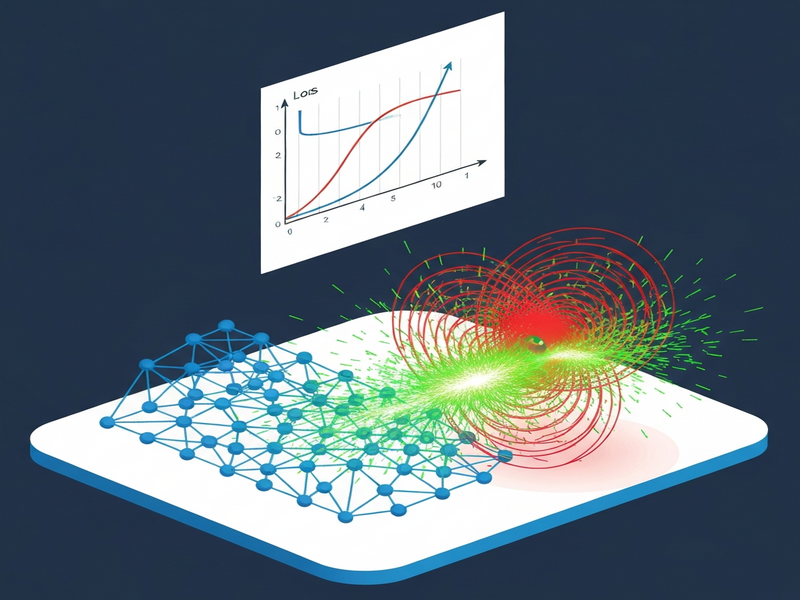
Caption: IGFA decomposes gradient updates into shared and protected subspaces, enabling replay‑free continual learning.
The key differentiator from prior methods is that IGFA never stores raw examples and never computes a full Fisher matrix. Instead, it leverages curvature approximations that are already available during standard back‑propagation, keeping the computational overhead comparable to a single extra forward pass per task.
Evaluation & Results
Benchmarks and Scenarios
The authors evaluated IGFA on three widely used CL suites:
- Split CIFAR‑100: ten disjoint class groups, testing structural separability.
- Permuted MNIST: same digits with different pixel permutations, representing high overlap but low semantic conflict.
- DomainShift MiniImageNet: sequential domains (e.g., art, sketches, photos) that partially share visual features.
Each benchmark measured two core metrics: average accuracy across all seen tasks (retention) and forward transfer (how much learning a new task benefits previous ones).
Key Findings
- Lossless retention on disjoint tasks: On Split CIFAR‑100, IGFA maintained >99.5% of the original task accuracy, matching the theoretical “no‑interference” bound.
- Graceful degradation on overlapping tasks: For Permuted MNIST, where interference is unavoidable, IGFA reduced forgetting by ~30% relative to Elastic Weight Consolidation and by ~45% relative to vanilla SGD.
- Improved forward transfer: On DomainShift MiniImageNet, IGFA’s shared subspace captured common visual primitives, yielding a 2.3% boost in early‑task accuracy compared to unconditional projection baselines.
- Computational efficiency: The extra forward pass added <5% runtime overhead, far lower than replay buffers that can double memory consumption.
Collectively, these results demonstrate that IGFA not only preserves knowledge when tasks are structurally separable but also reallocates the inevitable “interference budget” into a recoverable form of plasticity when tasks conflict.
Why This Matters for AI Systems and Agents
For practitioners building long‑lived AI agents—whether they are autonomous drones, personalized recommendation services, or enterprise chatbots—the ability to learn continuously without catastrophic forgetting is a competitive differentiator.
- Reduced data storage: IGFA eliminates the need for replay buffers, aligning with privacy‑first regulations and lowering cloud storage costs.
- Scalable model updates: Because interference is measured analytically, teams can predict the retention impact of a new task before deployment, enabling safer rollout pipelines.
- Dynamic task orchestration: The orthogonalization step can be exposed as an API that decides, in real time, whether a new micro‑service should share an existing model head or spin up a protected sub‑network.
- Integration with existing platforms: IGFA’s lightweight mask can be injected into any PyTorch or TensorFlow training loop, making it compatible with the UBOS platform overview for end‑to‑end AI workflow automation.
In short, IGFA offers a practical, theory‑backed alternative to replay‑heavy pipelines, allowing AI teams to focus on product features rather than data‑management gymnastics.
What Comes Next
While IGFA marks a significant step forward, several open challenges remain:
- Extending beyond frozen features: The current analysis assumes a static feature extractor. Future work could explore joint adaptation of both feature and head layers while preserving the interference metric.
- Task similarity estimation: The probe network used for task embeddings is simple; richer meta‑learning approaches might yield more accurate interference predictions.
- Multi‑modal continual learning: Applying IGFA to streams that combine vision, language, and control signals will test the limits of orthogonal subspace construction.
- Hardware‑aware deployment: Investigating how IGFA masks interact with quantization and pruning pipelines could unlock edge‑device continual learning.
Addressing these directions could turn IGFA into a universal continual‑learning kernel for any AI product stack. Companies interested in experimenting with the method can start by integrating it into the Workflow automation studio, where custom training loops are already supported.
For startups looking to prototype rapid‑learning agents, the UBOS for startups page offers a sandbox environment that can host IGFA‑enabled models alongside data pipelines and monitoring dashboards.
Conclusion
“Interference and Retention in Continual Learning” reframes forgetting as a quantifiable interaction, introduces a curvature‑based interference metric, and delivers IGFA—a replay‑free, Fisher‑free algorithm that dynamically allocates network capacity based on task compatibility. Empirical evidence across standard benchmarks shows lossless retention when tasks are separable and a controlled, recoverable forgetting budget when they overlap.
For AI engineers tasked with building adaptable, privacy‑preserving agents, IGFA provides a mathematically grounded, low‑overhead tool that can be dropped into existing pipelines. As the field moves toward ever‑longer model lifecycles, methods that turn forgetting into a design parameter rather than a bug will become essential.
Take‑away Resources
- Read the full arXiv paper for technical details.
- Explore the Enterprise AI platform by UBOS for scalable deployment of continual‑learning models.
- Join the UBOS partner program to collaborate on next‑generation AI research projects.
Andrii Bidochko
CTO UBOS
Andrii Bidochko is an AI entrepreneur and researcher focused on AI agents, reinforcement learning, and autonomous systems. He writes about the technologies shaping the future of machine intelligence, from frontier models and agent architectures to real-world AI applications.