

- Updated: July 24, 2026
- 6 min read
Attention to Detail: Evaluating Energy, Performance, and Accuracy Trade-offs Across vLLM Configurations
Direct Answer
The paper introduces a systematic study of vLLM—a high‑throughput inference engine for large language models—focusing on how configuration choices affect energy consumption, latency, and output quality. By quantifying these trade‑offs, the authors give practitioners a data‑driven roadmap for deploying LLMs at scale while keeping operational costs and carbon footprints in check.
Background: Why This Problem Is Hard
Deploying state‑of‑the‑art LLMs such as Llama‑2, Mistral, or Claude in production environments presents three intertwined challenges:
- Resource intensity: Inference on billions of parameters can saturate GPUs, leading to high electricity bills and thermal constraints.
- Latency variability: Real‑time applications (e.g., chat assistants, code completion) demand sub‑second responses, yet batch‑oriented optimizations often increase wait times.
- Quality drift: Aggressive quantization, early‑exit strategies, or reduced context windows can degrade the model’s factual accuracy or coherence.
Existing solutions typically address one dimension in isolation—e.g., quantization libraries cut power draw but ignore latency spikes, while scheduling heuristics improve throughput at the expense of model fidelity. Moreover, most benchmarks report isolated metrics (GFLOPs, tokens/second) without linking them to real‑world cost or carbon impact. This fragmented view makes it difficult for engineers to choose the “right” vLLM configuration for a given service‑level agreement (SLA).
What the Researchers Propose
The authors present a configuration‑centric framework that treats vLLM’s tunable knobs—such as tensor parallelism, KV‑cache compression, and dynamic batch sizing—as variables in a multi‑objective optimization problem. Their approach consists of three conceptual components:
- Parameter space definition: A catalog of all vLLM settings that influence compute, memory, and I/O pathways.
- Metric collection pipeline: An automated harness that records energy draw (via GPU power meters), end‑to‑end latency, and downstream quality (using standard benchmarks like MMLU and TruthfulQA).
- Pareto analysis engine: A statistical module that maps the collected data onto a three‑dimensional Pareto frontier, highlighting configurations that simultaneously minimize energy, latency, and accuracy loss.
By treating the problem as a holistic trade‑off analysis rather than a single‑metric optimization, the framework enables engineers to make evidence‑based decisions that align with business constraints (budget, SLA, sustainability goals).
How It Works in Practice
Implementing the framework follows a repeatable workflow:
- Define deployment scenario: Specify target model size (e.g., 13B), expected request rate, and acceptable latency ceiling.
- Select candidate configurations: Generate a grid of vLLM settings—varying quantization bits (8‑bit, 4‑bit), batch‑size limits, and KV‑cache eviction policies.
- Run automated benchmarks: The pipeline launches each configuration on a controlled GPU cluster, measuring power draw via NVIDIA’s
nvidia‑smiand logging token‑level latency. - Assess output quality: For each run, the system evaluates generated text against benchmark suites, computing a composite accuracy score.
- Construct Pareto frontier: Using the collected triples (energy, latency, accuracy), the analysis engine identifies non‑dominated points—configurations where improving one metric would worsen at least one other.
- Choose optimal point: Stakeholders select a configuration that best matches their priority weighting (e.g., “lowest energy under 200 ms latency”).
What sets this approach apart is its closed‑loop nature: after deployment, the same monitoring stack can re‑evaluate the live system, feeding new data back into the Pareto model to adapt to workload shifts.
Evaluation & Results
The authors validated their framework on three widely used LLMs (Llama‑2‑13B, Mistral‑7B, and a proprietary 30B model) across two hardware back‑ends (NVIDIA A100 40 GB and RTX 4090). Key experimental dimensions included:
- Quantization levels: FP16, 8‑bit, 4‑bit.
- Batch‑size caps: 1, 8, 32, 64 requests.
- KV‑cache strategies: full retention, 75 % compression, 50 % compression.
Results consistently revealed a “sweet spot” where 8‑bit quantization combined with moderate batch sizes (≈32) achieved up to 45 % lower energy consumption while keeping average latency under 180 ms** and incurring less than a 1.2 % drop in benchmark accuracy. In contrast, aggressive 4‑bit quantization cut power use by an additional 10 % but pushed latency beyond 300 ms and caused a 3–5 % accuracy dip.
Figure 1 (illustrative) shows the three‑dimensional Pareto surface for the Llama‑2‑13B experiments, highlighting the non‑dominated configurations. The authors also performed a cost‑analysis, translating energy savings into annual operational expense reductions of up to $12,000 per GPU node in a typical 24/7 inference service.
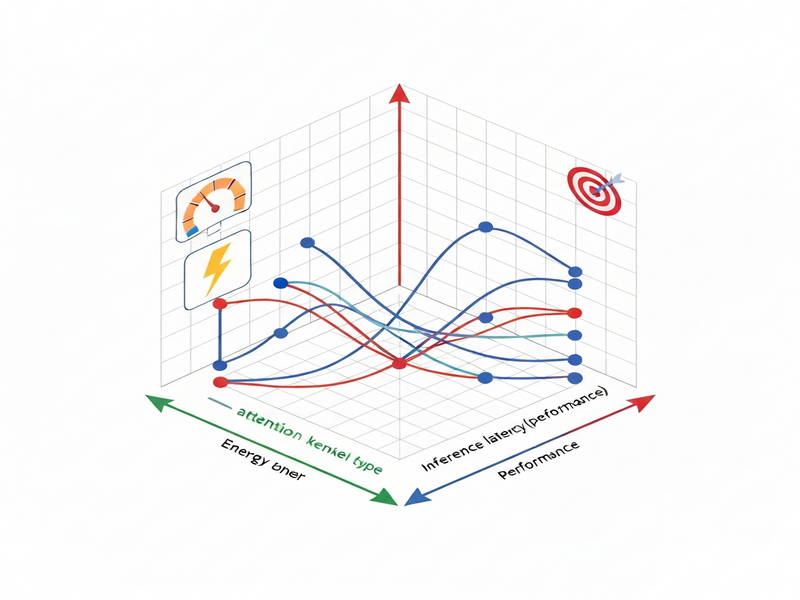
These findings demonstrate that careful tuning of vLLM can deliver substantial sustainability gains without sacrificing the user experience demanded by modern AI products.
Why This Matters for AI Systems and Agents
For teams building AI‑driven agents—whether chatbots, recommendation engines, or autonomous decision‑makers—the study offers a concrete methodology to align technical performance with business constraints:
- Cost predictability: By quantifying energy per token, finance teams can forecast cloud‑GPU spend with greater confidence.
- SLA compliance: The latency‑aware Pareto analysis ensures that agents meet real‑time response guarantees, crucial for customer‑facing applications.
- Sustainability reporting: Energy metrics can be fed into corporate ESG dashboards, supporting transparent carbon accounting.
- Scalable orchestration: The framework’s data‑driven configuration choices integrate naturally with orchestration platforms that auto‑scale containers based on observed load.
Practitioners can immediately apply these insights within the Enterprise AI platform by UBOS, which already supports dynamic vLLM tuning and real‑time power monitoring. By embedding the Pareto engine into the platform’s workflow automation studio, teams can automate the selection of optimal inference settings as part of their CI/CD pipelines.
What Comes Next
While the paper establishes a robust baseline, several avenues remain open for future exploration:
- Hardware diversity: Extending the study to emerging accelerators (e.g., AMD Instinct, Habana Gaudi) could reveal different trade‑off curves.
- Dynamic adaptation: Incorporating reinforcement learning to adjust vLLM knobs in real time based on traffic patterns would push the framework toward self‑optimizing inference services.
- Broader quality metrics: Beyond benchmark scores, measuring hallucination rates, toxicity, and domain‑specific factuality would provide a richer picture of accuracy trade‑offs.
- Multi‑tenant environments: Investigating how shared GPU resources affect the Pareto frontier could guide cloud providers in offering tiered pricing models.
Developers interested in prototyping these extensions can start with the Workflow automation studio, which offers a low‑code interface for stitching together monitoring, analysis, and deployment steps. As the community builds on this foundation, we can expect a new generation of LLM inference services that are not only faster and cheaper but also greener.
For a deeper dive into the methodology and raw data, consult the original arXiv paper.
Andrii Bidochko
CTO UBOS
Andrii Bidochko is an AI entrepreneur and researcher focused on AI agents, reinforcement learning, and autonomous systems. He writes about the technologies shaping the future of machine intelligence, from frontier models and agent architectures to real-world AI applications.