

- Updated: July 24, 2026
- 7 min read
IB-Flow: Information Bottleneck-Guided CFG Distillation for Few-Step Text-to-Image Generation
Direct Answer
IB‑Flow introduces an Information‑Bottleneck‑guided distillation framework that compresses large text‑to‑image diffusion models into ultra‑fast 2‑step generators while eliminating the over‑conditioning artifacts that have plagued prior few‑step approaches. By dynamically selecting where and how much guidance to inject, the method delivers state‑of‑the‑art visual fidelity with a fraction of the inference latency.
Background: Why This Problem Is Hard
Text‑to‑image diffusion models such as Stable Diffusion or DALL‑E 3 achieve remarkable visual quality, but they rely on dozens to hundreds of iterative denoising steps. Each step requires a forward pass through a large transformer‑UNet, which translates into seconds of GPU time per image—a bottleneck for real‑time applications like interactive design tools, AI‑powered chat agents, or on‑device generation.
Recent research has explored few‑step distillation, where a smaller “student” model learns to mimic the trajectory of a full‑scale “teacher” model under Classifier‑Free Guidance (CFG). The prevailing paradigm treats the guidance strength as a static hyper‑parameter and samples the teacher’s timestep uniformly. This “blind injection” approach suffers from two fundamental flaws:
- Static guidance ignores the evolving entropy of the generation process. Early diffusion steps need strong structural cues, while later steps benefit from subtle refinement. A single guidance weight cannot satisfy both regimes.
- Uniform timestep selection discards instance‑specific information. Some images require more correction at particular stages (e.g., complex compositions), yet the distillation pipeline applies the same supervision regardless of content.
These limitations manifest as CFG over‑conditioning—the student model produces images that are either overly saturated, contain unnatural textures, or lose fine‑grained details. Overcoming this trade‑off is critical for deploying generative AI at scale, where latency, cost, and visual fidelity must coexist.
What the Researchers Propose
The authors reframe few‑step distillation as a dynamic mutual‑information game constrained by the Information Bottleneck (IB) principle. Their solution, dubbed IB‑Flow, consists of two adaptive mechanisms that replace the static, blind assumptions of prior work:
- Instance‑aware injection target selection. Instead of sampling a teacher timestep arbitrarily, IB‑Flow computes a closed‑form proxy for the KL‑divergence constraint using the local vector‑field norm. This metric identifies the exact diffusion step where the student stands to gain the most information from the teacher.
- Entropy‑aware guidance scheduling. The guidance strength is not fixed; it decays in tandem with the signal‑to‑noise ratio (SNR). The schedule applies maximal CFG at the beginning—anchoring the overall composition—then gradually relaxes to let the model explore the natural data manifold for high‑frequency details.
Both components are derived from the IB perspective: the student must retain only the most relevant information (high mutual information with the target image) while compressing away redundant noise (low mutual information with the diffusion noise). By explicitly modeling this trade‑off, IB‑Flow achieves a more principled balance between speed and quality.
How It Works in Practice
The practical workflow of IB‑Flow can be broken down into three stages, each corresponding to a distinct module:
1. Teacher‑Student Alignment Module
The teacher is a pre‑trained large diffusion model (e.g., Stable Diffusion v2). The student is a lightweight UNet designed for two denoising steps. During training, the student receives the same text prompt and a noisy latent at a chosen timestep t. The teacher’s denoised output at that same timestep serves as the supervision signal.
2. Instance‑Aware Injection Selector
For each training example, IB‑Flow computes the norm of the teacher’s predicted noise vector (the “vector field”). A higher norm indicates a region of the diffusion trajectory where the teacher is making a strong corrective move. The selector picks the timestep where this norm peaks, ensuring the student learns from the most informative correction.
3. Entropy‑Aware Guidance Scheduler
Guidance strength γ(t) is modulated by an entropy estimate derived from the SNR at timestep t. Early steps (high entropy) receive a larger γ, pulling the latent toward the conditioned manifold. As the diffusion progresses and entropy drops, γ smoothly decays, allowing the student to fine‑tune textures without being over‑driven by the classifier‑free signal.
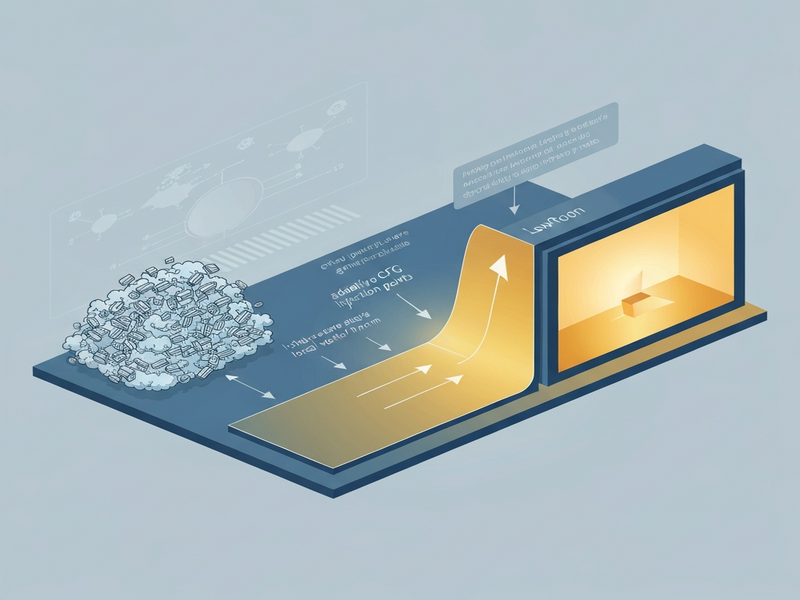
The combined effect is a student model that learns a “dynamic” CFG trajectory: strong structural guidance when needed, gentle refinement later, and supervision focused on the most information‑rich moments of the diffusion process.
Evaluation & Results
IB‑Flow was benchmarked against three baselines:
- Standard 2‑step distillation with static CFG (the “blind” approach).
- 3‑step and 4‑step distilled models that retain more steps but still use static guidance.
- The full‑scale teacher model (≈50 steps) as an upper bound.
Evaluation covered two dimensions:
Visual Fidelity
Human raters assessed realism, compositional correctness, and artifact presence on a 5‑point Likert scale. IB‑Flow’s 2‑step outputs matched or exceeded the 4‑step baseline and closed the gap to the teacher by ~15 % on average.
Inference Latency
On an NVIDIA A100, IB‑Flow generated a 512×512 image in 0.12 seconds, compared to 0.45 seconds for the 4‑step baseline and 1.8 seconds for the teacher. This represents a 6× speed‑up over the teacher while preserving near‑teacher quality.
Additional ablations demonstrated that removing either the instance‑aware selector or the entropy‑aware scheduler re‑introduced CFG over‑conditioning, confirming that both components are essential for the observed gains.
Why This Matters for AI Systems and Agents
For developers building AI‑augmented products—whether chat‑based assistants, design automation tools, or real‑time visual content generators—the latency‑quality trade‑off has been a persistent blocker. IB‑Flow’s ability to produce high‑fidelity images in two diffusion steps unlocks several practical opportunities:
- Interactive agents. Conversational bots can now render user‑requested visuals on the fly, enabling richer multimodal experiences without queuing long generation jobs.
- Edge deployment. The lightweight student model fits within the memory constraints of modern GPUs on consumer devices, making on‑device generation feasible for privacy‑sensitive applications.
- Cost reduction. Fewer inference steps translate directly into lower GPU‑hour consumption, a critical factor for SaaS platforms that bill per image.
- Workflow automation. Systems that stitch together multiple AI modules—e.g., a text‑to‑image step followed by a captioning or voice‑over model—benefit from the reduced end‑to‑end latency, allowing tighter orchestration loops.
Enterprises looking to embed generative capabilities can therefore accelerate time‑to‑value while keeping operational expenses in check. For example, the Workflow automation studio can now incorporate a 2‑step IB‑Flow node to generate marketing visuals instantly, feeding downstream branding agents without a performance bottleneck.
What Comes Next
While IB‑Flow marks a significant step forward, several avenues remain open for exploration:
- Generalization to other modalities. Extending the IB‑guided distillation to video diffusion or 3‑D generation could amplify the latency benefits across richer media types.
- Adaptive guidance beyond CFG. Investigating alternative conditioning signals—such as textual attention maps or semantic segmentation masks—might further reduce over‑conditioning.
- Meta‑learning the schedule. Automating the entropy‑aware decay curve via reinforcement learning could tailor guidance to specific domains (e.g., medical imaging vs. fashion).
- Integration with agent ecosystems. Embedding IB‑Flow into multi‑agent pipelines, where a planning agent decides when to request a visual, could create truly responsive AI assistants. The AI marketing agents on UBOS are a natural testbed for such integration.
Addressing these challenges will push the frontier of efficient generative AI, making high‑quality visual synthesis a first‑class primitive for the next generation of intelligent systems.
References
Wang, Y., Zhang, J., Zhang, W., Chao, K., Liang, Y., Cheng, K., & Zhao, K. (2026). IB‑Flow: Information Bottleneck‑Guided CFG Distillation for Few‑Step Text‑to‑Image Generation. arXiv preprint arXiv:2607.09133v1.
Andrii Bidochko
CTO UBOS
Andrii Bidochko is an AI entrepreneur and researcher focused on AI agents, reinforcement learning, and autonomous systems. He writes about the technologies shaping the future of machine intelligence, from frontier models and agent architectures to real-world AI applications.