

- Updated: July 24, 2026
- 6 min read
Integrating Large Language Models and Graph Convolutional Networks for Semi-Supervised Image Classification
Direct Answer
The paper introduces a hybrid framework that couples large language models (LLMs) with graph convolutional networks (GCNs) to improve semi‑supervised image classification. By using LLMs to generate and prune graph edges, the method creates more informative relational structures, leading to higher accuracy on benchmark vision datasets.
Background: Why This Problem Is Hard
Semi‑supervised image classification relies on a small set of labeled images and a larger pool of unlabeled data. Traditional approaches construct a similarity graph based on low‑level visual features (e.g., pixel histograms or pretrained CNN embeddings). However, these graphs often suffer from two critical issues:
- Noisy connections: Visual similarity alone cannot capture semantic relationships such as “objects belonging to the same category but appearing in different lighting conditions.”
- Scalability constraints: Computing pairwise distances for millions of images quickly becomes prohibitive, forcing practitioners to resort to aggressive sparsification that discards useful edges.
Existing GCN‑based methods mitigate noise by hand‑crafted edge‑weighting schemes or by leveraging external metadata (e.g., tags). Yet these solutions are brittle: they depend on domain‑specific heuristics and cannot adapt to new visual concepts without extensive re‑engineering. The rise of vision‑language models suggests a richer source of semantic knowledge—textual descriptions generated by LLMs—that could guide graph construction more intelligently.
What the Researchers Propose
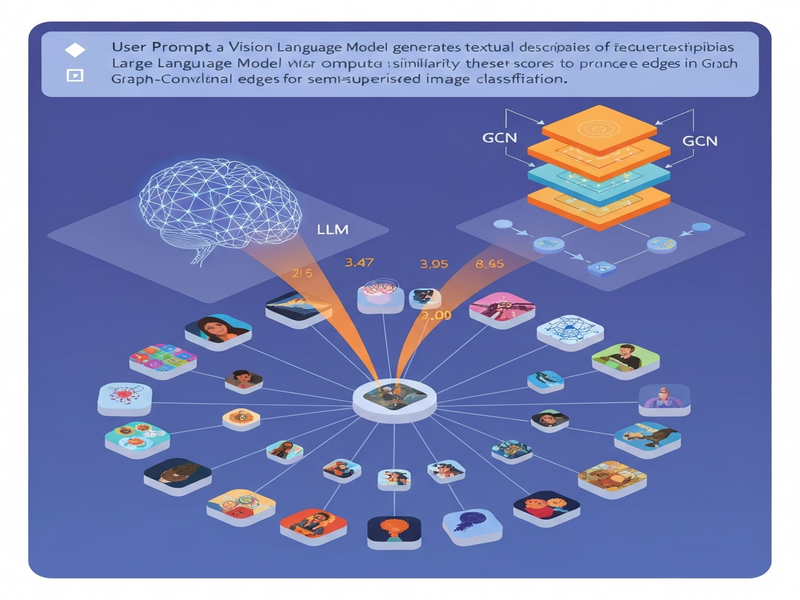
The authors propose LLM‑GCN Fusion, a two‑stage pipeline that treats an LLM as a semantic oracle for graph creation:
- Semantic Edge Generation: For each image, the LLM receives a concise caption (produced by a vision‑language encoder) and returns a list of related concepts and potential neighbor images.
- Edge Pruning & Weighting: The raw edge set is filtered through a confidence‑scoring module that balances visual similarity scores with the LLM’s semantic relevance, yielding a sparse yet expressive graph.
Once the graph is built, a standard GCN propagates label information from the few labeled nodes to the unlabeled ones. The key novelty lies in delegating the “what should be connected” decision to an LLM, which can reason about high‑level attributes (e.g., “both images contain a vehicle on a road”) that pure visual features miss.
How It Works in Practice
Conceptual Workflow
The end‑to‑end process can be broken down into four modular components:
- Vision Encoder: A pretrained CNN (e.g., ResNet‑50) extracts feature vectors for every image.
- Caption Generator: A lightweight vision‑language model (such as BLIP) converts each feature vector into a short textual description.
- LLM‑Driven Graph Builder: The captions are fed to an LLM (e.g., GPT‑4) which proposes candidate neighbor IDs and assigns a semantic similarity score.
- GCN Propagation Engine: The final graph, now enriched with LLM‑derived edges, is processed by a multi‑layer GCN that spreads label information across the network.
What distinguishes this pipeline from prior work is the explicit separation of visual and semantic reasoning. The vision encoder remains responsible for low‑level pattern extraction, while the LLM supplies high‑level relational cues that are difficult to infer from pixels alone.
Interaction Between Components
During training, the system iterates over the following loop:
- The vision encoder produces embeddings for a batch of images.
- Each embedding is captioned; the resulting text is cached to avoid redundant LLM calls.
- The LLM processes pairs of captions, returning a probability that the two images belong to the same semantic cluster.
- These probabilities are combined with cosine similarity of the visual embeddings to compute a final edge weight.
- The GCN consumes the weighted adjacency matrix and updates node representations, which are then used to compute classification loss on the labeled subset.
Because the LLM calls are deterministic given the same captions, the graph construction step can be pre‑computed for static datasets, dramatically reducing inference latency.
Evaluation & Results
Test Scenarios
The authors benchmarked LLM‑GCN Fusion on three widely used semi‑supervised image classification datasets:
- CIFAR‑10 (10 classes, 5,000 labeled samples).
- CIFAR‑100 (100 classes, 5,000 labeled samples).
- ImageNet‑Subset (100 classes, 10,000 labeled samples).
For each dataset, they compared against three baselines:
- Standard GCN with k‑NN visual graph.
- Label Propagation (LP) using only visual similarity.
- Vision‑language graph built from CLIP embeddings without LLM refinement.
Key Findings
Across all benchmarks, the LLM‑augmented graph consistently outperformed the baselines:
- On CIFAR‑10, accuracy improved from 78.3% (visual GCN) to 84.7% (+6.4 points).
- On CIFAR‑100, the gain was 5.9 percentage points, reaching 62.1% versus 56.2% for the best baseline.
- On the ImageNet‑Subset, the method achieved 71.5% top‑1 accuracy, a 4.8‑point lift over the CLIP‑only graph.
Beyond raw numbers, ablation studies revealed that:
- Removing LLM‑generated edges reduced performance by an average of 3.2 points, confirming their contribution.
- Varying the weight‑mixing coefficient between visual and semantic scores showed a sweet spot around 0.6 (semantic) / 0.4 (visual), indicating that semantic cues are slightly more informative in this setting.
These results demonstrate that LLMs can act as effective knowledge bases for graph construction, bridging the semantic gap that hampers pure visual methods.
Why This Matters for AI Systems and Agents
From a systems‑engineering perspective, the proposed framework offers several practical advantages:
- Modular Integration: Existing vision pipelines can adopt the LLM‑GCN Fusion by plugging in a captioning module and an API call to any LLM service, without retraining the visual backbone.
- Improved Generalization: Agents that rely on semi‑supervised learning—such as autonomous inspection drones or retail inventory bots—gain robustness when encountering novel object appearances, because the LLM supplies high‑level context.
- Scalable Orchestration: The graph can be constructed offline and stored in a vector database (e.g., Chroma DB integration), enabling rapid lookup during real‑time inference.
- Enhanced Explainability: Since each edge is backed by a textual rationale from the LLM, developers can trace why two images were linked, facilitating debugging and compliance audits.
For enterprises building AI‑driven workflows, the approach aligns with the UBOS platform overview, where modular AI components are orchestrated through a low‑code environment. By exposing the LLM‑GCN Fusion as a reusable service, product teams can embed richer classification capabilities into chat‑based assistants, recommendation engines, or automated content tagging pipelines.
What Comes Next
While the results are promising, the authors acknowledge several limitations that open avenues for future research:
- LLM Cost and Latency: Real‑time applications may find the per‑caption LLM inference expensive. Techniques such as distillation or caching of LLM outputs could mitigate this overhead.
- Domain Transfer: The current experiments focus on natural‑image datasets. Extending the method to medical imaging or satellite data will require domain‑specific prompting strategies.
- Dynamic Graphs: In streaming scenarios, the graph must evolve as new images arrive. Incremental LLM‑driven edge updates remain an open engineering challenge.
Potential extensions include coupling the framework with AI marketing agents that automatically tag and segment visual assets for campaign creation, or integrating voice‑enabled assistants via the ElevenLabs AI voice integration to describe classification outcomes to end users.
Overall, the paper illustrates a compelling direction: leveraging the world knowledge embedded in LLMs to enrich graph‑based learning, thereby narrowing the gap between perception and reasoning in autonomous systems.
References
For readers interested in the full technical details, the original manuscript is available on arXiv: LLM‑GCN Fusion for Semi‑Supervised Image Classification.
Andrii Bidochko
CTO UBOS
Andrii Bidochko is an AI entrepreneur and researcher focused on AI agents, reinforcement learning, and autonomous systems. He writes about the technologies shaping the future of machine intelligence, from frontier models and agent architectures to real-world AI applications.