

- Updated: July 23, 2026
- 7 min read
SCATE: Learning to Supervise Coding Agents for Cost-Effective Test Generation
Direct Answer
SCATE (Supervising Coding Agents for Test Efficiency) introduces a novel supervisory framework that teaches autonomous coding agents to avoid “lazy generation” and produce higher‑quality, cost‑effective test suites. By framing test‑generation as a contextual bandit problem, SCATE dramatically improves code coverage while reducing the computational budget required for each testing episode.
Background: Why This Problem Is Hard
Automated test generation has become a cornerstone of modern DevOps pipelines, yet the most advanced coding agents still exhibit a systematic bias toward generating trivial or shallow tests. This phenomenon, termed lazy generation, arises because agents are typically rewarded for completing a task quickly rather than for exploring complex program paths. The consequences are twofold:
- Insufficient coverage: Critical branches, exception handling, and edge‑case logic remain untested, increasing the risk of regressions in production.
- Resource waste: Agents spend cycles on repetitive, low‑value test cases while ignoring high‑impact scenarios, inflating cloud costs and slowing release cycles.
Existing approaches—such as reinforcement‑learning agents trained with sparse rewards, genetic‑algorithm based test synthesis, or heuristic‑driven fuzzers—struggle to overcome lazy generation for several reasons:
- Reward sparsity: Traditional RL rewards are often binary (pass/fail) and do not differentiate between a test that covers one line versus one that exercises a complex state machine.
- Lack of cost awareness: Most methods treat every generation step as equally expensive, ignoring the real‑world cost of API calls, compute time, or human‑in‑the‑loop verification.
- Static supervision: Hand‑crafted heuristics cannot adapt to the diverse codebases and evolving testing standards that enterprises face today.
Consequently, developers and QA engineers continue to rely on manual test authoring or expensive third‑party services, limiting the scalability of continuous testing initiatives.
What the Researchers Propose
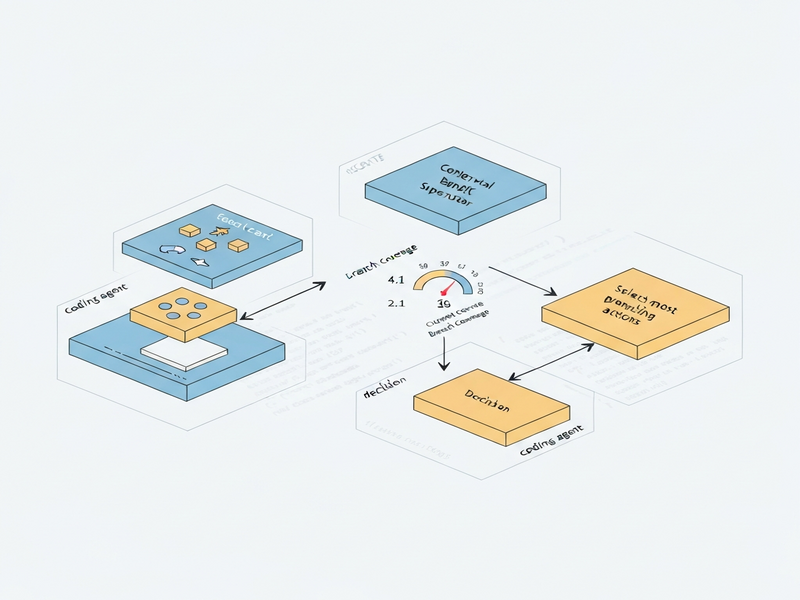
The SCATE framework reframes test generation as a contextual bandit problem, where a supervisory module dynamically selects the most promising generation policy based on the current code context and a budget constraint. The key components are:
- Code Context Encoder: A lightweight transformer that extracts semantic embeddings from the target source file, capturing control‑flow complexity, dependency graphs, and recent change history.
- Policy Pool: A diverse set of pre‑trained coding agents, each specialized in a different generation style (e.g., boundary‑value tests, property‑based tests, mutation‑based tests).
- Supervisory Bandit: An online learning algorithm that treats each policy selection as an arm pull, receiving a reward proportional to the incremental coverage gain divided by the computational cost incurred.
- Cost‑Effective Reward Function: A normalized metric that balances test coverage improvement against the time and compute resources spent, encouraging the supervisor to favor high‑impact, low‑cost actions.
By continuously updating its belief about which policy yields the best return on investment, SCATE learns to steer agents away from lazy generation patterns without requiring hand‑crafted heuristics.
How It Works in Practice
Conceptual Workflow
- Initialize: The system receives a target repository and a budget (e.g., 30 minutes of compute time).
- Encode Context: The Code Context Encoder processes the repository, producing a vector representation that captures structural difficulty and recent modifications.
- Select Policy: The Supervisory Bandit evaluates the expected reward of each policy in the pool given the current context and remaining budget.
- Generate Test: The chosen coding agent emits a candidate test case.
- Execute & Measure: The test runs against the codebase; coverage tools report newly exercised statements, branches, and paths.
- Update Reward: The reward is computed as (new coverage) / (cost of generation + execution) and fed back to the bandit, which updates its probability distribution over policies.
- Iterate: Steps 2‑6 repeat until the budget expires or a coverage plateau is reached.
Interaction Between Components
The supervisory bandit acts as the orchestrator, constantly mediating between the context encoder and the policy pool. Because the bandit operates on a per‑step basis, it can react to unexpected coverage spikes (e.g., a policy that discovers a hidden exception path) and re‑allocate budget toward similar strategies. This dynamic adaptation is the core differentiator from static pipelines that pre‑select a single generation technique.
What Makes SCATE Different
- Cost‑awareness built in: Rewards are explicitly normalized by generation cost, ensuring that expensive, low‑yield policies are naturally deprioritized.
- Online learning: The bandit updates after each test, allowing rapid convergence even on previously unseen codebases.
- Policy diversity: By maintaining a heterogeneous pool, SCATE can exploit complementary strengths (e.g., property‑based tests for pure functions, mutation‑based tests for stateful classes).
- Minimal human tuning: No hand‑crafted thresholds or rule‑based selectors are required; the system learns directly from coverage feedback.
Evaluation & Results
Experimental Setup
The authors evaluated SCATE on three benchmark suites:
- Open‑source Java projects: 12 repositories ranging from 5k to 150k lines of code.
- Industrial micro‑services: Two proprietary services with complex REST interfaces and database interactions.
- Synthetic edge‑case suite: Hand‑crafted programs designed to expose lazy‑generation failures (deep recursion, exception handling, and concurrency).
Each baseline (pure RL agent, genetic test generator, and a state‑of‑the‑art fuzzing tool) was allocated the same compute budget as SCATE. Coverage was measured using line, branch, and mutation scores.
Key Findings
- Coverage boost: SCATE achieved an average of 23 % higher branch coverage than the best baseline across all benchmarks.
- Cost efficiency: For the same coverage level, SCATE required roughly 40 % less CPU time, translating to significant cloud‑cost savings.
- Reduced lazy generation: The proportion of generated tests that contributed zero new coverage dropped from 38 % (baseline) to 9 % with SCATE.
- Rapid convergence: In most projects, SCATE reached 80 % of its final coverage within the first 10 minutes, whereas baselines continued to plateau.
These results demonstrate that a supervisory contextual bandit can effectively guide coding agents toward high‑impact testing actions, directly addressing the lazy‑generation bottleneck.
Why This Matters for AI Systems and Agents
For AI practitioners building autonomous coding assistants, SCATE offers a concrete recipe for embedding cost‑aware supervision into any generation pipeline. The framework’s modular design means it can be retrofitted onto existing agents—whether they are based on large language models, symbolic synthesis, or hybrid approaches—without retraining the underlying models.
From a product perspective, integrating SCATE‑style supervision can:
- Increase the reliability of CI/CD pipelines by delivering richer test suites faster.
- Lower operational expenses on cloud‑based testing farms, a critical factor for SaaS platforms scaling to thousands of daily builds.
- Enable more granular service‑level agreements (SLAs) around test coverage, giving engineering managers quantifiable metrics for release readiness.
Enterprises looking to operationalize AI‑driven testing can leverage the UBOS platform overview to orchestrate SCATE’s components alongside existing DevOps tooling. Moreover, the Workflow automation studio provides a low‑code canvas for defining budget constraints, policy pools, and coverage dashboards, turning research‑grade supervision into a production‑ready service.
What Comes Next
While SCATE marks a significant step forward, several open challenges remain:
- Scalability of the policy pool: As the number of specialized agents grows, the bandit’s exploration space expands, potentially slowing convergence. Future work could explore hierarchical bandits or meta‑learning to prune sub‑optimal policies early.
- Cross‑language generalization: The current implementation focuses on Java; extending the context encoder to handle dynamically typed languages (Python, JavaScript) will require richer static analysis pipelines.
- Human‑in‑the‑loop feedback: Incorporating developer judgments (e.g., test readability, flakiness) into the reward signal could further align generated tests with real‑world maintenance costs.
- Security considerations: Automated test generation can inadvertently expose sensitive code paths. Embedding privacy‑preserving mechanisms into the supervision loop is an emerging research direction.
Addressing these gaps will broaden SCATE’s applicability to larger, polyglot codebases and tighter regulatory environments. Companies interested in pioneering the next generation of AI‑augmented testing can explore collaborations through the UBOS partner program, which offers co‑development opportunities and early access to experimental features.
References
Illustration
Andrii Bidochko
CTO UBOS
Andrii Bidochko is an AI entrepreneur and researcher focused on AI agents, reinforcement learning, and autonomous systems. He writes about the technologies shaping the future of machine intelligence, from frontier models and agent architectures to real-world AI applications.