

- Updated: July 23, 2026
- 7 min read
MultiView-Bench: A Diagnostic Benchmark for World-Centric Multi-View Integration in VLMs
Direct Answer
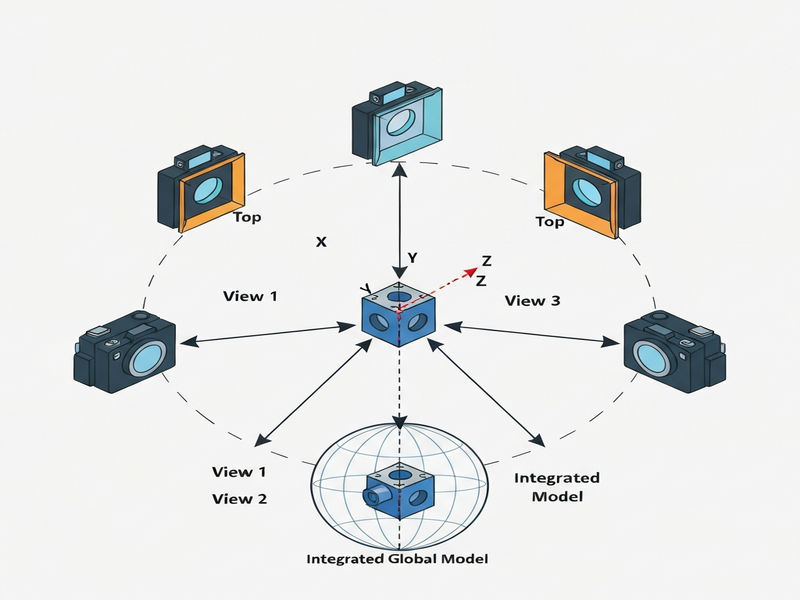
MultiView‑Bench is a newly released diagnostic benchmark that measures how well vision‑language models (VLMs) can fuse observations from multiple camera viewpoints into a single, world‑centric 3D mental model. It matters because the ability to reason about allocentric spatial relationships is a prerequisite for real‑world tasks such as robotic assembly, autonomous navigation, and immersive AR/VR experiences.
Background: Why This Problem Is Hard
Most existing VLM evaluations focus on single‑image captioning, object detection, or limited‑view reasoning (e.g., “what’s in front of the car”). Those tasks are inherently egocentric—they tie spatial language to the camera that captured the image. In contrast, many downstream applications require an allocentric understanding: a fixed global coordinate system that remains stable as the observer moves.
Achieving allocentric perception forces a model to solve three intertwined challenges:
- Viewpoint Decoupling: The model must separate an object’s intrinsic properties (shape, color) from the transient pose of the camera.
- 3‑D Spatial Reasoning: It must infer depth, orientation, and relative placement in three dimensions, not just planar (2‑D) relations.
- Cross‑View Fusion: Information gathered from disparate viewpoints must be aggregated without double‑counting or losing consistency.
Current VLMs excel at extracting 2‑D cues from a single image but stumble when asked to reconcile contradictory or complementary evidence across views. The gap is largely due to training data that rarely presents the same scene from multiple angles, and model architectures that lack explicit mechanisms for coordinate‑frame alignment.
What the Researchers Propose
The authors introduce MultiView‑Bench, a diagnostic suite explicitly designed to probe allocentric multi‑view integration. The benchmark consists of a curated set of synthetic and photorealistic scenes where a VLM receives a sequence of images taken from different camera positions. For each sequence, the model must answer questions that require grounding objects in a fixed global coordinate system (e.g., “Is the red bolt north of the blue gear?”).
To complement the benchmark, the paper also proposes ViewNavigator, a multi‑agent framework that actively selects the most informative viewpoints, captures images, and fuses the evidence before answering. ViewNavigator consists of three cooperating agents:
- Planner Agent: Generates a short‑term viewpoint policy based on the current uncertainty about object locations.
- Perceiver Agent: Executes the plan, captures images, and extracts visual embeddings using a base VLM.
- Integrator Agent: Aligns embeddings across viewpoints, resolves conflicts, and produces a world‑centric answer.
The framework is deliberately model‑agnostic; it can wrap any existing VLM (e.g., CLIP‑based, Flamingo‑style) and improve its multi‑view performance under a strict budget of image captures.
How It Works in Practice
The end‑to‑end workflow of ViewNavigator can be broken down into four conceptual steps:
- Initial Query Ingestion: The system receives a natural‑language question that implicitly defines a spatial query (e.g., “Locate the screwdriver relative to the workbench”).
- Uncertainty Estimation: The Planner Agent queries a lightweight uncertainty estimator (often a shallow neural net) to identify which axes or object pairs have the highest ambiguity.
- View Selection & Capture: Based on the uncertainty map, the Planner proposes a set of camera poses that are expected to reduce ambiguity the most. The Perceiver moves a virtual or physical camera to those poses, captures images, and feeds them to the base VLM to obtain visual tokens.
- Cross‑View Fusion: The Integrator aligns the visual tokens into a common coordinate frame using learned pose‑aware attention. It then runs a reasoning module that maps the fused representation to the answer space (yes/no, distance, direction).
What distinguishes this approach from naïve multi‑image prompting is the explicit budgeting of viewpoints and the use of a dedicated fusion module that respects geometric constraints. Instead of feeding all images at once and hoping the VLM can “figure it out,” ViewNavigator orchestrates a purposeful perception loop, akin to how a human technician would move around a machine to inspect hidden parts.
Evaluation & Results
The authors evaluated six state‑of‑the‑art VLMs (including GPT‑4‑V, LLaVA, and Flamingo‑2) on MultiView‑Bench under two regimes:
- Single‑View Baseline: Each model receives only the first image of the sequence.
- Full‑View Baseline: All images are provided simultaneously without any active selection.
Key findings include:
- All models achieve >85% accuracy on planar 2‑D relations (e.g., “left of”, “above”) when given a single view.
- Performance drops sharply (<60% accuracy) on 3‑D queries that require depth or axis reasoning, even when all views are supplied.
- Models exhibit systematic biases: they struggle with non‑standard axis definitions (e.g., “east‑west” in a rotated scene) and are overly sensitive to color variations that should be irrelevant to spatial reasoning.
- When equipped with ViewNavigator, the same base models improve by 3–5× on the full benchmark while staying within a tight image‑budget (e.g., three views instead of ten).
These results demonstrate that current VLMs lack robust allocentric reasoning capabilities, but that a lightweight multi‑agent orchestration layer can unlock latent spatial competence without retraining the underlying vision model.
Why This Matters for AI Systems and Agents
For practitioners building AI agents that interact with the physical world, MultiView‑Bench offers a concrete yardstick to measure whether their models truly understand space or merely “see” it. The benchmark’s focus on world‑centric reasoning aligns directly with use cases such as:
- Robotic assembly lines where a robot must locate parts from multiple camera feeds.
- AR/VR platforms that need to maintain a stable scene graph as users move around.
- Autonomous drones that must fuse aerial snapshots to build a coherent map.
Integrating a ViewNavigator‑style controller can turn a generic VLM into a task‑specific perception engine, reducing the need for costly data collection or model fine‑tuning. Companies that already leverage the UBOS platform overview can embed ViewNavigator as a micro‑service within their workflow automation studio, enabling agents to request “best‑view” images on demand.
Moreover, the benchmark highlights the importance of AI marketing agents that must understand product placement across multiple storefront images, and the need for robust Workflow automation studio pipelines that can orchestrate view selection, capture, and reasoning as a repeatable pattern.
What Comes Next
While ViewNavigator closes a substantial performance gap, several open challenges remain:
- Real‑World Transfer: The benchmark currently relies on synthetic and curated photorealistic scenes. Bridging the sim‑to‑real gap will require domain‑randomization or few‑shot adaptation techniques.
- Scalable Pose Estimation: Accurate camera pose prediction is assumed in the current fusion module. Future work could explore self‑supervised pose learning to reduce reliance on external sensors.
- Multi‑Modal Fusion: Extending the framework to incorporate depth sensors, LiDAR, or tactile feedback could further improve allocentric reasoning.
- Benchmark Expansion: Adding tasks such as “assemble the gearbox” or “verify wiring connections” would push models toward procedural understanding.
Developers interested in prototyping these extensions can start with the UBOS for startups offering, which provides a sandboxed environment for rapid experimentation with custom agents and data pipelines. For enterprises seeking to scale, the Enterprise AI platform by UBOS delivers managed compute, secure data stores, and compliance‑ready deployment options.
Finally, pricing considerations are transparent through the UBOS pricing plans, allowing teams to align budget with the compute demands of multi‑view inference.
References
- MultiView‑Bench: A Diagnostic Benchmark for World‑Centric Multi‑View Integration in VLMs – Zhang et al., 2026.
- Related work on allocentric perception in robotics and computer vision literature.
Andrii Bidochko
CTO UBOS
Andrii Bidochko is an AI entrepreneur and researcher focused on AI agents, reinforcement learning, and autonomous systems. He writes about the technologies shaping the future of machine intelligence, from frontier models and agent architectures to real-world AI applications.