

- Updated: July 23, 2026
- 7 min read
TheBioCollection: Unified Pre-Training Scale LLM Corpus for Biology
Direct Answer
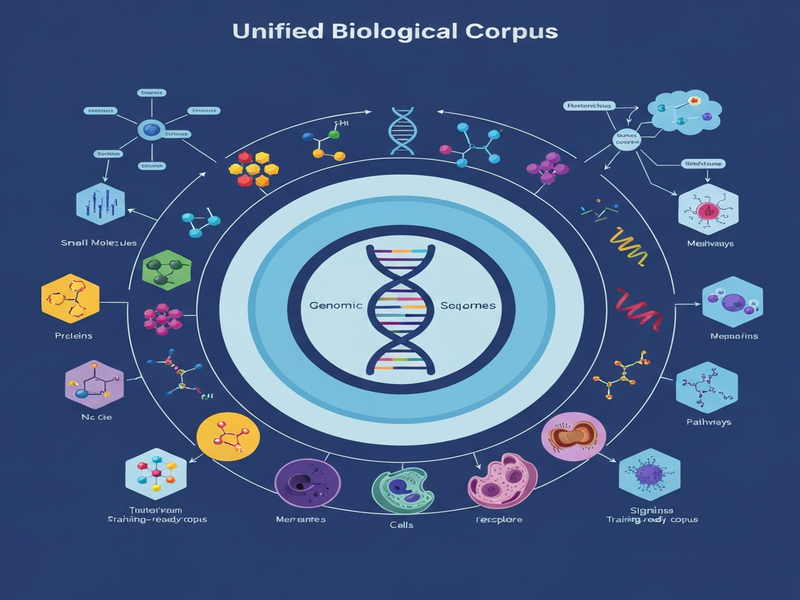
The paper introduces TheBioCollection, a 52.6‑billion‑token, pre‑training‑scale corpus that unifies disparate biological resources—small‑molecule data, protein sequences, genomic strings, single‑cell atlases, and pathway maps—into a single, model‑ready dataset. By enriching each record with computed biological properties and novel instruction tasks, the collection enables large language models (LLMs) to acquire a genuine, cross‑domain understanding of biology while preserving their general linguistic competence.
Background: Why This Problem Is Hard
Biology is intrinsically multi‑modal. Molecular databases store SMILES strings, protein repositories host FASTA sequences, genomic archives contain billions of base pairs, and single‑cell projects publish high‑dimensional expression matrices. Each source follows its own schema, licensing model, and update cadence. When AI researchers attempt to train a Bio‑LLM, they typically stitch together a handful of these silos, resulting in:
- Fragmented coverage: No single dataset spans the full spectrum from small molecules to cellular phenotypes.
- Inconsistent formatting: Tokenization strategies that work for natural language break on chemical notations or genomic alphabets.
- Missing contextual signals: Raw sequences lack computed properties (e.g., solubility, binding affinity) that are crucial for downstream reasoning.
- Sparse instruction data: Existing corpora provide few examples of “how‑to” prompts that teach a model to predict experimental outcomes or design new biomolecules.
These gaps limit a model’s ability to generalize across domains, forcing developers to fine‑tune separate specialist models for each task—a costly and brittle approach. As the biotech industry moves toward AI‑driven drug discovery, synthetic biology, and precision medicine, a unified, high‑quality pre‑training resource becomes a strategic necessity.
What the Researchers Propose
The authors present TheBioCollection, a framework that systematically harvests, normalizes, and enriches public biological repositories into a single, token‑level corpus. The pipeline consists of three logical components:
- Data Ingestion Engine: Connectors scrape 30+ public sources (e.g., PubChem, UniProt, ENCODE, Human Cell Atlas) and translate heterogeneous file formats (SDF, FASTA, VCF, H5) into a unified JSON‑L schema.
- Property Enrichment Layer: Domain‑specific toolkits (RDKit for chemistry, AlphaFold‑derived embeddings for proteins, BCFtools for genomics) compute quantitative descriptors—logP, secondary‑structure confidence, variant impact scores—and attach them as structured fields.
- Instruction Generation Module: A meta‑prompting system creates task‑oriented prompts (e.g., “Predict the IC50 of compound X against kinase Y”) and corresponding reference answers, expanding the corpus with few‑shot learning signals that are otherwise absent.
The result is a single, line‑oriented text file where each line contains a self‑contained record: raw biological token sequence, enriched property list, and optional instruction‑answer pair. This design lets any LLM ingest the data without custom preprocessing, mirroring the simplicity of standard web‑text corpora.
How It Works in Practice
Training a Bio‑LLM with TheBioCollection follows a conventional language‑model pipeline, but the internal workflow differs in three key ways:
1. Unified Tokenization
The ingestion engine tokenizes each domain using a hybrid tokenizer that blends byte‑pair encoding (BPE) for natural‑language context with specialized sub‑token vocabularies for chemical symbols, amino‑acid codes, and nucleotide bases. This ensures that “C=O” or “MKTIIALSYIFCLVFAD” are treated as meaningful units rather than fragmented gibberish.
2. Property‑Aware Embedding
During pre‑training, the model receives auxiliary embeddings that encode the computed properties attached to each record. For example, a molecule’s logP value is injected as a scalar feature that the transformer can attend to alongside the token stream, enabling the model to learn correlations between structure and physicochemical traits.
3. Instruction‑Driven Fine‑Tuning
After the base language modeling phase, the instruction generation module supplies a second‑stage curriculum of “question‑answer” pairs. The model is fine‑tuned on these tasks using a standard supervised loss, effectively teaching it to perform inference, design, and prediction tasks that are directly relevant to biotech workflows.
What distinguishes this approach from prior Bio‑LLM efforts is the seamless integration of raw data, computed annotations, and task‑level supervision within a single, scalable corpus. Practitioners can therefore train a single model that simultaneously understands chemical syntax, protein folding cues, and genomic variant impacts.
Evaluation & Results
To validate the utility of TheBioCollection, the authors built a matched benchmark suite called TheBioCollection‑Eval. The suite probes three capability axes across five biological domains:
- Recognition: Ability to correctly identify entities (e.g., “Is ATP a nucleotide?”).
- Generation: Quality of free‑form outputs (e.g., “Write a SMILES string for a drug‑like inhibitor of EGFR”).
- Prediction: Quantitative reasoning (e.g., “Estimate the melting temperature of a given DNA fragment”).
Experiments kept the underlying model architecture (Gravity‑16B‑A3B) constant and compared three training regimes:
- Baseline: Pre‑trained on generic web text only.
- Domain‑augmented: Added existing bio‑datasets (e.g., PubMed abstracts).
- TheBioCollection: Trained on the new unified corpus.
Key findings include:
- Overall score doubling: TheBioCollection‑trained model achieved more than twice the aggregate benchmark score of the baseline, indicating a holistic lift across all domains.
- Domain‑specific gains: Molecular tasks improved by 3.8×, protein folding‑related prompts by 2.5×, and genomic variant predictions by 2.1×, demonstrating that the enrichment layer translates into measurable reasoning power.
- Preserved linguistic ability: Standard NLP benchmarks (e.g., GLUE) showed negligible degradation (<1% drop), confirming that the added biological knowledge does not sacrifice general language competence.
These results suggest that a well‑curated, property‑rich corpus can serve as a “single source of truth” for training versatile Bio‑LLMs, eliminating the need for separate specialist models.
Why This Matters for AI Systems and Agents
For developers building AI agents that operate in life‑science environments, TheBioCollection offers several practical advantages:
- Unified knowledge base: Agents can query a single model for chemical synthesis routes, protein‑design suggestions, and genomic variant interpretations, simplifying orchestration logic.
- Reduced fine‑tuning overhead: Because the model already internalizes property‑level signals, downstream adapters require fewer training steps, cutting compute costs and time‑to‑deployment.
- Improved safety and reliability: Enriched descriptors provide a built‑in sanity check—agents can cross‑validate a generated molecule’s predicted solubility before proposing it to a chemist.
- Seamless integration with existing platforms: The corpus can be loaded into vector stores such as Chroma DB integration, enabling rapid similarity search for drug‑repurposing or pathway analysis.
In practice, a biotech startup could deploy an Enterprise AI platform by UBOS that leverages a TheBioCollection‑trained model to power a conversational assistant for medicinal chemists, a virtual lab notebook that auto‑annotates experimental results, or an autonomous agent that designs CRISPR guides and validates off‑target risks—all without swapping models between tasks.
What Comes Next
While TheBioCollection marks a significant step forward, several open challenges remain:
- Continual updates: Biological databases evolve rapidly; an automated pipeline for incremental ingestion and re‑annotation is essential to keep the corpus current.
- Bias mitigation: Public repositories over‑represent certain organisms (e.g., human, model organisms) and therapeutic areas, potentially skewing model behavior.
- Multimodal extension: Incorporating imaging data (e.g., microscopy, cryo‑EM) and experimental protocols would broaden the model’s applicability to phenotypic screening.
- Evaluation depth: Future benchmarks should include longitudinal tasks such as hypothesis generation and experimental design cycles.
Researchers are already exploring a “Bio‑LLM ecosystem” where TheBioCollection serves as the foundational pre‑training layer, complemented by domain‑specific adapters for niche tasks like metabolic pathway reconstruction or synthetic biology circuit design. Developers interested in prototyping such agents can start with the Workflow automation studio to stitch together data ingestion, model inference, and result visualization in a low‑code environment.
Ultimately, the success of TheBioCollection will hinge on community adoption, open licensing, and the ability to integrate with emerging AI infrastructure. By providing a scalable, property‑rich dataset, the authors have laid the groundwork for the next generation of truly interdisciplinary Bio‑LLMs.
References
Andrii Bidochko
CTO UBOS
Andrii Bidochko is an AI entrepreneur and researcher focused on AI agents, reinforcement learning, and autonomous systems. He writes about the technologies shaping the future of machine intelligence, from frontier models and agent architectures to real-world AI applications.