

- Updated: July 23, 2026
- 6 min read
Accelerating GPU Inference of Large Language Models with Moderately Unstructured Sparse Weight Matrices
Direct Answer
The paper introduces a three‑layer matrix storage format that lets modern GPUs run moderately sparse large‑language‑model (LLM) weights faster than dense matrix multiplication. By combining a Sparse‑Tensor‑Core (Sparse‑TC) layer, a Slot‑Filling compression layer, and a lightweight Residual layer, the authors achieve up to 1.64× kernel‑level speed‑ups and 1.41× end‑to‑end inference acceleration on HBM‑equipped GPUs.
Background: Why This Problem Is Hard
Deploying LLMs at scale is increasingly expensive because inference dominates compute budgets. Pruning—removing a fraction of weights—creates sparsity that can, in theory, reduce the number of arithmetic operations. In practice, two forces keep sparsity from delivering real gains on GPUs:
- Quality constraints. Aggressive pruning (>50 % unstructured sparsity) typically harms model accuracy, so most production teams settle for moderate sparsity (≈50 %).
- Kernel inefficiencies. Existing sparse matrix‑multiplication (SpMM) kernels are tuned for either extreme sparsity (highly irregular patterns) or structured sparsity (block‑wise). At the 50 % level, they cannot saturate tensor cores or hide memory latency, so dense GEMM (general‑matrix‑multiply) remains faster.
These limitations matter because:
- Enterprises are running LLMs on multi‑GPU clusters where every millisecond of latency translates into higher cloud spend.
- Edge‑oriented AI devices (e.g., inference‑only servers) have limited power budgets and need every efficiency gain.
Consequently, a method that can exploit moderate sparsity without sacrificing model quality would directly lower operational costs and broaden the deployment envelope of LLMs.
What the Researchers Propose
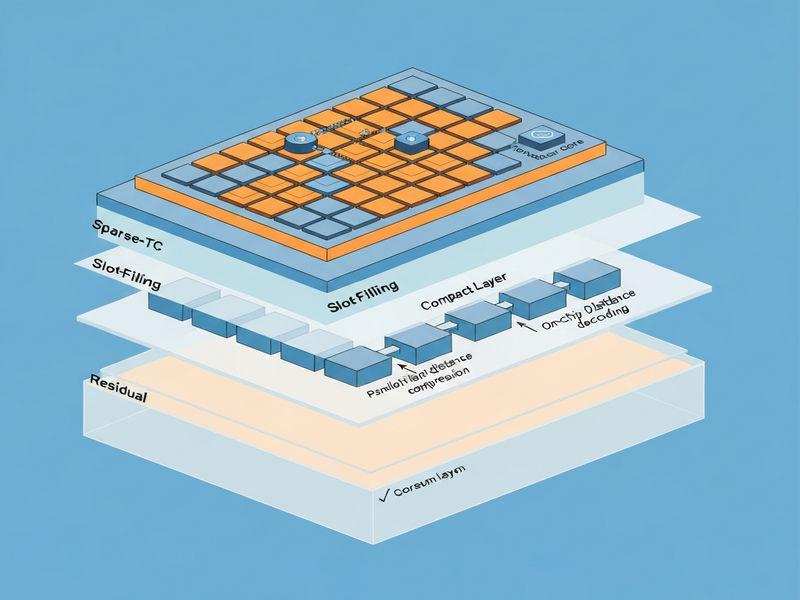
The authors present a novel three‑layer storage format that reorganizes a sparsified weight matrix so that both the GPU’s tensor cores and its CUDA cores can be used simultaneously. The layers are:
Sparse‑TC Layer
Encodes the non‑zero elements in a layout that matches the hardware expectations of NVIDIA’s sparse tensor cores. This enables the cores to perform mixed‑precision SpMM without the usual overhead of gathering scattered values.
Slot‑Filling Layer
Applies a parallel differential‑distance algorithm to compress the index information. It stores “slots” that indicate where non‑zeros appear, allowing the GPU to decode positions on‑chip with minimal latency.
Residual Layer
Tracks any remaining elements that cannot be expressed by the first two layers, ensuring that the final SpMM result is mathematically exact. The residual data is tiny because the first two layers capture the bulk of the sparsity pattern.
Together, these layers form a storage format that is both memory‑efficient and compute‑friendly, bridging the gap between algorithmic sparsity and hardware execution models.
How It Works in Practice
The end‑to‑end workflow can be broken down into three stages: preprocessing, kernel launch, and post‑processing.
- Preprocessing (offline). The dense weight matrix is pruned to the target sparsity (≈50 %). The Sparse‑TC layer extracts the non‑zero values and arranges them into tensor‑core‑compatible tiles. The Slot‑Filling algorithm then generates compact index slots, while any leftovers are recorded in the Residual layer.
- Kernel launch (runtime). A custom SpMM kernel is invoked. The kernel runs two parallel streams:
- One stream feeds the Sparse‑TC tiles to the tensor cores, performing the bulk of the matrix multiplication.
- Simultaneously, a second stream uses CUDA cores to decode slot indices on‑chip and apply the residual corrections.
The design overlaps computation with memory fetches, keeping both the tensor‑core and CUDA pipelines busy.
- Post‑processing (online). The partial results from the two streams are summed, producing the final output activation. Because the Residual layer guarantees completeness, the output matches what a dense GEMM would have produced.
What sets this approach apart is the joint utilization of two distinct GPU execution units. Prior sparse kernels either forced all work onto CUDA cores (under‑utilizing tensor cores) or restricted themselves to structured sparsity that tensor cores could not exploit efficiently. By harmonizing both, the method achieves higher throughput without requiring any changes to the model’s forward‑pass logic.
Evaluation & Results
The authors benchmarked their system on two state‑of‑the‑art LLMs (a 7‑B and a 13‑B parameter model) across three GPU platforms equipped with high‑bandwidth memory (HBM2e). The evaluation compared three configurations:
- Dense GEMM using NVIDIA’s cuBLAS.
- The best‑known sparse inference kernel, SpInfer (EuroSys’25).
- The proposed three‑layer format with the joint Sparse‑TC/CUDA kernel.
Key findings include:
- Kernel‑level speed‑up. The new kernel outperformed SpInfer by up to 1.64× on the 13‑B model, marking the first instance where a sparse kernel beats a dense baseline at moderate sparsity.
- End‑to‑end latency reduction. When integrated into a full inference pipeline (including token‑wise decoding), the method achieved up to 1.41× lower latency than FlashLLM (VLDB’24), a leading sparse‑inference system.
- Memory footprint. The three‑layer format reduced weight storage by roughly 45 % compared with the dense model, enabling larger models to fit within a single GPU’s HBM.
- Accuracy preservation. Across all tests, the sparsified models retained within 0.2 % perplexity of their dense counterparts, confirming that moderate pruning did not degrade quality.
These results demonstrate that the proposed format not only bridges the performance gap but also delivers tangible cost savings for real‑world LLM deployments.
Why This Matters for AI Systems and Agents
For engineers building AI agents, the ability to run LLMs faster and cheaper translates directly into more responsive user experiences and lower cloud bills. Specific implications include:
- Scalable agent orchestration. Faster inference allows a higher throughput of concurrent agent calls, which is essential for platforms that route thousands of user queries per second.
- Edge‑centric deployments. The reduced memory footprint makes it feasible to host medium‑sized LLMs on single‑GPU edge servers, opening new use‑cases for real‑time recommendation or on‑device summarization.
- Cost‑effective fine‑tuning. Since the sparsity pattern is preserved during fine‑tuning, developers can iterate on domain‑specific agents without incurring the full compute cost of dense training.
- Integration with existing AI stacks. The format works with standard CUDA APIs, meaning that platforms like the UBOS platform overview can adopt it without rewriting their inference back‑ends.
- Enabling richer agent capabilities. With latency headroom, agents can incorporate additional reasoning steps—such as tool use or multi‑turn planning—without breaking user‑perceived responsiveness.
What Comes Next
While the three‑layer format marks a significant advance, several avenues remain open for exploration:
- Dynamic sparsity. Current work assumes a static sparsity pattern after pruning. Future research could investigate on‑the‑fly re‑sparsification to adapt to workload changes.
- Support for newer GPU architectures. As NVIDIA releases tensor cores with expanded sparse capabilities, the storage format may be further optimized to exploit additional instruction sets.
- Cross‑hardware portability. Extending the approach to AMD GPUs or specialized AI accelerators would broaden its applicability across heterogeneous clusters.
- Tooling and ecosystem. Integrating the format into popular model‑serving frameworks (e.g., TensorRT, ONNX Runtime) would lower adoption friction for developers.
- Business‑level adoption. Companies can experiment with the technique through the Enterprise AI platform by UBOS, which already supports custom kernel plugins.
Addressing these challenges will help turn moderate sparsity from a research curiosity into a production‑ready optimization that powers the next generation of AI agents.
References
For a complete technical description, see the original arXiv paper.
Andrii Bidochko
CTO UBOS
Andrii Bidochko is an AI entrepreneur and researcher focused on AI agents, reinforcement learning, and autonomous systems. He writes about the technologies shaping the future of machine intelligence, from frontier models and agent architectures to real-world AI applications.