

- Updated: July 23, 2026
- 7 min read
Reward Transport: Property Control in Flow Matching via Noise‑Space Alignment
Direct Answer
Reward Transport introduces a novel way to steer flow‑matching generative models by aligning a single scalar coordinate in the noise space with a target molecular property. This alignment turns the coupling between noise vectors and data points into a controllable “knob,” enabling property‑guided generation without extra reward models, gradient guidance, or runtime overhead.
Background: Why This Problem Is Hard
Designing molecules with specific physicochemical attributes—such as high lipophilicity (logP) or drug‑likeness (QED)—has long been a bottleneck in AI‑driven drug discovery. Traditional generative pipelines rely on:
- Post‑hoc optimization: Sampling a large batch, scoring each candidate, and discarding the undesired ones.
- Classifier‑guided diffusion: Using a learned reward model to bias the diffusion trajectory, which adds inference cost and can suffer from reward hacking.
- Conditional generation: Training separate models for each property, which scales poorly as the number of desired attributes grows.
All of these approaches treat the coupling between the latent noise and the data as a fixed computational detail. Consequently, they lack a built‑in mechanism to embed property control directly into the learned flow field. This limitation forces practitioners to either accept inefficient sampling or to introduce heavyweight auxiliary components that complicate deployment.
What the Researchers Propose
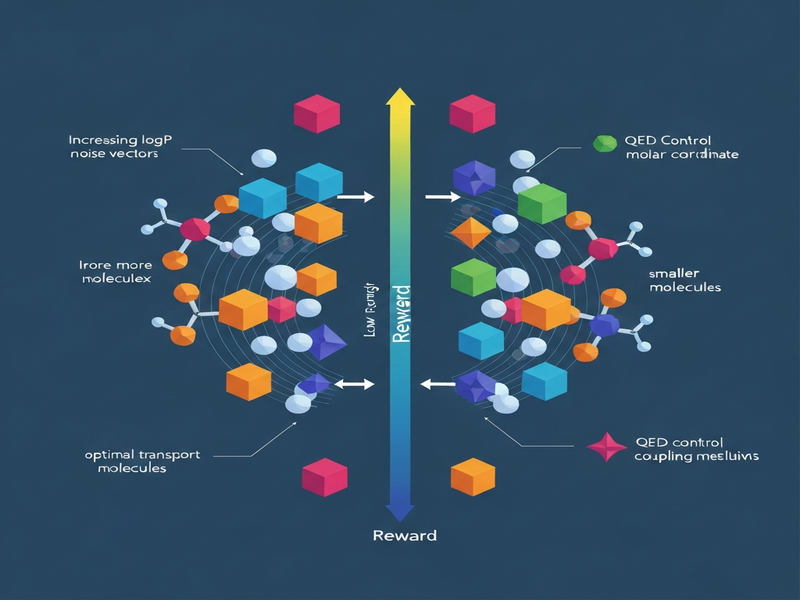
The authors reframe the coupling in flow matching as an alignment interface. By using optimal transport to pair each noise vector with a data point that shares a similar reward value, they embed a scalar “reward coordinate” into the noise space. The key ideas are:
- Noise‑Space Alignment: During training, a transport plan aligns low‑dimensional noise coordinates with high‑reward molecules, effectively learning a mapping from a scalar coordinate to a property distribution.
- Reward Transport: The optimal transport coupling is computed once per training epoch, creating a smooth, monotonic relationship between the scalar coordinate and the target property.
- Distribution‑Level Control: At inference, adjusting the scalar coordinate shifts the entire generated distribution, reproducing the effect of the Cross‑Entropy Method’s truncated reward distribution but with a continuous knob.
In essence, the method turns the “choice of coupling”—normally a design convenience—into a powerful control lever that can be tuned at generation time.
How It Works in Practice
The workflow can be broken down into three stages: data preparation, transport‑guided training, and controllable inference.
1. Data Preparation
Each molecule in the training set is annotated with a scalar reward (e.g., logP or QED). The reward values are normalized to a common range, forming a one‑dimensional property vector.
2. Transport‑Guided Training
- Sample Noise: Draw a batch of Gaussian noise vectors z ∈ ℝⁿ.
- Compute Optimal Transport: Solve a 1‑D optimal transport problem that matches the distribution of noise‑space scalar projections (e.g., the first coordinate of z) to the empirical reward distribution of the batch.
- Pairing: The transport plan yields a pairing (zᵢ, xⱼ) where xⱼ is a molecule whose reward aligns with the scalar coordinate of zᵢ.
- Flow Matching Loss: Train the flow‑matching network to map each paired (zᵢ, xⱼ) using the standard loss, now enriched with the reward‑aligned coupling.
3. Controllable Inference
- Select a Target Coordinate: Choose a scalar value c that reflects the desired property level (e.g., a high c for high logP).
- Generate Noise: Sample a noise vector whose first coordinate equals c while the remaining dimensions follow the standard Gaussian.
- Decode: Pass the conditioned noise through the trained flow model to obtain a molecule.
- Iterate or Sweep: By sweeping c across its range, practitioners can produce a continuum of molecules from low to high property values.
This pipeline requires no extra reward predictor at inference, no gradient‑based guidance, and no additional computational budget beyond the base flow model.
Evaluation & Results
The authors validated Reward Transport on two widely used molecular benchmarks:
- ZINC‑250K: A dataset of drug‑like molecules with associated logP values.
- GuacaMol: A suite of tasks that includes QED optimization and multi‑objective property tuning.
Key experimental steps:
- Train a baseline flow‑matching model without any alignment.
- Train the same architecture with Reward Transport for logP and separately for QED.
- Sweep the scalar coordinate across its feasible interval and record the generated molecules’ property distributions.
Findings:
- Monotonic Control: For logP, increasing the coordinate produced a steady rise in average logP, confirming a smooth, monotonic relationship.
- Consistent QED Steering: Adjusting the coordinate for QED yielded a predictable shift in drug‑likeness scores, without sacrificing molecular validity.
- Opposite Structural Responses: The same coordinate range caused molecules to grow larger for logP optimization but shrink for QED, demonstrating that the knob captures genuine property semantics rather than a trivial size bias.
- Comparison to Baselines: Reward Transport matched or exceeded the property control achieved by classifier‑free guidance while using no extra inference steps.
These results illustrate that a single scalar can serve as a universal control interface for diverse molecular objectives, a capability that was previously only achievable with multiple, task‑specific models.
Why This Matters for AI Systems and Agents
From an engineering perspective, Reward Transport offers a clean separation between model learning and property steering. This has several practical consequences:
- Reduced Deployment Complexity: Teams can ship a single flow‑matching model and expose a simple API that accepts a scalar “property knob.” No need to bundle separate reward networks or gradient‑based samplers.
- Faster Iteration Cycles: Because the control is baked into the noise space, agents can explore property trade‑offs in real time, enabling interactive design loops for chemists or autonomous agents that negotiate multi‑objective constraints.
- Compatibility with Existing Toolchains: The method works alongside classifier‑free guidance and conditional flow matching, allowing developers to stack multiple conditioning signals (e.g., scaffold constraints + property knob) without architectural overhaul.
- Scalable Orchestration: In large‑scale AI pipelines—such as those built on the UBOS platform overview—Reward Transport can be wrapped as a microservice that receives a target property value and returns a molecule, fitting naturally into workflow automation studios.
- Business Impact: Companies developing AI‑driven drug discovery platforms can accelerate lead generation, reduce compute costs, and offer end‑users a more intuitive “dial‑in” experience for property optimization.
What Comes Next
While Reward Transport marks a significant step forward, several avenues remain open for exploration:
- Multi‑Dimensional Reward Transport: Extending the scalar alignment to a vector of properties could enable simultaneous control of logP, QED, synthetic accessibility, and more.
- Dynamic Transport Plans: Investigating online or adaptive optimal transport that updates as new data arrives could keep the alignment fresh in non‑stationary domains.
- Cross‑Domain Applications: The same principle could be applied to image generation (e.g., aligning brightness or style) or text synthesis (e.g., sentiment control), broadening the impact beyond chemistry.
- Integration with Agent Frameworks: Embedding the property knob into autonomous agents that negotiate design constraints could lead to self‑optimizing pipelines. For example, an AI marketing agents workflow could use a similar scalar to balance brand tone against conversion metrics.
- Robustness and Safety: Formal analysis of how the transport coupling behaves under distribution shift will be essential for high‑stakes applications like clinical candidate generation.
Addressing these challenges will help turn the reward‑aligned flow field from a research prototype into a production‑ready component for next‑generation generative AI systems.
References
Reward Transport: Property Control in Flow Matching via Noise‑Space Alignment – Original arXiv preprint, July 2026.
Andrii Bidochko
CTO UBOS
Andrii Bidochko is an AI entrepreneur and researcher focused on AI agents, reinforcement learning, and autonomous systems. He writes about the technologies shaping the future of machine intelligence, from frontier models and agent architectures to real-world AI applications.