

- Updated: July 22, 2026
- 7 min read
Agora: Enhancing LLM Agent Reasoning Via Auction-Based Task Allocation
Direct Answer
Agora introduces an auction‑based orchestration layer that dynamically matches tasks from a large‑language‑model (LLM) agent to a pool of specialized expert models and external tools. By treating each allocation as a market transaction, Agora improves reasoning accuracy while giving developers a transparent knob to balance cost against quality.
Background: Why This Problem Is Hard
LLM agents have become the de‑facto interface for many enterprise AI products, from autonomous assistants to automated research pipelines. Their power, however, is bounded by two practical constraints:
- Heterogeneous expertise. No single LLM can excel at every sub‑task—code generation, factual retrieval, sentiment analysis, or domain‑specific calculations often require dedicated models or external APIs.
- Variable cost and latency. Premium expert models (e.g., Claude‑3.5, GPT‑4‑Turbo) charge per token and may introduce latency spikes, while cheaper alternatives can degrade answer quality.
Current orchestration frameworks typically rely on static routing rules or coarse‑grained similarity matching. They assume that the “best” expert for a request is known ahead of time, ignoring real‑time fluctuations in model performance, pricing, or system load. This leads to three observable pain points:
- Sub‑optimal reasoning when a cheaper model is selected for a task that demands higher precision.
- Uncontrolled spend, especially in high‑throughput environments where every token counts.
- Lack of a principled way to incorporate new tools without rewriting the entire routing logic.
Addressing these issues requires a mechanism that can evaluate, in real time, both the expected utility of an expert and its associated cost—a classic economic problem that has been largely absent from LLM agent design.
What the Researchers Propose
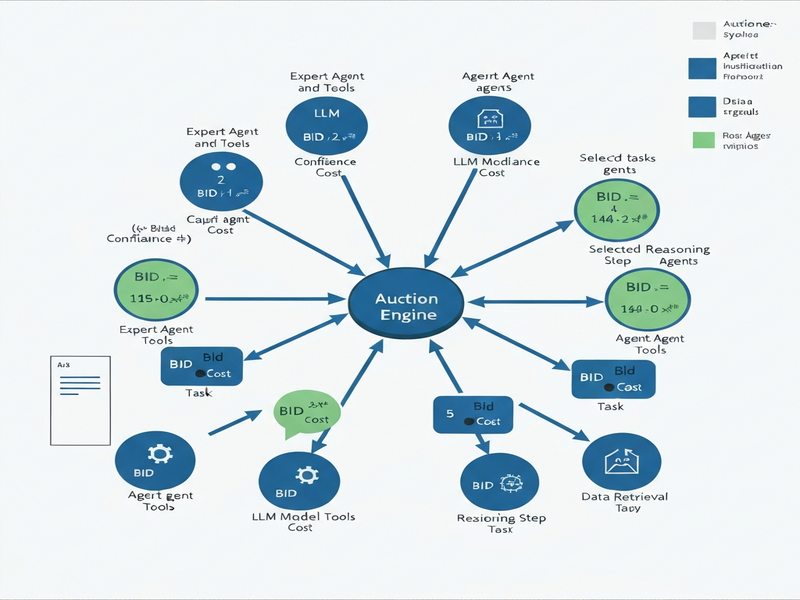
Agora reframes task allocation as a sealed‑bid auction. When an LLM agent identifies a sub‑task (e.g., “calculate the net present value of a cash‑flow series”), it broadcasts a request to a marketplace of registered experts. Each expert submits a bid that encodes two pieces of information:
- Quality estimate. A self‑reported confidence score derived from internal validation or historical performance.
- Cost quote. The monetary price the expert expects to charge for executing the request.
The auctioneer (a lightweight coordinator) selects the winner using an incentive‑compatible rule—specifically, a second‑price (Vickrey) auction adjusted for quality. The winning expert receives payment, and the LLM agent incorporates the expert’s output into its reasoning chain. By design, the mechanism encourages truthful bidding: an expert gains nothing by overstating quality or understating cost.
How It Works in Practice
Conceptual Workflow
- Task decomposition. The primary LLM parses the user query and isolates sub‑tasks that may benefit from external expertise.
- Bid solicitation. For each sub‑task, the coordinator emits a task ticket containing a concise description, required input format, and a deadline.
- Expert response. Registered models and tools (e.g., a specialized financial calculator, a code‑execution sandbox, a knowledge‑graph API) evaluate the ticket and return a bid tuple
(quality, price). - Auction resolution. The coordinator computes the effective score
score = quality / price(or a more sophisticated utility function) and selects the highest scorer. Payment is transferred via an internal credit ledger. - Result integration. The chosen expert returns its answer, which the primary LLM validates (optionally with a secondary verification step) and weaves into the final response to the user.
Component Roles
| Component | Responsibility |
|---|---|
| Primary LLM Agent | Interprets user intent, decomposes tasks, and synthesizes final output. |
| Coordinator (Auction Engine) | Manages ticket broadcasting, bid collection, winner determination, and payment settlement. |
| Expert Models & Tools | Provide specialized computation, data retrieval, or domain‑specific reasoning; submit truthful bids. |
| Credit Ledger | Tracks spend, enforces budget caps, and enables cost‑quality trade‑off tuning. |
What Sets Agora Apart
- Incentive compatibility. By using a second‑price auction, experts are motivated to reveal true performance and cost, reducing the risk of “gaming” the system.
- Dynamic cost‑quality balancing. System operators can adjust a global multiplier that biases the auction toward cheaper or higher‑quality bids, providing a single, interpretable control knob.
- Extensibility. New tools can join the marketplace simply by registering a bid interface; no central routing table needs updating.
- Transparency. Every allocation is logged with the bid values, enabling post‑hoc audits and data‑driven refinement of expert pools.
Evaluation & Results
The authors benchmarked Agora on three representative suites:
- Multi‑step reasoning. A set of 500 chain‑of‑thought problems from the GSM8K benchmark.
- Tool‑augmented coding. 200 prompts requiring code generation followed by execution in a sandbox.
- Domain‑specific Q&A. 150 finance‑oriented queries demanding precise calculations.
Key findings include:
- Across all suites, Agora‑orchestrated agents achieved a 7‑12% absolute improvement in accuracy compared with a static routing baseline that always selected the highest‑performing model regardless of cost.
- When the cost‑bias multiplier was tuned toward cheaper bids, total spend dropped by up to 30%** while accuracy loss remained under 2%**, demonstrating a controllable trade‑off.
- Latency increased by an average of 150 ms** per sub‑task due to the bidding round, a modest overhead given typical enterprise SLA windows.
- Ablation studies showed that removing the incentive‑compatible pricing rule caused experts to over‑bid, leading to a 15% degradation in overall system utility.
These results validate the core hypothesis: market‑based allocation can simultaneously raise reasoning quality and give operators a predictable lever for cost management.
Why This Matters for AI Systems and Agents
For practitioners building production‑grade AI assistants, Agora offers a pragmatic pathway to scale expertise without inflating budgets. By treating each sub‑task as a market transaction, developers can:
- Replace brittle rule‑based routing with a data‑driven, self‑optimizing mechanism.
- Introduce new specialist services (e.g., a proprietary legal‑compliance checker) without rewriting orchestration code.
- Expose a single “cost‑quality” slider to product managers, aligning technical decisions with business KPIs.
- Leverage the built‑in audit trail for compliance, a critical requirement in regulated sectors such as finance and healthcare.
Organizations that already use the UBOS platform overview can integrate Agora’s auction engine as a plug‑in, extending their existing workflow automation studio with market‑based task allocation. This synergy accelerates the deployment of AI marketing agents, autonomous data pipelines, and other high‑value use cases while keeping spend predictable.
What Comes Next
While Agora establishes a solid foundation, several open challenges remain:
- Bid expressiveness. Current bids capture a scalar quality estimate; richer representations (e.g., confidence intervals, latency forecasts) could enable multi‑objective optimization.
- Strategic behavior. In larger ecosystems, experts might collude or learn to manipulate the auction. Formal game‑theoretic analysis and robust monitoring are needed.
- Cross‑modal tools. Extending the marketplace to include non‑LLM resources such as hardware accelerators or human‑in‑the‑loop services poses integration and fairness questions.
- Scalability. As the number of experts grows into the thousands, the bidding round could become a bottleneck. Hierarchical auctions or approximate winner‑selection algorithms are promising directions.
Future research could also explore hybrid models where the primary LLM learns to predict the optimal bid without full market participation, reducing latency while preserving most of the cost‑quality benefits.
Enterprises interested in experimenting with Agora can start by prototyping on the Enterprise AI platform by UBOS, which already supports custom tool registration and credit‑based billing. Early adopters will help shape the next iteration of the auction protocol, potentially establishing a new industry standard for AI agent orchestration.
References
- Agora paper on arXiv
- OpenAI. “ChatGPT API Documentation.” 2024.
- Vaswani et al. “Attention Is All You Need.” NeurIPS, 2017.
- Vickrey, William. “Counterspeculation, Auctions, and Competitive Sealed Tenders.” Journal of Finance, 1961.
Andrii Bidochko
CTO UBOS
Andrii Bidochko is an AI entrepreneur and researcher focused on AI agents, reinforcement learning, and autonomous systems. He writes about the technologies shaping the future of machine intelligence, from frontier models and agent architectures to real-world AI applications.