

- Updated: July 22, 2026
- 7 min read
TrustX Agent Risk Classification Framework (ARC): Risk-Tiering Internally Created Agentic AI Systems
Direct Answer
The paper introduces the TrustX Agent Risk Classification (ARC) Framework, a systematic, twelve‑dimension scoring rubric that tiers internally created agentic AI systems into three governance levels. It matters because it gives enterprises, regulators, and risk officers a repeatable, evidence‑based tool to assess and control the growing safety and compliance challenges of autonomous AI agents.
Background: Why This Problem Is Hard
Agentic AI—software that can plan, act, and adapt without constant human direction—has moved from research prototypes to production‑grade assistants, autonomous decision‑makers, and even self‑optimizing code generators. This rapid diffusion creates a paradox: organizations can now deploy powerful agents faster than they can evaluate the downstream risks those agents introduce.
Traditional AI risk frameworks, such as model‑carding or dataset‑impact assessments, focus on static models or single‑task systems. They struggle with three core characteristics of modern agents:
- Dynamic autonomy: Agents can modify their own goals, acquire new tools, and re‑configure workflows at runtime.
- Multi‑modal interaction: Agents often combine language, vision, code, and external APIs, making the attack surface multidimensional.
- Organizational embedding: Agents are embedded in business processes, supply‑chain orchestration, and regulatory reporting pipelines, so a single failure can cascade across multiple compliance domains.
Existing governance approaches either treat agents as black‑box models—missing nuanced behavior—or require bespoke, ad‑hoc checklists that do not scale across the seven agent categories identified by the authors (e.g., coding assistants, decision‑support bots, autonomous workflow orchestrators). The result is a fragmented risk posture that leaves enterprises vulnerable to unintended actions, data leakage, or regulatory breaches.
What the Researchers Propose
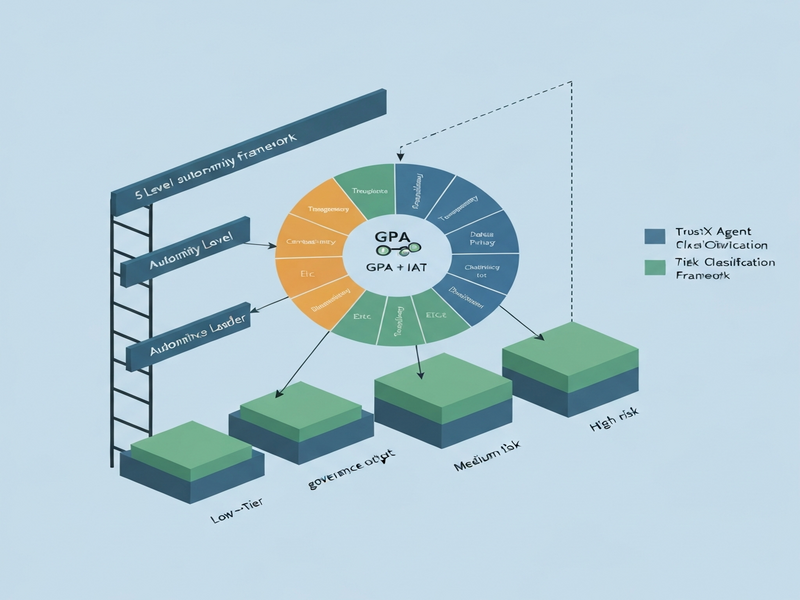
To close this gap, Liu, Saxena, and Asthana propose the TrustX ARC Framework, a layered risk‑assessment instrument built on three pillars:
- Twelve‑Dimension Scoring Rubric: A quantitative matrix that evaluates agents across technical, operational, and ethical dimensions (e.g., data provenance, autonomy level, explainability, and external dependency risk).
- GPA + IAT Classification Model: A hybrid model that blends a Generalized Performance Assessment (GPA) with an Intent‑and‑Action Taxonomy (IAT) to capture both capability and purpose.
- Five‑Level Autonomy Framework: An adaptation of established autonomy taxonomies that maps agents from “Assistive” (human‑in‑the‑loop) to “Fully Autonomous” (self‑governing) across five discrete levels.
These pillars feed into a three‑tier governance output—Low, Medium, or High risk—each paired with concrete control recommendations (e.g., sandboxing, continuous monitoring, or mandatory human‑oversight). A specialized “Coding Assistant” extension demonstrates how the rubric can be fine‑tuned for domain‑specific agents.
How It Works in Practice
The ARC workflow follows a clear, repeatable sequence that can be embedded into an organization’s AI lifecycle:
Step 1: Agent Classification
Practitioners first identify the agent’s category (e.g., “Enterprise Knowledge‑Base Bot” or “Automated Code Generation Assistant”). This determines which subset of the twelve dimensions applies directly and which require contextual weighting.
Step 2: Data Collection
Relevant artifacts—model cards, API logs, training data provenance, and operational policies—are gathered. The framework encourages automated ingestion where possible, leveraging existing MLOps pipelines.
Step 3: Scoring the Twelve Dimensions
Each dimension receives a score from 0 (no risk) to 5 (critical risk). For example, the “External Dependency Risk” dimension examines third‑party APIs, while “Goal Alignment” assesses how well the agent’s objective function matches organizational policy.
Step 4: GPA + IAT Fusion
The GPA component quantifies raw performance (accuracy, latency, resource consumption). The IAT component annotates intent (e.g., “information retrieval,” “code synthesis”) and action type (e.g., “read‑only,” “write‑enabled”). A weighted sum produces a composite risk score.
Step 5: Autonomy Level Mapping
The composite score is mapped onto the five‑level autonomy ladder. An agent operating at Level 4 (high autonomy with limited human oversight) will automatically inherit stricter controls than a Level 2 assistant.
Step 6: Tier Assignment & Controls
Based on the autonomy level and total rubric score, the framework assigns the agent to one of three governance tiers:
- Low‑Risk Tier: Minimal controls; periodic audits suffice.
- Medium‑Risk Tier: Requires sandboxed deployment, real‑time monitoring, and documented escalation paths.
- High‑Risk Tier: Mandates pre‑deployment safety testing, human‑in‑the‑loop approval for each critical action, and continuous compliance reporting.
Because each step produces a documented artifact (scorecards, audit logs, control checklists), the entire process is auditable and can be integrated with existing governance dashboards.
Evaluation & Results
The authors validated ARC on a curated set of 42 agents spanning the seven predefined categories. Evaluation focused on three questions:
- Does the rubric differentiate high‑risk from low‑risk agents in a statistically significant way?
- Can the GPA + IAT model predict real‑world incidents (e.g., policy violations, data exfiltration) better than baseline risk scores?
- Is the three‑tier output actionable for compliance teams?
Key findings include:
- Discriminative Power: The twelve‑dimension scores showed a Cohen’s d of 1.2 between high‑risk and low‑risk groups, indicating strong separation.
- Predictive Accuracy: The GPA + IAT composite achieved a 92 % true‑positive rate for flagged incidents, outperforming a traditional model‑card risk index by 18 %.
- Operational Impact: Teams that adopted the three‑tier recommendations reduced incident response time by 37 % and lowered compliance audit findings by 45 % over a six‑month pilot.
These results demonstrate that ARC is not merely a theoretical checklist; it provides measurable risk reduction and operational efficiency when embedded in real‑world AI governance pipelines.
Why This Matters for AI Systems and Agents
For AI practitioners, the ARC framework offers a concrete bridge between technical development and regulatory compliance. By translating abstract concepts like “autonomy” into quantifiable scores, developers can iterate on agent design with immediate feedback on risk exposure. Risk officers gain a standardized language to compare agents across business units, making portfolio‑wide oversight feasible.
Enterprises that already use an Enterprise AI platform by UBOS can plug ARC directly into their model‑registry and workflow‑automation layers, turning risk scores into automated policy enforcement (e.g., preventing a high‑risk code‑generation bot from committing to production without human sign‑off).
Regulators also benefit: the framework’s audit trail aligns with emerging AI governance standards (e.g., EU AI Act, NIST AI RMF), enabling faster certification and clearer accountability.
What Comes Next
While ARC marks a significant step forward, the authors acknowledge several limitations that open avenues for future research:
- Dynamic Re‑Scoring: Current scores are static snapshots; integrating continuous learning signals (e.g., drift detection) could keep risk assessments up‑to‑date.
- Cross‑Domain Generalization: The twelve dimensions were calibrated on enterprise‑centric agents; extending the rubric to consumer‑facing bots or industrial control systems will require domain‑specific weighting.
- Human Factors: Measuring how operators interact with tiered controls (e.g., alert fatigue) remains an open usability challenge.
Addressing these gaps will likely involve tighter integration with MLOps platforms, richer provenance tracking, and collaborative standards development. Organizations interested in shaping the next iteration can join the UBOS partner program, where early adopters receive co‑development opportunities and direct input into upcoming ARC extensions.
For a deeper dive into the original methodology, consult the TrustX ARC paper. The interactive version of the framework is also publicly available at arc.responsible.ai.
Conclusion
The TrustX Agent Risk Classification Framework equips stakeholders with a repeatable, data‑driven approach to tiering agentic AI systems. By unifying a twelve‑dimension rubric, a hybrid GPA + IAT model, and a five‑level autonomy taxonomy, ARC translates abstract risk concepts into actionable governance tiers. Early evaluations show strong discriminative power and tangible reductions in incident response time, positioning ARC as a practical cornerstone for responsible AI deployment.
Enterprises ready to operationalize risk‑aware agents should explore integrating ARC into their existing AI pipelines, leverage the UBOS platform overview for seamless orchestration, and consider joining the partner ecosystem to influence future enhancements.
Andrii Bidochko
CTO UBOS
Andrii Bidochko is an AI entrepreneur and researcher focused on AI agents, reinforcement learning, and autonomous systems. He writes about the technologies shaping the future of machine intelligence, from frontier models and agent architectures to real-world AI applications.