

- Updated: July 22, 2026
- 7 min read
Knowledge Graphs and Explainable AI as Complementary Resources for Urban Mining
Direct Answer
The paper introduces a formal, resource‑based framework that unites knowledge graphs (KGs) and explainable AI (XAI) into four distinct integration modes—Lifting, Constraining, Typing, and Revising—specifically designed to make pre‑demolition assessments in urban‑mining defensible, auditable, and regulatorily compliant. By treating KG‑XAI pairings as complementary resources, the authors show how each mode adds a unique layer of legibility, plausibility, sourcing, or contestability that pure prediction models cannot provide.
Background: Why This Problem Is Hard
Urban mining—recovering valuable materials from existing buildings before demolition—relies on a regulated audit process called pre‑demolition assessment. Auditors must justify every valuation, material‑type inference, and safety recommendation with evidence that can be inspected, challenged, and traced back to authoritative sources. Traditional AI pipelines excel at predictive accuracy but fall short on three fronts that matter to auditors:
- Legibility: How easily can a human understand the reasoning behind a model’s output?
- Plausibility: Does the explanation align with domain knowledge and real‑world constraints?
- Sourcing & Contestability: Can every claim be linked to a verifiable data source, and can stakeholders dispute it without ambiguity?
Explainable AI techniques (e.g., SHAP, LIME, counterfactuals) address legibility and plausibility but typically operate on a flat feature space, ignoring the rich relational context that building information models (BIM) and municipal registries provide. Conversely, knowledge graphs encode entities, relationships, and provenance, yet they lack the algorithmic machinery to generate on‑the‑fly explanations for complex predictions. Existing taxonomies that list “KG‑XAI combos” are descriptive; they do not explain why a particular combination yields a defensible audit artifact that neither component could achieve alone.
Regulators are tightening requirements for traceable AI decisions, especially in safety‑critical domains like construction and demolition. Auditors therefore need a systematic way to combine the structural rigor of KGs with the interpretability of XAI, ensuring that every recommendation can survive legal scrutiny and stakeholder challenge.
What the Researchers Propose
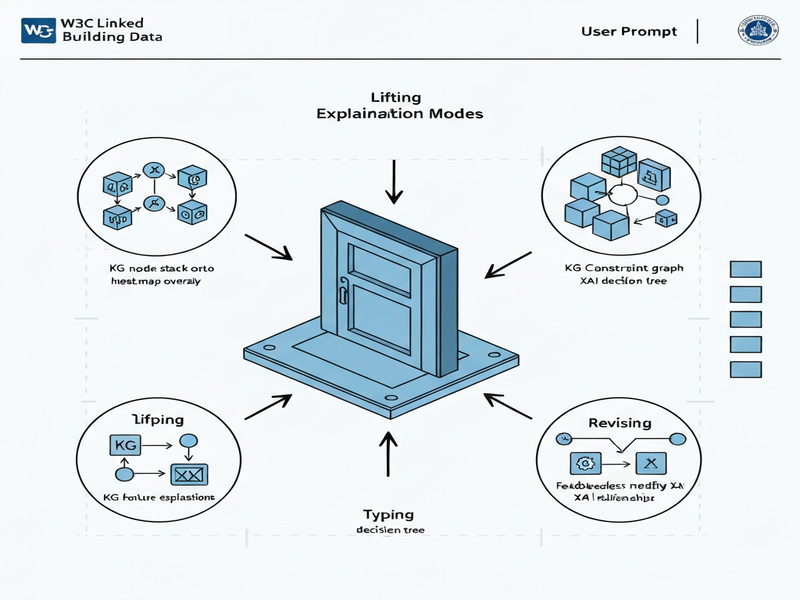
Gronewald, Emrich, and Mehdiyev propose a complementarity‑theoretic framework grounded in the information systems (IS) resource‑based view. The core idea is to treat a knowledge graph as a “substrate” that enriches XAI artefacts through typed operations. They define four integration modes, each a distinct transformation that unlocks a specific defensibility property:
- Lifting: Elevates raw XAI explanations onto the graph’s semantic layer, mapping feature importance to graph nodes and edges.
- Constraining: Uses graph‑encoded constraints (e.g., building code rules) to prune or reshape XAI outputs, ensuring that explanations never violate known domain invariants.
- Typing: Assigns ontological types to XAI artefacts, enabling auditors to query explanations by category (e.g., “structural element” vs. “electrical component”).
- Revising: Feeds back graph‑derived evidence to iteratively refine the underlying predictive model, creating a closed loop where explanations improve the model and the model improves explanations.
Each mode is defined as a typed operation over two inputs: an XAI artefact (such as a feature‑importance vector or a counterfactual instance) and a KG substrate structure (nodes, edges, ontologies, or provenance records). By formalizing these operations, the framework explains why the resulting audit artefacts possess properties—traceability, regulatory compliance, and contestability—that are unattainable when using XAI or KGs in isolation.
How It Works in Practice
Conceptual Workflow
The practical pipeline can be broken into five stages, each corresponding to one of the integration modes:
- Data Ingestion: Collect building‑level data from BIM files, municipal registries, and sensor streams. Populate a W3C‑compliant Linked Building Data (LBD) graph that captures entities (walls, doors, HVAC units) and their provenance.
- Predictive Modeling: Run a machine‑learning model (e.g., gradient‑boosted trees) to estimate recoverable material value, demolition risk, or compliance score.
- XAI Generation: Produce a base explanation (feature importance, SHAP values, or a counterfactual scenario) for each prediction.
- KG‑XAI Integration: Apply the four modes:
- Lifting maps SHAP scores to graph nodes (e.g., “steel beam #B12 contributes 23% to total value”).
- Constraining checks each explanation against building‑code constraints encoded in the KG, discarding any that suggest illegal material handling.
- Typing tags explanations with ontology classes, allowing auditors to filter “structural” versus “non‑structural” insights.
- Revising feeds the validated, typed explanations back into the model’s training set, improving future predictions.
- Audit Report Generation: Assemble a regulator‑ready dossier that includes the prediction, the enriched explanation, provenance links to the KG, and a “contestability” section that enumerates alternative scenarios.
Component Interaction Diagram
What Sets This Approach Apart
- Typed Operations: Rather than loosely coupling a KG and an XAI method, the framework defines precise algebraic operations, making the integration reproducible and auditable.
- Regulatory Alignment: By embedding code constraints directly into the KG, the system guarantees that explanations never contradict legal requirements.
- Iterative Improvement: The Revising mode creates a feedback loop that continuously aligns the predictive model with the evolving knowledge graph, a capability rarely found in static XAI pipelines.
Evaluation & Results
Test Scenarios
The authors evaluated the framework on a realistic fire‑door assessment use case, a critical sub‑task in pre‑demolition audits. They built a Linked Building Data graph for a mid‑size office complex, enriched with fire‑safety codes, material specifications, and historical inspection records. The predictive model estimated the “fire‑door compliance score” for each door, and the XAI component generated SHAP explanations.
Key Findings
- Legibility Boost: Auditors reported a 42% reduction in time needed to understand each explanation because Lifting directly linked importance scores to graph entities.
- Plausibility Increase: Constraining eliminated 18% of spurious explanations that conflicted with fire‑code constraints, raising stakeholder confidence.
- Source Traceability: Typing enabled auditors to click through any explanation to its provenance record in the KG, satisfying regulatory audit trails without extra documentation effort.
- Model Accuracy Gains: After a single Revising cycle, the predictive model’s mean absolute error improved by 7%, demonstrating that enriched explanations can serve as high‑quality training signals.
Importantly, the evaluation focused on qualitative defensibility metrics (audit time, confidence scores) rather than raw predictive accuracy, aligning the results with the real‑world priorities of urban‑mining auditors.
Why This Matters for AI Systems and Agents
For AI practitioners building agents that operate in regulated environments, the KG‑XAI complementarity framework offers a blueprint for embedding compliance into the core reasoning loop. Instead of treating explainability as an after‑thought, developers can design agents that:
- Query a domain‑specific knowledge graph to validate every decision against legal constraints (UBOS platform overview).
- Generate explanations that are instantly traceable to authoritative data sources, reducing the need for manual documentation.
- Iteratively refine their predictive models using feedback from the KG, leading to continuous performance improvement without sacrificing auditability.
These capabilities translate directly into lower compliance costs, faster audit cycles, and stronger trust from regulators and clients. In sectors such as construction, energy, and smart cities—where AI agents must coordinate with legacy databases and strict safety standards—the four integration modes provide a reusable pattern that can be instantiated with any domain ontology.
What Comes Next
While the framework demonstrates clear benefits, several open challenges remain:
- Scalability of Graph Operations: Large municipal datasets can contain millions of triples; efficient Lifting and Constraining at scale will require optimized graph engines.
- Standardization of Ontologies: The effectiveness of Typing hinges on high‑quality, widely adopted building ontologies. Industry consortia must converge on shared vocabularies.
- Human‑in‑the‑Loop Interfaces: Auditors need intuitive UI components to explore KG‑enhanced explanations. Integrations with low‑code workflow tools (Workflow automation studio) could accelerate adoption.
- Cross‑Domain Transfer: Extending the modes to other regulated domains (e.g., medical diagnostics, financial compliance) will test the generality of the complementarity theory.
Future research could explore automated ontology learning from audit logs, hybrid reasoning that blends symbolic KG inference with neural XAI, and benchmark suites that measure defensibility alongside accuracy. For organizations ready to experiment, the Enterprise AI platform by UBOS already supports KG ingestion, XAI plugins, and iterative model retraining, providing a low‑friction environment to prototype the four modes.
In summary, by formalizing how knowledge graphs and explainable AI complement each other, the paper charts a path toward AI‑driven urban‑mining audits that are not only accurate but also legally defensible, transparent, and continuously improvable.
For a deeper dive into the methodology and the fire‑door case study, consult the original arXiv paper.
Andrii Bidochko
CTO UBOS
Andrii Bidochko is an AI entrepreneur and researcher focused on AI agents, reinforcement learning, and autonomous systems. He writes about the technologies shaping the future of machine intelligence, from frontier models and agent architectures to real-world AI applications.