

- Updated: July 22, 2026
- 6 min read
SAGEAgent: A Self-Evolving Agent for Cost-Aware Modality Acquisition in Multimodal Survival Prediction
Direct Answer
SAGEAgent is a self‑evolving, large‑language‑model (LLM) driven clinical agent that decides, on a per‑patient basis, which diagnostic modalities to acquire for multimodal survival prediction while explicitly accounting for acquisition cost and invasiveness. By learning from past cases, it reduces unnecessary testing by more than half without sacrificing prognostic accuracy, offering a pragmatic path toward cost‑aware AI in oncology.
Background: Why This Problem Is Hard
In modern oncology, prognosis often relies on a cascade of diagnostic modalities—starting with basic demographics, moving through imaging, histopathology, and finally genomic profiling. Each step adds clinical burden, financial cost, and patient discomfort. Existing multimodal survival models typically assume that all data streams are already available, or they treat missing inputs as a static problem solved by imputation. This approach ignores two critical realities:
- Sequential ordering: Clinical workflows enforce a strict order; you cannot request a genomic test before a tissue sample is collected.
- Cost‑benefit trade‑offs: Not every patient benefits from every test. Some may achieve reliable predictions with only low‑cost data, while others truly need high‑resolution molecular information.
Consequently, current systems either over‑test—driving up healthcare expenditures and patient anxiety—or under‑test—risking inaccurate survival forecasts. The challenge is to embed a decision‑making layer that dynamically evaluates whether the next modality is justified for a specific case, respecting both clinical guidelines and resource constraints.
What the Researchers Propose
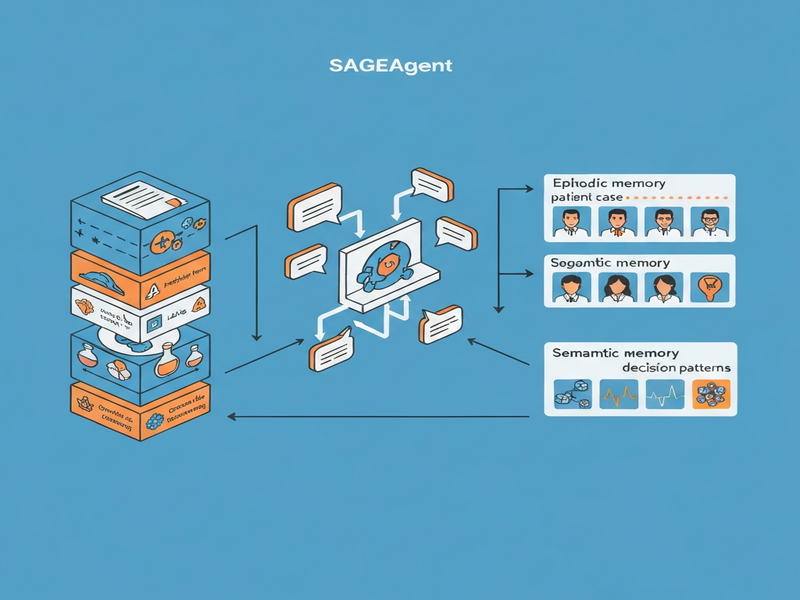
The authors introduce SAGEAgent (Sequential Acquisition Guided by Experience), a framework that treats modality acquisition as a sequential decision problem. At its core, SAGEAgent is an LLM‑based clinical agent that:
- Receives the current patient state (e.g., demographics, imaging results) expressed as natural‑language summaries.
- Queries an episodic memory to retrieve similar historical cases, providing concrete precedents for the current decision.
- Consults a semantic memory that abstracts reusable acquisition patterns across the entire cohort.
- Generates a text‑based recommendation—“acquire MRI” or “stop acquisition”—that balances predicted survival gain against the incremental cost and invasiveness of the next test.
Crucially, the agent continuously updates its memories after each patient encounter, allowing it to “self‑evolve” and improve its policy without external re‑training. This design merges the reasoning flexibility of LLMs with the data‑driven rigor of case‑based learning.
How It Works in Practice
The operational workflow of SAGEAgent can be broken down into four interacting modules:
- Clinical State Encoder: Raw numerical inputs (age, tumor grade, imaging features) are transformed into concise textual statements using a set of domain‑specific templates. For example, “Patient is a 58‑year‑old male with a left‑temporal glioma, WHO grade III.”
- Episodic Memory Retrieval: A vector store (e.g., Chroma DB) indexes these textual summaries. When a new case arrives, the system performs a similarity search to pull the top‑k most analogous patients, along with the modalities they received and the resulting survival outcomes.
- Semantic Memory Update: Over time, the agent abstracts high‑level rules such as “If age > 65 and MRI shows necrosis, genomic profiling rarely improves prediction.” These rules are stored as natural‑language snippets that the LLM can reference during inference.
- LLM Decision Engine: Powered by a large language model (e.g., OpenAI ChatGPT), the agent ingests the current state, episodic examples, and semantic rules, then produces a cost‑aware acquisition decision. The output is a short, actionable sentence that downstream orchestration tools can parse.
After the decision is executed—either by ordering the next test or terminating the workflow—the new data (if any) are fed back into the encoder, and the loop repeats until a stop condition is met. The entire loop can be orchestrated through a Workflow automation studio, enabling seamless integration with hospital information systems.
Evaluation & Results
The research team validated SAGEAgent on a multimodal glioma cohort that combined TCGA‑LGG, TCGA‑GBM, and BraTS datasets. The cohort featured four diagnostic modalities:
- Demographics & clinical history
- Standard MRI sequences
- Histopathology slides
- Whole‑exome genomic profiling
Two primary evaluation axes were considered:
- Predictive performance: Concordance index (C‑index) for overall survival prediction.
- Acquisition burden: Average number of modalities requested per patient, weighted by a cost matrix reflecting invasiveness and financial expense.
Key findings include:
- SAGEAgent achieved a C‑index within 2 % of the upper bound set by a “full‑modalities” oracle, demonstrating that selective testing does not materially degrade prognostic power.
- The average acquisition burden dropped by 55 % compared with the baseline that always requests all four modalities.
- When stratified by tumor grade, high‑grade cases still received genomic profiling, while low‑grade cases often stopped after imaging, confirming that the agent learned clinically sensible patterns.
These results were obtained without any hand‑crafted rule engine; the agent discovered the trade‑offs purely from experience, underscoring the viability of self‑evolving LLM agents in high‑stakes medical decision making.
Why This Matters for AI Systems and Agents
For AI practitioners building clinical decision support tools, SAGEAgent offers a blueprint for embedding cost‑awareness directly into the inference loop. Traditional pipelines treat data acquisition as a pre‑processing step, but SAGEAgent demonstrates that:
- Dynamic data gating can be learned end‑to‑end, reducing unnecessary tests and associated healthcare spend.
- Memory‑augmented LLMs provide a natural interface for case‑based reasoning, making the system’s rationale more interpretable to clinicians.
- Self‑evolution eliminates the need for frequent model re‑training as new modalities or cost structures emerge.
From an engineering perspective, the modular design aligns with modern agent orchestration stacks. The episodic memory can be swapped for any vector database (e.g., Chroma DB integration), while the decision engine can be replaced with newer LLM providers as they become available. This plug‑and‑play architecture accelerates experimentation and reduces vendor lock‑in.
What Comes Next
Despite its promise, SAGEAgent leaves several avenues open for future work:
- Generalization beyond glioma: Extending the framework to other cancer types (e.g., breast, lung) will test its adaptability to different modality hierarchies.
- Real‑world deployment studies: Prospective trials in hospital settings are needed to measure actual cost savings, patient satisfaction, and regulatory compliance.
- Multi‑agent collaboration: Combining SAGEAgent with downstream treatment recommendation agents could create a full‑stack AI clinician that both diagnoses and prescribes.
- Explainability enhancements: Integrating visual explanations (e.g., attention maps over retrieved cases) would further increase clinician trust.
Addressing these challenges will require close collaboration between AI researchers, oncologists, and health‑system engineers. Platforms that already support rapid prototyping of AI agents—such as the Enterprise AI platform by UBOS—can serve as testbeds for these next‑generation clinical agents.
For a deeper dive into the methodology and to explore the full set of experiments, consult the original SAGEAgent paper on arXiv.
Andrii Bidochko
CTO UBOS
Andrii Bidochko is an AI entrepreneur and researcher focused on AI agents, reinforcement learning, and autonomous systems. He writes about the technologies shaping the future of machine intelligence, from frontier models and agent architectures to real-world AI applications.