

- Updated: July 21, 2026
- 6 min read
Play2Perfect: What Matters in Dexterous Play Pretraining for Precise Assembly?
Direct Answer
Play2Perfect introduces a task‑agnostic RL framework that lets a multi‑fingered robot hand first “play” with diverse objects and then fine‑tune that experience into high‑precision assembly skills. The approach dramatically cuts the sample budget for precise assembly—by more than 30×—and enables zero‑shot sim‑to‑real transfer on sub‑millimeter insertion tasks.
Background: Why This Problem Is Hard
Dexterous robot hands promise human‑level speed and flexibility, yet real‑world assembly remains a stubborn bottleneck. The difficulty stems from three intertwined factors:
- Contact‑rich dynamics: Precise insertion, screwing, or part alignment generates complex force feedback that is hard to model and even harder to capture in large‑scale imitation datasets.
- Sparse rewards: Traditional reinforcement learning (RL) relies on dense signals; in assembly the reward often appears only after a successful final contact, making exploration infeasible.
- Specialized hardware workarounds: Prior successes have leaned on custom grippers, fixtures, or tool attachments that limit generality and increase system cost.
Because of these challenges, most existing pipelines either sidestep the hardest contact phases or require painstaking hand‑crafted curricula. The result is a gap between laboratory demos and robust, deployable solutions for manufacturers, logistics, or consumer‑grade robots.
What the Researchers Propose
The authors present Play2Perfect, a two‑stage learning paradigm that separates “play” from “perfect”. In the first stage, a robot explores a broad set of objects, goals, and interaction styles without any task‑specific supervision. This stage builds reusable manipulation priors—basic skills such as stable grasping, in‑hand reorientation, and reaching arbitrary poses. In the second stage, the same policy is fine‑tuned on a narrow, high‑precision assembly task, leveraging the priors to focus exploration on the final contact‑rich steps.
Key components of the framework include:
- Play environment: A procedurally generated sandbox populated with dozens of object categories and random goal specifications.
- Task‑agnostic objective: A combination of curiosity‑driven exploration and goal‑conditioned reward that encourages diverse trajectories.
- Fine‑tuning module: A lightweight RL head that adapts the pre‑trained policy using dense, multi‑stage rewards specific to the assembly problem.
How It Works in Practice
The workflow can be visualized as a loop of three interacting modules:
- Play Data Generator: Randomly samples objects, initial poses, and target configurations. The robot executes a goal‑conditioned policy that receives intrinsic rewards for novelty and progress.
- Prior Learner: A deep neural network (typically a transformer‑based policy) ingests the play trajectories and learns a latent representation of “how to move the hand” that is agnostic to any downstream task.
- Assembly Fine‑Tuner: When a specific assembly scenario (e.g., inserting a peg into a 0.5 mm clearance hole) is presented, the fine‑tuner re‑weights the latent space, adds task‑specific reward shaping, and runs a short RL episode to converge on the precise motion.
The novelty lies in the deliberate separation of exploration and exploitation phases, allowing the robot to amortize the cost of learning basic dexterity across many downstream tasks.
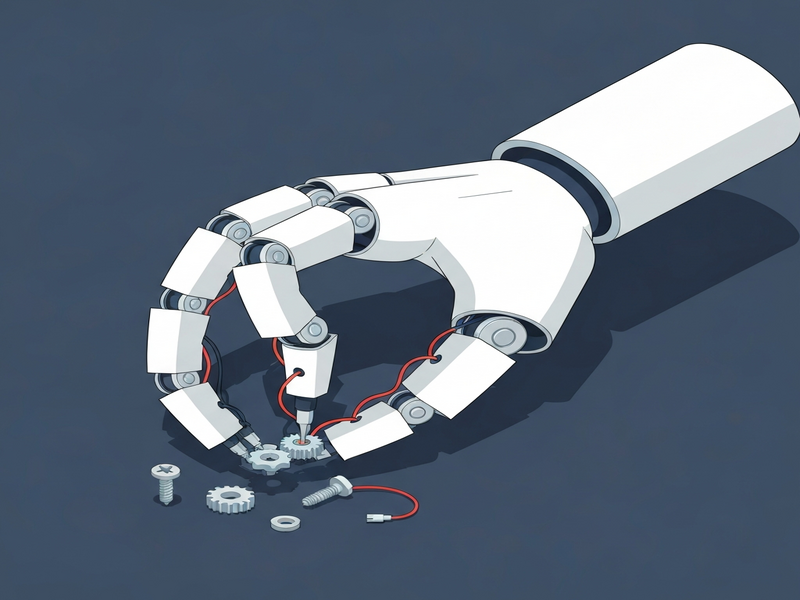
During play, the robot encounters a wide distribution of contact events—sliding, rolling, and pivoting—that collectively encode the physics of multi‑fingered manipulation. When the fine‑tuning stage begins, the policy already knows how to maintain stable contacts, so it can concentrate on the sub‑millimeter alignment required for precise assembly.
Evaluation & Results
The authors benchmarked Play2Perfect on three representative tasks:
- Tight peg‑in‑hole insertion: 0.5 mm clearance, requiring sub‑millimeter positioning.
- Multi‑part sequential assembly: A chain of five parts that must be joined in order.
- Screw fastening: Aligning a screw with a threaded hole and applying torque.
Key findings include:
- Sample efficiency: The pre‑trained prior achieved the same success rate as training from scratch with 33× fewer environment steps, even when dense multi‑stage rewards were provided to the baseline.
- Zero‑shot sim‑to‑real transfer: Policies trained entirely in simulation succeeded on a physical robot with 60% success on the tight insertion task without any real‑world fine‑tuning.
- Long‑horizon performance: Over 50% success on the multi‑part assembly and screw‑driving benchmarks, demonstrating that the learned priors scale to complex, temporally extended sequences.
These results were validated using a standard set of metrics (success rate, episode length, and final pose error) and compared against strong baselines such as behavior cloning from expert demonstrations and end‑to‑end RL without play pretraining.
Why This Matters for AI Systems and Agents
Play2Perfect reshapes how engineers think about robot learning pipelines. By front‑loading the cost of acquiring dexterous manipulation skills, organizations can:
- Rapidly prototype new assembly lines without redesigning the low‑level controller for each part.
- Leverage existing simulation assets to generate rich play data, reducing the need for costly real‑world data collection.
- Integrate the learned priors into broader AI orchestration stacks, such as UBOS platform overview, where a single policy can serve multiple downstream agents.
- Accelerate product development for AI marketing agents that need to coordinate physical actions with digital campaigns, e.g., robotic kiosks that assemble promotional displays on demand.
From a systems‑design perspective, the framework offers a clean separation of concerns: a reusable “play engine” that can be shared across teams, and a lightweight fine‑tuning interface that domain experts can configure with task‑specific reward functions. This modularity aligns with modern AI infrastructure trends, where reusable models are treated as services rather than monolithic codebases.
What Comes Next
While Play2Perfect marks a significant step forward, several open challenges remain:
- Generalization to novel object geometries: The current play set covers a finite library; expanding to open‑world object distributions will require continual learning mechanisms.
- Real‑time adaptation: In production, robots may encounter wear‑and‑tear or unexpected tolerances; integrating online adaptation without catastrophic forgetting is an active research frontier.
- Safety and compliance: Contact‑rich manipulation in unstructured environments raises safety concerns that must be addressed through robust perception and force‑control policies.
Future work could explore hybrid approaches that combine play pretraining with language‑guided task specifications, enabling non‑technical operators to describe new assembly goals in natural language. Additionally, extending the framework to collaborative multi‑robot scenarios could unlock new levels of throughput for factory floors.
For teams interested in experimenting with Play2Perfect‑style pipelines, the Play2Perfect paper provides open‑source code and simulation environments that can be integrated with existing robotics stacks. Pairing this with the Workflow automation studio can streamline data generation, policy training, and deployment across cloud and edge devices.
Finally, startups looking to differentiate their product offerings can leverage the UBOS for startups program to access compute credits and consulting support for building custom play‑based manipulation models.
Andrii Bidochko
CTO UBOS
Andrii Bidochko is an AI entrepreneur and researcher focused on AI agents, reinforcement learning, and autonomous systems. He writes about the technologies shaping the future of machine intelligence, from frontier models and agent architectures to real-world AI applications.