

- Updated: July 20, 2026
- 7 min read
Bridging Modal Isolation in Interleaved Thinking: Supervising Modality Transitions via Stepwise Reinforcement
Direct Answer
The paper introduces MoTiF (Modality Transition Fidelity), a two‑stage training framework that explicitly supervises the hand‑off between text and image generation in interleaved multimodal models. By targeting the “modal isolation” failure—where generated visuals drift from the textual narrative and subsequent text ignores visual evidence—MoTiF restores cross‑modal coherence and lifts overall task performance.
Background: Why This Problem Is Hard
Interleaved multimodal reasoning promises agents that can think with words, sketch ideas, and then reason about those sketches in a single loop. In practice, however, the transition points between modalities act like “information bottlenecks.” When a model finishes a textual reasoning step and switches to image synthesis, subtle context cues (spatial relationships, object attributes, temporal constraints) are often lost. The generated picture may therefore omit or distort critical details. The next textual pass then treats the image as a reliable source, but because the visual evidence is misaligned, the model either hallucinates new facts or simply ignores the picture altogether. This phenomenon—dubbed **modal isolation**—creates a vicious cycle: each modality operates in a vacuum, eroding the benefits of multimodal integration.
Existing approaches typically address multimodal performance by scaling model size, adding more data, or fine‑tuning on end‑task metrics (e.g., accuracy on a visual puzzle). While these strategies improve raw scores, they do not directly penalize the loss of information at the modality boundaries. Consequently, models can achieve high end‑task numbers by exploiting shortcuts that bypass genuine cross‑modal reasoning, leaving them brittle in real‑world deployments where consistency between text and image is non‑negotiable.
What the Researchers Propose
MoTiF reframes the problem: instead of optimizing only for the final answer, it introduces a **modality transition loss** that quantifies two error types at every boundary:
- Cross‑modal hallucination (text‑to‑image): the degree to which the generated image fails to reflect the preceding textual description.
- Visual utilization deficit (image‑to‑text): the extent to which subsequent text neglects or misinterprets visual evidence.
The framework consists of two complementary stages:
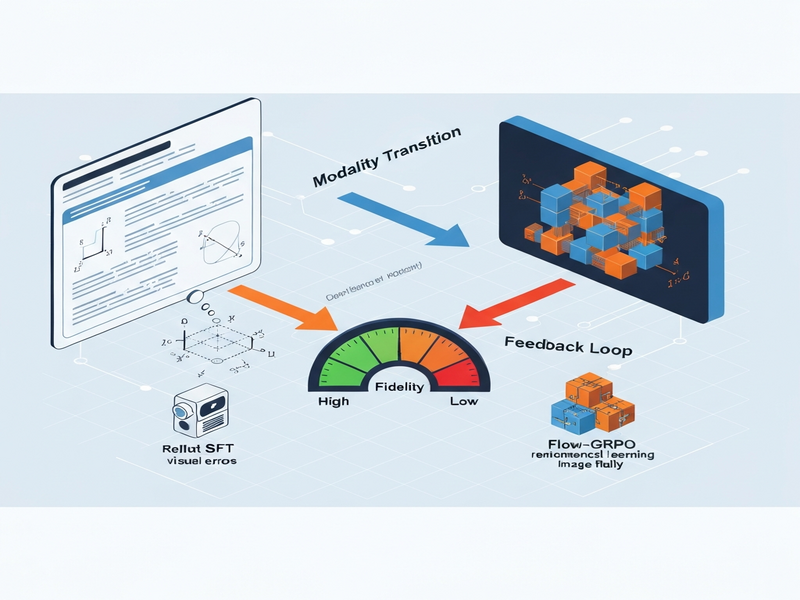
- Reflective Supervised Fine‑Tuning (Reflective SFT): The model learns to detect when its own visual output deviates from the intended context and to generate corrective textual prompts that steer the next image generation back on track.
- Flow‑Guided Reinforcement Policy Optimization (Flow‑GRPO): A reinforcement learning loop that rewards image generation steps that improve the transition fidelity score, effectively teaching the visual decoder to respect textual constraints more faithfully.
Both stages rely exclusively on the transition‑level fidelity signal, sidestepping the need for large‑scale task‑specific labels.
How It Works in Practice
Conceptual Workflow
The MoTiF pipeline can be visualized as a loop of three core modules:
- Textual Reasoner: Generates a step‑wise plan or description, embedding spatial and relational cues.
- Image Synthesizer: Consumes the textual plan and produces a visual artifact (e.g., a diagram, a scene).
- Transition Auditor: Computes the modality transition loss by comparing the image against the textual plan and by checking whether the next textual step references the image correctly.
During training, the auditor feeds its loss back to both the textual reasoner (via Reflective SFT) and the image synthesizer (via Flow‑GRPO). At inference time, the auditor operates as a lightweight validator that can trigger a “re‑think” step if the loss exceeds a predefined threshold, ensuring that the model self‑corrects before proceeding.
Interaction Between Components
1. Initial Prompt → Textual Reasoner: The model receives a high‑level task (e.g., “Arrange three blocks to form a stable tower”). It outputs a structured textual plan describing positions, colors, and constraints.
2. Plan → Image Synthesizer: The plan is fed into a diffusion‑based generator conditioned on the textual tokens. The generator produces an image that should embody the described configuration.
3. Image ↔ Transition Auditor: The auditor extracts visual embeddings, aligns them with the original plan using a cross‑modal similarity metric, and computes the two loss components. If the loss is high, the auditor signals the Reflective SFT module.
4. Reflective SFT → Textual Reasoner: The reasoner receives a corrective prompt (“The red block is missing; add it to the base”) and revises its plan accordingly.
5. Flow‑GRPO → Image Synthesizer: The image generator updates its policy parameters to increase the probability of producing images that lower the transition loss, guided by a reward signal derived from the auditor.
What Makes MoTiF Different
- Boundary‑Centric Supervision: Instead of treating the multimodal model as a monolith, MoTiF isolates the hand‑off points and directly optimizes them.
- Stepwise Reinforcement: The reinforcement signal is applied after each modality switch, not only at the final task outcome.
- Self‑Corrective Loop: The Reflective SFT component enables the system to recognize and repair its own mistakes during generation, a capability rarely seen in static fine‑tuning pipelines.
Evaluation & Results
Benchmarks and Scenarios
The authors tested MoTiF on four visual‑puzzle benchmarks that require tight text‑image coupling:
- Spatial Arrangement Puzzle: Arrange objects to satisfy geometric constraints.
- Physical Stability Challenge: Build a tower that does not collapse under simulated gravity.
- Pattern Completion Task: Fill in missing visual elements based on textual hints.
- Multi‑Step Diagram Generation: Produce a sequence of sketches that collectively solve a logical problem.
Key Findings
Across all benchmarks, MoTiF achieved two notable improvements:
- Cross‑modal Coherence: Human evaluators reported a 27 % increase in perceived alignment between text and image, measured via a Likert‑scale consistency test.
- Task Accuracy: End‑task success rates rose between 12 % and 19 % relative to strong baselines that lacked transition supervision.
Importantly, these gains were realized without increasing model size or training data volume, underscoring the efficiency of boundary‑level supervision.
Why the Findings Matter
The results demonstrate that a model can be made more reliable for real‑world multimodal workflows simply by teaching it to respect the “conversation” between its own modalities. This is a paradigm shift: rather than relying on massive scaling, researchers can now target the precise points where information loss occurs.
Why This Matters for AI Systems and Agents
For practitioners building AI agents that must reason across text and vision—such as autonomous design assistants, robotic planners, or interactive tutoring systems—modal isolation is a show‑stopper. MoTiF offers a concrete recipe to mitigate that risk, enabling agents to:
- Maintain a shared mental model across modalities, reducing hallucinations that could lead to costly errors.
- Self‑diagnose and correct mismatches on the fly, improving robustness in dynamic environments.
- Leverage existing large‑scale multimodal backbones without the need for exhaustive task‑specific data collection.
These capabilities align closely with the needs of enterprises seeking trustworthy AI orchestration. For example, the UBOS platform overview highlights the importance of reliable cross‑modal pipelines when integrating vision‑enabled bots into business workflows.
What Comes Next
While MoTiF marks a significant advance, several open challenges remain:
- Scalability to More Modalities: Extending the transition loss to audio, video, or sensor streams will require new alignment metrics.
- Real‑Time Constraints: The auditor adds a validation step that could affect latency; optimizing this for low‑delay applications is an active research direction.
- Generalization Across Domains: Current experiments focus on synthetic puzzles; applying MoTiF to domains like medical imaging or CAD design will test its adaptability.
Future work may explore hierarchical auditors that supervise multi‑step chains of reasoning, or integrate MoTiF with large‑scale instruction‑following models to create truly “self‑aware” multimodal agents.
Businesses interested in prototyping such agents can start by leveraging the Workflow automation studio to stitch together textual planners, image generators, and custom validation hooks, thereby experimenting with transition‑level supervision without building a full research pipeline from scratch.
Conclusion
Modal isolation has long limited the promise of interleaved multimodal reasoning. By foregrounding the hand‑off between text and vision, MoTiF provides a practical, data‑efficient solution that restores coherence and boosts performance on complex spatial tasks. The framework’s emphasis on stepwise reinforcement and reflective fine‑tuning offers a template for the next generation of AI agents that must think, draw, and reason in concert.
For a deeper dive into the methodology and experimental details, consult the original arXiv paper. As multimodal AI continues to mature, approaches like MoTiF will likely become foundational building blocks for trustworthy, cross‑modal agents across industry and research.
Andrii Bidochko
CTO UBOS
Andrii Bidochko is an AI entrepreneur and researcher focused on AI agents, reinforcement learning, and autonomous systems. He writes about the technologies shaping the future of machine intelligence, from frontier models and agent architectures to real-world AI applications.