

- Updated: July 20, 2026
- 6 min read
KG-SoftMAP: Soft Knowledge-Graph Priors for Bayesian Network Structure Learning from Sparse Discrete Data
Direct Answer
KG-SoftMAP introduces a Bayesian‑network structure‑learning method that blends sparse discrete observations with a soft, confidence‑weighted knowledge‑graph prior. By treating the prior as a finite‑strength MAP term, the approach can recover directed causal edges even when each data instance records only a handful of variables.
Background: Why This Problem Is Hard
In many enterprise and educational settings, data collection is deliberately lightweight: a questionnaire may ask a student to answer a few multiple‑choice items, or a sensor network may only log a subset of possible events per tick. This “sparse observation” regime creates two intertwined challenges for Bayesian network (BN) learning:
- Missing joint counts. Scoring functions such as BDeu rely on co‑occurrence frequencies. When most variable pairs never appear together, the likelihood surface becomes flat, and greedy search algorithms cannot distinguish true edges from noise.
- Combinatorial explosion. Even with full data, the number of possible DAGs grows super‑exponentially with the number of nodes. Sparse data dramatically widens the search space because many structures receive identical scores.
Traditional data‑only methods therefore either over‑fit to spurious patterns or return an almost empty graph. Practitioners often resort to manual expert elicitation, but pure hard constraints (e.g., “X must be a parent of Y”) are brittle: experts are rarely certain about every edge, and contradictory domain knowledge can cripple the learning process.
What the Researchers Propose
KG-SoftMAP (Soft Knowledge‑Graph MAP) reframes imperfect domain knowledge as a *soft* prior rather than a hard rule set. The key ideas are:
- Weighted directed knowledge graph. The domain expert supplies a directed graph where each edge carries a confidence weight (e.g., 0.7 for “highly likely”, 0.2 for “weak hint”).
- Logit‑form prior. This graph is transformed into a log‑odds penalty that is added to the standard BDeu score, yielding a MAP objective that balances data evidence against prior belief.
- Finite strength. Unlike infinite‑strength hard constraints, the prior’s influence can be tuned. When data are abundant, the prior fades; when data are scarce, the prior dominates, guiding the search toward plausible structures.
The framework therefore treats the knowledge graph as an *agent* that proposes probabilistic edge preferences, while the BN learner remains a *data‑driven* agent that evaluates those proposals against the observed counts.
How It Works in Practice
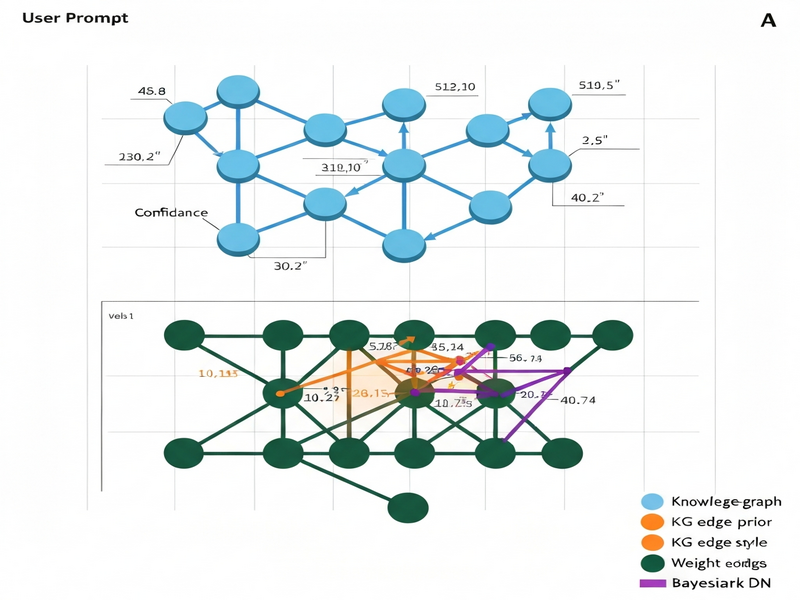
The KG-SoftMAP pipeline can be visualized as a three‑stage workflow:
- Knowledge‑graph ingestion. A domain expert (or an LLM that extracts ontologies) creates a directed graph GKG. Each edge e receives a confidence c(e) ∈ [0,1].
- Prior construction. The system converts GKG into a logit prior L(e) = α·logit(c(e)), where α controls overall strength. This prior is stored alongside the BDeu scoring function.
- Structure search. A standard BN structure‑search algorithm (e.g., hill‑climbing, tabu search) evaluates candidate DAGs using the combined score: Score(DAG) = BDeu(DAG | data) + Σe∈DAG L(e). The search naturally prefers edges endorsed by the KG while still rewarding edges that improve data likelihood.
What sets KG-SoftMAP apart is the *dynamic interplay* between the prior and the data:
- If an edge has high confidence but the data strongly contradict it, the combined score penalizes the edge, preventing forced inclusion.
- If the data are too sparse to resolve a relationship, the prior can “break the tie,” allowing the learner to adopt the expert’s suggestion.
Because the prior is finite, practitioners can experiment with different α values to find a sweet spot where the learned graph reflects both domain intuition and empirical evidence.
Evaluation & Results
The authors benchmarked KG-SoftMAP on three synthetic and three real‑world datasets, varying the observation rate ρ (the fraction of variables observed per instance). Key evaluation dimensions included:
- Directed F1 (DF1) score. Measures how many true directed edges are recovered.
- Prediction accuracy. How well the learned BN predicts held‑out variable values.
- Calibration and KG‑consistency. Whether the posterior probabilities align with true outcome frequencies and respect the supplied KG.
Highlights from the results:
- At an extremely sparse regime (ρ = 0.05), KG-SoftMAP achieved DF1 scores between 0.19 and 0.32, whereas a data‑only baseline hovered around 0.00–0.21.
- When the observation rate increased to ρ = 0.20, DF1 rose to 0.44–0.66, demonstrating that the method scales gracefully as more data become available.
- Stress tests that deliberately corrupted the KG (random edge flips, weight blurring) showed a proportional drop in DF1, confirming that the algorithm’s performance is tightly coupled to prior quality.
- On the real “Short Answer Feedback” (SAF) educational dataset, KG-SoftMAP combined with a variance‑estimation module (KG‑SoftMAP+VE) reached a Fail‑class F1 of 0.75, comparable to a tuned logistic‑regression baseline (0.78) while also delivering an interpretable concept graph and calibrated failure probabilities.
These findings collectively demonstrate that a well‑crafted soft KG can act as a “knowledge amplifier,” turning otherwise unusable sparse data into actionable causal models.
Why This Matters for AI Systems and Agents
From a systems‑engineering perspective, KG-SoftMAP offers a reusable building block for any AI pipeline that must infer causal structure from limited observations:
- Agent orchestration. Autonomous agents often operate with partial state information. Embedding a KG‑soft prior enables them to infer missing dependencies on‑the‑fly, improving decision‑making under uncertainty.
- Explainability. The resulting Bayesian network is inherently interpretable; each edge is backed by both data evidence and a quantified expert confidence, facilitating audit trails for regulated industries.
- Modular integration. The prior construction step can be hooked into existing knowledge‑graph services (e.g., ontologies stored in Chroma DB integration) or LLM‑driven extraction pipelines, making the approach compatible with modern AI stacks.
- Scalable calibration. Because the MAP objective yields posterior probabilities, downstream agents can query “what is the probability that concept X fails given evidence Y?”—a capability directly useful for risk‑aware planning in autonomous workflows.
In practice, a product team building an AI marketing agent could feed a high‑level campaign ontology into KG‑SoftMAP, allowing the agent to infer hidden causal links between audience segments and conversion metrics, even when only a few interaction logs are available per user.
What Comes Next
While KG-SoftMAP marks a significant step forward, several avenues remain open for research and deployment:
- Adaptive prior strength. Current implementations require a manually set α. Future work could learn α jointly with the network structure, letting the model automatically decide how much to trust the KG at each iteration.
- Dynamic knowledge graphs. In many domains, expert knowledge evolves (e.g., new medical guidelines). Extending the framework to handle time‑varying priors would enable continual learning without retraining from scratch.
- Hybrid multimodal data. The present study focuses on discrete variables. Integrating continuous sensors, text embeddings, or image features would broaden applicability to robotics and vision‑centric agents.
- Robustness to noisy LLM extraction. As LLMs become a primary source for KG construction, systematic methods to quantify extraction uncertainty and feed it into the confidence weights will be crucial.
Practitioners interested in experimenting with KG‑SoftMAP can start by prototyping the workflow in the Workflow automation studio, where the knowledge‑graph ingestion, prior generation, and BN search can be wired together with minimal code.
For a deeper dive into the technical details, consult the original KG-SoftMAP paper on arXiv.
Andrii Bidochko
CTO UBOS
Andrii Bidochko is an AI entrepreneur and researcher focused on AI agents, reinforcement learning, and autonomous systems. He writes about the technologies shaping the future of machine intelligence, from frontier models and agent architectures to real-world AI applications.