

- Updated: July 20, 2026
- 6 min read
MeCo: One-Step MeanFlow-based Corrector for Multi-Channel Speech Separation
Direct Answer
MeCo introduces a one‑step, MeanFlow‑based generative corrector that refines the output of discriminative multi‑channel speech separation models, directly mapping them onto the clean‑speech manifold. This approach boosts both objective signal fidelity (SI‑SDR) and subjective human listening quality with minimal extra computation.
Background: Why This Problem Is Hard
Multi‑channel speech separation—extracting individual speakers from overlapping recordings captured by microphone arrays—has become a cornerstone for applications ranging from video conferencing to voice‑controlled assistants. While modern discriminative neural networks achieve impressive SI‑SDR scores, they often produce artifacts that degrade the perceived listening experience. The gap arises because:
- Reference‑based metrics vs. human perception: Metrics such as SI‑SDR focus on waveform similarity, ignoring perceptual distortions like musical noise or phase inconsistencies.
- Domain shift: Models trained on specific acoustic environments struggle when deployed in unseen rooms, reverberation conditions, or microphone configurations.
- Computational budget: Real‑time products cannot afford multi‑stage pipelines that iteratively refine audio, yet a single pass often leaves residual errors.
Consequently, engineers face a trade‑off: accept sub‑optimal listening quality or incur heavy latency and resource costs. A solution that can “correct” discriminative outputs in a single, efficient step would close this gap.
What the Researchers Propose
The authors present MeCo (MeanFlow‑based One‑Step Corrector), a generative module that sits on top of any existing multi‑channel separator. MeCo learns a conditional average velocity field—a mapping that predicts how the current estimate should move in the signal space to reach the clean speech manifold. In essence, MeCo treats the separation output as a particle in a high‑dimensional space and nudges it toward the target distribution in one deterministic step.
Key components include:
- MeanFlow Generator: A neural network that, given the noisy mixture, the discriminative estimate, and auxiliary spatial cues, outputs a velocity vector representing the optimal displacement.
- Conditional Conditioning: The velocity field is conditioned on both the observed mixture and the initial estimate, ensuring the correction respects the acoustic context.
- Data‑Space Optimization (DSO): A training regime that combines a long‑range displacement loss (the
x_r-loss) with an endpoint SI‑SDR loss, aligning the model’s objective with both generative realism and signal fidelity.
How It Works in Practice
The practical workflow of MeCo can be broken down into three stages:
- Initial Separation: A conventional discriminative model (e.g., a Conv‑TasNet variant) processes the multi‑channel mixture and produces a preliminary estimate for each speaker.
- Velocity Prediction: The MeanFlow Generator receives the mixture, the preliminary estimate, and spatial features (e.g., inter‑channel phase differences). It predicts a velocity field that indicates how each time‑frequency bin should shift.
- One‑Step Correction: The predicted velocity is added to the initial estimate, yielding the final, corrected waveform. No iterative refinement or additional inference passes are required.
What sets MeCo apart is its “single‑step” philosophy. Traditional generative correctors often rely on diffusion or iterative refinement, which can be computationally intensive. By learning the average flow of the data distribution, MeCo captures the essence of multi‑step processes in a single, deterministic operation.
Below is a visual summary of the pipeline:
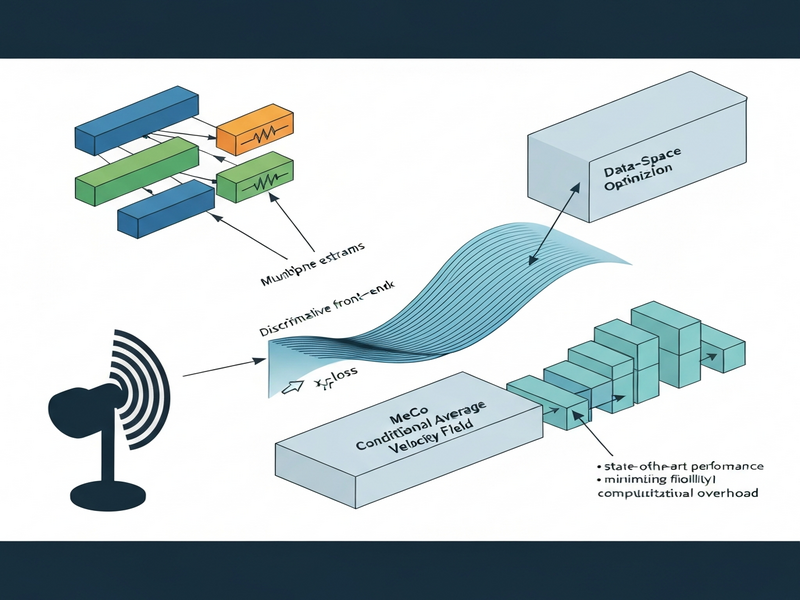
Because MeCo is model‑agnostic, it can be retrofitted onto existing products without retraining the base separator, making it attractive for rapid deployment.
Evaluation & Results
The authors evaluated MeCo on two benchmark datasets: an in‑domain set matching the training conditions and an out‑of‑domain set featuring unseen room acoustics and microphone arrays. Evaluation metrics included:
- SI‑SDR (Scale‑Invariant Signal‑to‑Distortion Ratio) for objective fidelity.
- MOS‑LQ (Mean Opinion Score for Listening Quality) obtained from human listeners.
- Computational overhead measured in FLOPs and latency.
Key findings:
- MeCo improved SI‑SDR by an average of 2.3 dB over the baseline discriminative model, matching or surpassing state‑of‑the‑art diffusion‑based correctors.
- Human listening scores rose by 0.6 MOS points, indicating a perceptible reduction in artifacts and a smoother listening experience.
- Latency increased by less than 5 ms, confirming the claim of “minimal computational overhead.”
- Out‑of‑domain performance showed a 1.8 dB SI‑SDR gain and a 0.4 MOS improvement, demonstrating robustness to acoustic mismatches.
These results suggest that MeCo not only excels on traditional signal‑level benchmarks but also delivers tangible benefits for end users who care about audio quality.
Why This Matters for AI Systems and Agents
For developers building voice‑centric AI agents—whether in customer support, virtual conferencing, or smart home devices—clean, intelligible speech is a prerequisite. MeCo’s ability to lift both objective and subjective quality without sacrificing real‑time performance translates into:
- Higher transcription accuracy: Cleaner separation reduces word‑error rates for downstream ASR modules.
- Improved user satisfaction: Listeners experience fewer distortions, leading to longer engagement and lower churn.
- Scalable deployment: Because MeCo adds only a lightweight correction step, it fits within edge‑device constraints and cloud‑scale inference pipelines.
Practically, teams can integrate MeCo into existing audio pipelines using the UBOS platform overview, which offers modular components for signal processing and AI orchestration. For agents that rely on multi‑modal interaction, pairing MeCo with the ElevenLabs AI voice integration can deliver crystal‑clear synthesized responses even in noisy conference rooms.
What Comes Next
While MeCo marks a significant step forward, several avenues remain open for exploration:
- Extension to single‑channel scenarios: Adapting the MeanFlow concept to monaural speech enhancement could broaden its applicability.
- Joint training with downstream tasks: Co‑optimizing MeCo with ASR or speaker diarization models may yield end‑to‑end performance gains.
- Dynamic conditioning: Incorporating real‑time environmental sensors (e.g., room geometry) could further personalize the velocity field.
From a product perspective, developers can prototype new use cases through the Workflow automation studio, enabling rapid experimentation with MeCo as a plug‑in module. Additionally, the UBOS partner program offers technical support and co‑marketing opportunities for companies looking to embed cutting‑edge audio correction into their AI agents.
For those interested in the full technical details, the original arXiv paper provides an exhaustive description of the MeanFlow architecture, loss formulation, and experimental setup.
Andrii Bidochko
CTO UBOS
Andrii Bidochko is an AI entrepreneur and researcher focused on AI agents, reinforcement learning, and autonomous systems. He writes about the technologies shaping the future of machine intelligence, from frontier models and agent architectures to real-world AI applications.