

- Updated: July 20, 2026
- 6 min read
DeepTutor: Towards Agentic Personalized Tutoring
Direct Answer
DeepTutor is an open‑source, agentic framework that unifies citation‑grounded problem tutoring with difficulty‑calibrated question generation, delivering truly personalized learning experiences powered by large language models (LLMs). It matters because it bridges the gap between static LLM knowledge and the dynamic, learner‑specific feedback that modern education demands, showing measurable gains in both personalization metrics and general agentic reasoning.
Background: Why This Problem Is Hard
Education has long been a prime target for AI, yet most LLM‑driven tutoring tools suffer from two fundamental bottlenecks. First, they rely on a frozen pre‑training corpus, which means the model cannot adapt its explanations to a student’s evolving misconceptions or knowledge gaps. Second, retrieval‑augmented generation (RAG) pipelines can surface relevant documents but lack the ability to turn those citations into guided, step‑by‑step tutoring that adjusts difficulty on the fly.
Existing approaches—static question banks, rule‑based adaptive systems, or simple RAG chatbots—either scale poorly, require extensive manual curation, or provide feedback that feels generic. In a university‑level setting, where curricula span mathematics, physics, computer science, and humanities, the inability to personalize at the granularity of individual problem‑solving pathways leads to disengagement and sub‑optimal learning outcomes.
What the Researchers Propose
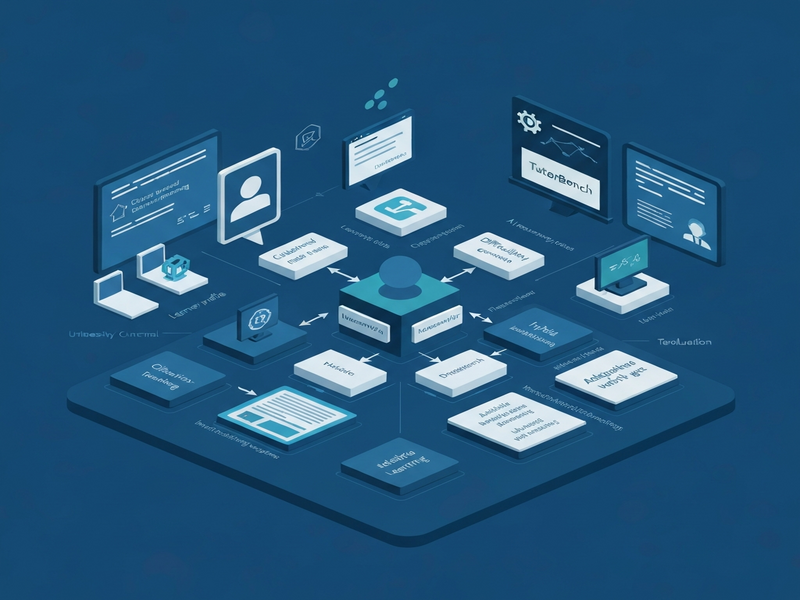
DeepTutor introduces a hybrid personalization engine that couples two complementary strands of knowledge:
- Static Knowledge Grounding: The system anchors every tutoring interaction in verifiable citations drawn from curated academic sources, ensuring factual correctness and traceability.
- Dynamic Learner Memory: A lightweight, continuously updated learner profile records past attempts, misconceptions, and confidence signals, allowing the model to tailor subsequent prompts.
The framework is built around three core agents:
- Problem Tutor Agent – Generates step‑by‑step solutions grounded in citations, monitors student responses, and provides corrective feedback.
- Question Generator Agent – Crafts new problems whose difficulty is calibrated against the learner’s current mastery level.
- Orchestration Layer – Mediates data flow between the static knowledge base, the learner memory, and the two tutoring agents, ensuring consistent personalization across sessions.
How It Works in Practice
When a student initiates a tutoring session, the orchestration layer first retrieves relevant scholarly citations based on the curriculum tag (e.g., “Linear Algebra – Eigenvectors”). These citations are fed to the Problem Tutor Agent, which produces a scaffolded solution that explicitly references the source material. As the student interacts—answering sub‑questions, requesting hints, or indicating confusion—the Dynamic Learner Memory logs each event.
After the initial problem, the Question Generator Agent consults the updated learner profile to select a difficulty level that is neither too easy nor too hard. It then synthesizes a new question, again grounding the prompt in citations, and presents it to the student. This loop repeats, creating a closed feedback cycle where each interaction refines the learner’s model and the system’s next move.
What sets DeepTutor apart is the seamless blend of citation grounding (ensuring academic rigor) with real‑time difficulty calibration (ensuring pedagogical relevance). The architecture is modular, allowing developers to plug in alternative LLM backbones, replace the citation source, or extend the orchestration layer to support multi‑modal inputs such as voice or video.
Evaluation & Results
To validate the framework, the authors built TutorBench, an interactive benchmark that simulates five university‑level domains (mathematics, physics, computer science, chemistry, and economics). Each domain includes a set of customized learner profiles that model realistic strengths, weaknesses, and learning trajectories.
The evaluation protocol is first‑person and interactive: a student simulator, driven by an LLM, follows the profile’s constraints while engaging with DeepTutor. Metrics focus on personalization (e.g., alignment of question difficulty with learner proficiency) and agentic reasoning (e.g., the system’s ability to plan multi‑step tutoring strategies).
Across five backbone models, DeepTutor achieved an average 10.8 % lift in personalization scores compared to a strong RAG baseline, and a 29.4 % improvement in agentic reasoning benchmarks. Ablation studies showed that removing either static grounding or dynamic memory reduced performance by more than 15 %, confirming the necessity of both components.
Human‑in‑the‑loop evaluations—where real students rated the helpfulness of explanations—corroborated the simulated results, reporting higher satisfaction and perceived learning gains. The comprehensive suite of experiments demonstrates that DeepTutor is not only technically robust but also practically beneficial.
Why This Matters for AI Systems and Agents
For AI practitioners building enterprise‑grade agents, DeepTutor offers a blueprint for marrying factual grounding with adaptive behavior. The hybrid personalization engine can be repurposed for any domain where user‑specific guidance is critical—think compliance assistants, technical support bots, or sales enablement agents.
Integrating DeepTutor‑style orchestration into existing platforms can elevate the quality of AI‑driven interactions. For example, the UBOS platform overview already supports modular agent pipelines; adding a citation‑grounded tutor module would instantly expand its value proposition for education‑focused customers.
Moreover, the framework’s emphasis on transparent citations aligns with emerging regulatory expectations around AI explainability. By surfacing source documents alongside generated advice, developers can meet audit requirements while delivering richer user experiences.
Finally, the multi‑channel extensions demonstrated in the paper—interactive e‑books, proactive messaging agents, and workflow‑automation hooks—show how a single personalization substrate can power a suite of products without duplicating effort. This reuse potential is a compelling economic argument for any organization looking to scale AI services.
What Comes Next
Despite its promising results, DeepTutor has several open challenges. The current learner memory is lightweight and may struggle with long‑term retention across semesters. Future work could explore hierarchical memory architectures that capture both short‑term misconceptions and long‑term mastery trends.
Another limitation lies in the reliance on curated citation databases. Expanding to open‑access repositories, or integrating with tools like Chroma DB integration, would broaden the knowledge base and reduce manual curation overhead.
From an application standpoint, extending the framework to multimodal tutoring—incorporating voice explanations via ElevenLabs AI voice integration or visual step‑by‑step diagrams—could make the system accessible to learners with diverse preferences.
Finally, the authors invite the community to experiment with the open‑source code, contribute new domain adapters, and benchmark against emerging LLMs. As the field moves toward more agentic, self‑improving systems, DeepTutor’s modular design positions it as a foundational layer for the next generation of personalized AI tutors.
For a deeper dive into the methodology and to explore the codebase, see the original DeepTutor paper.
Andrii Bidochko
CTO UBOS
Andrii Bidochko is an AI entrepreneur and researcher focused on AI agents, reinforcement learning, and autonomous systems. He writes about the technologies shaping the future of machine intelligence, from frontier models and agent architectures to real-world AI applications.